The AI Job-Hunting Death Spiral: Why a 150-Person Circle Beats a Resume
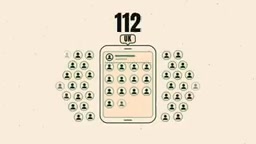
In the AI recruiting death spiral, Dunbar's 150 reveals that cultivating a small circle beats mass applications.
Through marketer Matt's job search, the article reveals the AI-era recruiting death spiral: job seekers mass-submit perfect applications with AI while companies screen with AI, driving application volumes up and response rates down. Hiring managers value personality, which can only be judged through human interaction. Dunbar's number (~150) and Bahcall's incentive model both point to 150 as the critical threshold for organization and relationship size: small circles have stronger incentives to win together, and referrals yield interview odds (~40%) far above self-applications (~3%). Matt stopped mass-applying and cultivated 5/15/50/150 concentric circles through no-request calls and regular gatherings, eventually landing contracts and clients. The article stresses that 150 is an average, not a law, and weak ties still matter—but the inner circle requires real time.
AI makes everyone look flawlessly qualified on paper, and recruiters use AI to screen applicants in bulk—leaving job seekers trapped in a death spiral where the more they apply, the fewer responses they get. A marketer named Matt sent out his 80th application with no reply, yet six months later he was turning down job offers. The turning point was a number that kept recurring: 150.
The AI Recruiting Death Spiral: Perfect Applications Lose Their Meaning
Matt spent 11 years in marketing at a software company. After his entire team was laid off, he sent out 80 applications in six weeks, each one rewritten with AI for the specific role. He thought they were impeccable—but not a single human replied.
According to data from recruiting software company Greenhouse, the average number of applications per job rose from 115 in 2022 to 244 in 2025. Job seekers flood the market with AI, and companies screen with AI—what Fortune calls a "death spiral." When every application looks perfect, a perfect application no longer sends any signal.
So what are hiring managers looking at? A Harris Poll survey of more than 1,000 hiring managers this year found that 86% believe the right personality can compensate for a skills gap—and the most common ways to judge personality are small talk, the tone of an email, and how you treat the person at the front desk. None of that fits on a resume.
Matt turned to his network: he had over 2,000 LinkedIn connections. After posting that he was job hunting, he got 140 likes and a dozen "good luck" comments—and not a single job opportunity.
Dunbar's Number: The Upper Limit of Relationships Your Brain Can Maintain
After surveying UK Facebook users, anthropologist Robin Dunbar found that each person had an average of 150 to 180 friends on the platform. But when asked how many friends they could rely on in a crisis, the average answer was just 4. Matt's situation was exactly this: 2,000 people knew his name, but maybe four or five would drop everything to help him.
In the early 1990s, Dunbar noticed that monkeys and apes with larger brains lived in larger groups—remembering who's who and who's trustworthy consumes a lot of brainpower. Applying the same calculation to the human brain predicted a group size of 148. He then encountered this number repeatedly in real-world settings: from Stone Age villages to agricultural communities that split into two once their population reached around 150.
Within 150 there are concentric circles: about 5 people you'd call at 3 a.m., 15 close friends, 50 good friends, and 150 people you'd be happy to see. Each layer takes time to build. One study estimated that turning an acquaintance into a close friend requires more than 200 hours together. Matt's 2,000 connections had cost him almost nothing—which is precisely why they were so cheap when it mattered.
Dunbar's number was proposed in the 1990s by Robin Dunbar, an anthropologist at the University of Oxford. It refers to the cognitive upper limit on the number of stable social relationships a person can maintain—about 150. The number is based on research into the correlation between primate neocortex volume and group size: the larger the neocortex, the more social information it can process and the larger the group. Dunbar further proposed that social circles form a concentric structure—roughly 5 people (support clique), 15 (sympathy group), 50 (friendship group), and 150 (meaningful circle) from the inside out—each layer corresponding to a different level of emotional intimacy and interaction frequency. Dunbar's number is not a precise threshold but a statistical average; the actual range may vary with individual differences, cultural environment, and social media use.
Another 150: How Incentives Flip as a Company Grows
150 also explains what went wrong at Matt's old employer. When he joined, the company had about 120 people, everyone knew everyone, and when a marketing campaign failed the whole office felt it. By his final year, the company had 4,000 people, and the fastest path upward was getting a good word from some vice president.
Safi Bahcall—a physicist by training who later founded a biotech company—describes this shift in his book Loonshots: two forces are always pulling at work—what you get if the project succeeds, and what you get if you get promoted. In a small team, winning together pays off more; as the company grows, your share of the victory is diluted and the reward for climbing the ladder rises in relative terms. At a certain scale the two curves cross, and people stop asking how to make the project succeed and start asking when it's their turn for a promotion.
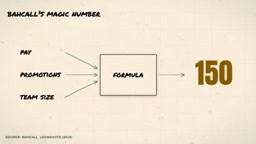
Plugging typical values for pay, promotion, and team size into the formula, the crossover point comes out at roughly 150. Dunbar arrived at this number from the brain; Bahcall arrived at it from compensation structure—and the two nearly coincide. Matt's company had crossed that line years earlier, so when the layoffs came he was just a row in a spreadsheet. What he really needed was a small group of people where, if they won, he won.
The incentive model Safi Bahcall presents in Loonshots is based on a simple trade-off: how employees allocate their motivation between "project success" and "career advancement." In a small team, the benefits of project success (bonuses, a sense of achievement, team recognition) are shared by fewer people, so the appeal of winning together is strong. As the organization expands, an individual's share of collective results is diluted, while the pay and status gains from promotion become relatively more certain—so the incentive to climb gradually takes over. When the organization reaches a certain critical size, the two incentive curves cross, and employee behavior shifts from "how do I make the project succeed" to "how do I get myself promoted." Bahcall plugged parameters such as pay differentials, promotion probability, and team size into the model and calculated that this crossover point is about 150 people—coinciding with Dunbar's number.
Referral Interview Rates: About 40% vs. 3%
The shift is just as clear in recruiting data. Recruiting software company Ashby analyzed 38 million applications: referred candidates had about a 40% chance of landing an interview, versus about 3% for those who applied on their own. Part of that is because referrals are stronger candidates to begin with—but a study covering nine major companies found that even with comparable qualifications, referred candidates were still hired more often.
Macro trends are moving in the same direction. In 1995, 88% of Americans had hosted guests at home in the past year; by 2026, that share had fallen to 67%. Americans spend about half as much time with friends as they did 20 years ago. Most people have never had so many connections—and never had so few people vouching for them.
The weak ties theory was proposed by sociologist Mark Granovetter in 1973. It refers to relationships with acquaintances who interact infrequently and have weaker emotional bonds. Granovetter found that people more often find job opportunities through weak ties than through strong ties (close friends, family), because weak ties bridge different social circles and bring in new information. Later research refined this: weak ties are more valuable for information breadth and opportunity discovery, while strong ties are irreplaceable for emotional support and deep trust. The study of 20 million LinkedIn users cited in the article confirms this—job-change opportunities most often come from people of moderate familiarity. The ideal network structure therefore maintains both the strong ties of the inner circle and the weak ties of the outer circle.
Matt's Breakthrough: Stop Applying, Start Cultivating His 150
Matt stopped mass-applying and poured his time into his 150. He listed the people he'd worked with and trusted and called them one by one—without making any request. He hosted dinners for eight people in his field on the first Thursday of every month. He even traded tomatoes from his garden and banana bread with a neighbor he didn't know well.
For the first two months, nothing happened, and his severance pay was draining away paying for those dinners. Then Bahcall's logic kicked in: in a small circle, when a friend wins, you win. In the third month, a product director he'd met at one of the dinners put Matt's name forward before a contract role was even posted. The banana-bread neighbor happened to run operations at a local company that needed exactly Matt's skills. By the sixth month, he had one contract and two clients—and was starting to turn down work.

A survey of 603 self-employed people revealed a similar pattern: the highest earners used AI heavily, yet 77% still put offline networks first.
An Honest Note on the Limits of the Research
150 is an average, not a law. A 2021 study re-ran these numbers and found the range could span from a handful of people to over 500—and Dunbar himself acknowledges the debate around the number continues. Broad networks matter too: a study of 20 million LinkedIn users found that job-change opportunities most often come from people who are only moderately familiar. So the outer circle still needs filling—but fill it with people who have actually seen your work.
The author's own approach: he founded a newsletter for Austin founders that grew from zero to more than 6,500 subscribers; this year he met about 400 people in person at events, gatherings, and conferences, which turned into business partnerships, sponsorships, and clients. He caps private events for content creators at 50 (the friendship circle) and private dinners at 15 (the close-friend circle), with a long-term goal of building a small off-grid farming community of no more than 150.
AI is worth using every day—it's one of the best short-term hedges available—but it can't be the person who vouches for you. The actionable starting point is small: spend 10 minutes tonight writing down your 5, 15, 50, and 150 lists. Most people will find that one of the circles is much thinner than they thought. Then reach out to a few people you've lost touch with—in one study, hundreds of executives contacted people they hadn't spoken to in more than three years, and those old contacts often gave more useful advice than current ones. An experiment spanning 13 studies and nearly 6,000 participants also found that people who reach out consistently underestimate how grateful the other person is. After that, give one circle real time: a weekly call with no request attached, a monthly gathering—even if it's just three people and pizza.
Related articles

Prospero: A Lightweight Native AI Coding Tool Built with ImGui
Prospero is a bloat-free native AI coding tool built with ImGui, emphasizing lightweight design, high performance, and low dependencies. This article analyzes its design philosophy, technical choices, and the divergence between platformization and toolization in AI coding tools.

WebRTC Abused: New Variant of Credit Card Skimming Scripts on Shopping Sites
Security researchers found skimming scripts on popular shopping sites using WebRTC data channels to exfiltrate credit card data. This article analyzes the technical原理, differences from traditional Magecart attacks, and defense strategies for e-commerce platforms in third-party script governance and CSP policies.

Single GB10 Card Hits 101 tok/s: Inkling 2 Mini Performance Tested on vLLM
A developer shared on Hacker News running Inkling 2 Mini with vLLM on a single GB10 at 101 tok/s. This article analyzes the technical context, the significance of vLLM with small models on single cards, and caveats for interpreting tok/s metrics.