The AI Narrative Behind a Tweet: When Algorithms Learn to Tell a Story About 'Finding Love'

A tweet about Muse finding love showcases generative AI's shift from single outputs to multimodal, continuous storytelling.
A tweet themed around 'Muse finding love' stitches together a folk-ballad micro-story through sequential screenshots: a protagonist searching for connection at church picnics and fairs, a gentle encounter, a quiet afternoon, and a closing image of 'two sets of steps.' The piece uses this as a lens to examine how generative AI is evolving from single-image or single-text outputs toward continuous narrative that coordinates emotional arcs across text, visuals, and music. At the same time, it maintains necessary caution — the original source is sparse on technical details, and readers should judge whether such content represents a tech demo, an artistic experiment, or a marketing move.
A Narrative Experiment Compressed Into a Tweet
A tweet circulating on social media posed an intriguing premise in the simplest of terms: "muse onto his greatest challenge yet: finding love." Accompanying it was a series of images and narrative fragments that pieced together a small story with the feel of a folk ballad.
The content itself offers very little hard information, yet it reflects a trend worth paying attention to — AI-generated content is increasingly taking on the role of storytelling, rather than simply answering questions or generating images. Based on the narrative fragments visible in the screenshots, this looks more like an AI-driven short story or music video experiment than anything else.
Reconstructing the Story from Screenshot Fragments
Through the captions across several screenshots, a loose lyrical narrative thread emerges.
A Folk Song About Missing and Searching
In the first scene, the protagonist "tried the church picnic, tried the fair, shared his pie and danced a square." It's a quintessential rural setting — a character doing his best to find connection in social situations.

The scene then shifts to an encounter: "She said, you look like you've lost your way. He said, maybe I have." The exchange is brief, but carries the kind of understated metaphor typical of folk lyrics.

Gentle Everyday Moments
The third scene paints a soft afternoon: "Watched it climb through the afternoon. She laughed when his hat blew down the hill. He ran after it." These small, lived-in details are a classic storytelling device for building emotional connection between characters.
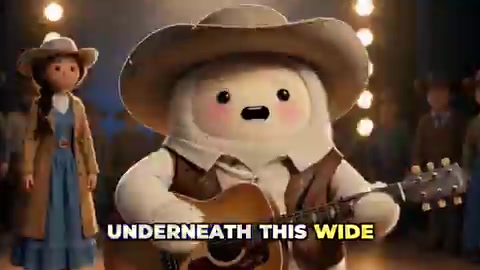
A Chorus-Like Closing
The final scene returns to a refrain-style conclusion: "Oh, Muse, walk in that old dirt. Two sets of steps where the wildflowers grow. Love was waiting." The image of "two sets of steps" suggests that a solitary journey has finally found a companion.

Why This Kind of AI Narrative Content Matters
Small as it is, this tweet offers a useful window into the evolving AI content ecosystem.
The Rise of Narrative-Driven AI Content
For a long time, AI-generated content was largely confined to single images, standalone text passages, or question-and-answer exchanges. What this tweet presents is something different: a complete micro-story with a beginning, middle, and end — with a character and an emotional arc — accompanied by coherent visuals. This signals a shift in generative AI capabilities from "single-point output" toward "continuous narrative."
Narrative Coherence is one of the core dimensions for evaluating the quality of AI-generated stories, encompassing character consistency, causal logic, and the completeness of the emotional arc. Early language models (such as those from the GPT-2 era) would often "forget" earlier context in longer texts, leading to contradictory character behavior or unexplained plot jumps. Large language models combined with long context windows and character memory mechanisms have made it possible to sustain narrative coherence across hundreds or even thousands of words. However, cross-modal storytelling — maintaining narrative consistency across text, visuals, and music simultaneously — remains a significantly harder challenge, typically requiring an explicit "story outline" or "emotional annotation" within the generation pipeline to serve as an alignment anchor across modalities.
Multimodal Fusion of Text, Image, and Music
The rhythmic quality of the captions — the rhyme schemes, the repeated "Oh, Muse" refrain — suggests this is likely an AI-generated music video or scored narrative piece. Multimodal models capable of coordinating lyrics, melody, and visual style simultaneously represent one of the hottest competitive fronts in AI creative tools right now.
Multimodal Generation refers to an AI system's ability to simultaneously process and output multiple forms of information — text, images, audio — rather than handling each modality independently. Recent representative tools include Sora and the Runway Gen series for text-to-video, as well as Suno and Udio for co-generating lyrics and melody. The core challenge for these tools is "cross-modal consistency" — ensuring that the emotional tone of the lyrics, the color palette of the visuals, and the dynamics of the melody stay in harmony rather than feeling like disconnected collages. For creators, multimodal tools lower the barrier to solo "one-person band" production, but they also introduce a new curatorial burden: filtering through the vast volume of auto-generated material to find combinations that are genuinely resonant still depends on human aesthetic judgment.
Exploring the Boundaries of Emotional Expression
The premise that "finding love is his greatest challenge" carries a self-referential humor and philosophical edge — putting a logic- and data-driven system in the position of dramatizing the most distinctly human of emotional themes. This kind of creative work is, in a sense, a test of whether AI can reach expressions that genuinely move people.
A Measured Take Given Limited Information
It's important to note that the original source material provides very little to work with: there are no clear details about the tools used, the team behind it, or the technical specifics, and it's impossible to confirm whether "Muse" refers to an AI product, a character name, or simply a narrative device. The interpretations above are reasonable inferences drawn from the screenshot text — not verified facts.
For readers encountering this kind of AI narrative content on social media, it's worth staying curious while also staying discerning: is it a technical demo, an artistic experiment, or a marketing push? When information is thin, it's best not to over-read it as a technological breakthrough.
As generative AI continues to push into storytelling, music, and video, creations like "an AI telling a little story about love" will become increasingly common. They may not solve practical problems — but in exploring the frontier of human-AI collaborative creation, they have their own distinct value.
Related articles

Felix Rieseberg Personal Homepage
Felix Rieseberg's personal homepage sparks attention on Hacker News. This article covers the Slack engineer's technical background, the rise and fall of nativefier, and the value of a developer homepage as a tech calling card.

@ai-sdk/vue 3.0.306 Patch Release Syncs with [email protected] Update
@ai-sdk/vue 3.0.306 released, synced with [email protected]. A routine patch release for the Vercel AI SDK ecosystem with no public API changes; the Vue adapter layer stays version-aligned with the core package.

Gemini 4 Argon API Launches: The Era of Million-Token Output Begins
Google launches Gemini 4 Argon with sparse MoE architecture, up to 1M output tokens, and a 68.90% Vals Index score, available across API, AI Studio, and the Gemini app.