The AI Risk Observatory: What Annual Report Disclosures Reveal About Social Resilience

LLM analysis of UK annual reports finds AI risk disclosures booming in volume but hollow in substance.
The arXiv paper 'The AI Risk Observatory' uses LLMs to analyze 9,821 annual reports from 1,362 UK-listed companies (2020–2025), finding AI risk disclosure rates jumped from 2.8% to 41.2%. Yet quality lags badly: only 4.3% of 2025 reports contain substantive content, just 7 reports document actual AI harms, and vendor mentions are heavily concentrated among a few giants like Microsoft. Critical sectors — energy, data infrastructure — and smaller AIM-listed firms disclose the least, exposing systemic gaps in social resilience.
An Underexplored Data Goldmine: Corporate Annual Reports
Researchers studying social resilience have long faced a persistent bottleneck: a shortage of useful, actionable data. Yet every year, companies publish annual reports that represent a largely untapped information resource — documenting how organizations perceive risk, adopt new technologies, and account for their strategies to investors and the public.
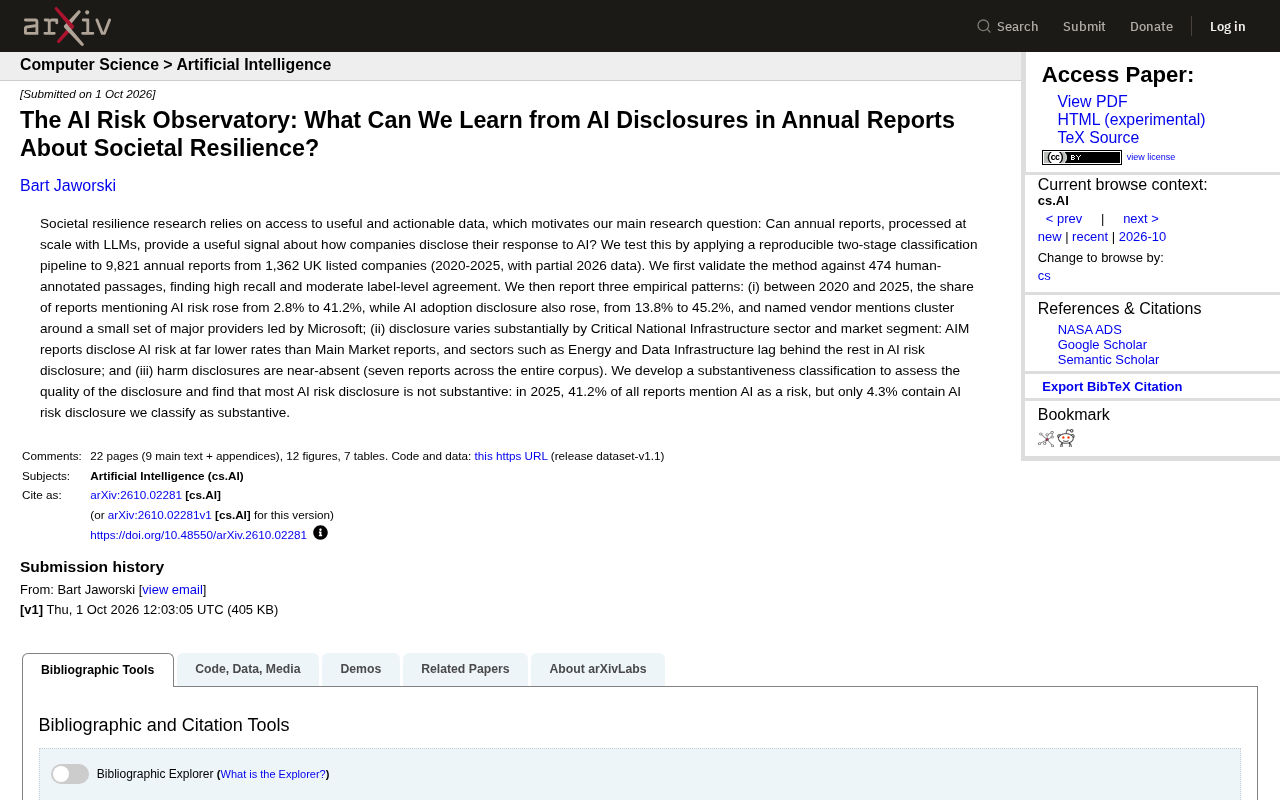
A newly published arXiv paper, The AI Risk Observatory, poses a compelling question: can large language models (LLMs) process annual reports at scale to extract meaningful signals about how companies are responding to artificial intelligence? The research team systematically analyzed 9,821 annual reports from 1,362 UK-listed companies published between 2020 and 2025 (including some 2026 data), delivering a substantive empirical answer.
Methodology: A Reproducible Two-Stage Classification Pipeline
The study employs a reproducible two-stage classification pipeline. To ensure the reliability of machine-generated judgments, the team validated their approach against 474 manually annotated text segments, finding high recall and moderate label-level agreement.
This means LLMs can capture AI-related content in annual reports fairly comprehensively, though fine-grained label assignment still involves a degree of subjective variation. This transparent validation step underpins the credibility of the large-scale statistical findings that follow, and offers a replicable model for similar research.
A typical two-stage classification pipeline consists of a "relevance filtering" step followed by a "category labeling" step. The first stage determines whether a given passage is AI-related, filtering out irrelevant content; the second stage assigns more granular labels to passages that pass the filter — distinguishing, for example, between "AI risk," "AI adoption," and "AI harm." This cascaded design controls costs (avoiding fine-grained classification of all text) while enabling independent optimization of precision-recall tradeoffs at each stage. Recall measures how much truly relevant content the model captures; high recall means a low miss rate, which is desirable when comprehensiveness matters. Label-level agreement reflects how closely the model's category assignments match human annotators — moderate agreement signals that fine-grained classification remains ambiguous in places, and that conclusions should be interpreted with appropriate caution.
Three Key Empirical Findings
AI Risk Disclosures Have Surged Nearly 15-Fold in Five Years
The most striking trend is the explosive growth in disclosure frequency. In 2020, just 2.8% of annual reports mentioned AI risk; by 2025, that figure had soared to 41.2%. Similarly, disclosures related to AI adoption rose from 13.8% to 45.2%.
Also notable is the issue of vendor concentration — the AI service providers explicitly named in these reports are heavily concentrated among a handful of dominant players, with Microsoft leading the list. This dependence on a single or small number of vendors constitutes a form of latent systemic risk: when critical infrastructure broadly relies on the same suppliers, any failure or disruption is amplified across the system.
Disclosure Gaps: Divergence Across Sectors and Market Segments
Disclosure levels vary significantly across different Critical National Infrastructure (CNI) sectors and market segments.
The data shows that AIM (Alternative Investment Market) companies disclose AI risk at far lower rates than those on the Main Market. More concerning is that Energy and Data Infrastructure — sectors most essential to the functioning of society — actually lag behind other industries in AI risk disclosure. This structural disclosure gap appears precisely where attention to technology risk is most needed, exposing weak points in the broader project of building social resilience.
The Alternative Investment Market (AIM) was established by the London Stock Exchange in 1995 as a secondary market primarily for smaller, earlier-stage companies. Its listing thresholds and disclosure requirements are considerably lighter than those of the Main Market. Main Market companies must comply with more stringent Listing Rules and the Disclosure Guidance and Transparency Rules, while AIM companies are only required to follow the relatively relaxed AIM Rules — with no prospectus audit requirement and no minimum market capitalization. This regulatory difference helps explain why AIM companies systematically lag in AI risk disclosure: lighter compliance pressure means less incentive to disclose proactively. Critical National Infrastructure (CNI) refers to the sectors identified by the UK government as essential to the normal functioning of society — typically including energy, water, transport, communications, and finance. When technology risks materialize in these sectors, the consequences extend far beyond any single company, making their disclosure lag all the more systemically significant.
Harm Disclosures Are Nearly Nonexistent
Across the entire corpus of 9,821 reports, only 7 contained disclosures relating to actual AI harm. This is effectively a collective silence. Companies are willing to discuss AI risk in the abstract, yet rarely acknowledge or document harms that have actually occurred. This gap should concern regulators and researchers alike.
Quantity vs. Quality: A Substantiveness Crisis
The study's most penetrating insight lies in its distinction between the volume and the quality of disclosures. The team developed a "substantiveness" classification framework to assess the genuine informational value of what companies report.
The conclusions are sobering: the vast majority of AI risk disclosures are not substantive. In 2025, while 41.2% of reports mentioned AI risk, only 4.3% contained disclosures judged to have substantive content.
In other words, behind the impressive headline numbers lies mostly boilerplate — companies are including AI risk language in their reports as a standard compliance gesture, not as a rigorous analysis of their actual risk exposure. This "disclosure inflation" is a reminder that mention rates alone cannot be used to gauge the maturity of a company's risk governance.
The concept of "substantive disclosure" originates in financial reporting, referring to content that provides information genuinely useful for decision-making — as opposed to vague platitudes or templated language. In the context of AI risk, substantive disclosure typically requires: specific identification of risk sources and transmission pathways, description of mitigation measures already taken or planned, and quantitative or semi-quantitative estimates of financial or operational impact. Its opposite, "boilerplate disclosure," involves directly lifting industry-standard language — such as "the rapid development of AI technology may have uncertain effects on our business" — which technically satisfies disclosure requirements while conveying virtually no incremental information about the company's specific risk exposure. The finding that only 4.3% of reports meet the substantiveness threshold represents a significant gap between the current reality and regulators' hopes that mandatory disclosure requirements would drive genuine improvements in risk governance.
Implications for Social Resilience
This research demonstrates a methodological proof of concept: annual reports, when processed by LLMs at scale, can indeed serve as a useful signal source for observing how society is responding to AI. It offers a viable path toward establishing an ongoing "AI risk monitoring" mechanism.
From a governance perspective, several signals deserve policymakers' attention: the systemic dependency created by high vendor concentration, the lagging disclosure in critical infrastructure sectors, and the near-universal absence of substantive content. True social resilience lies not in how many companies "mention" AI risk, but in whether they genuinely understand and manage it. When disclosure becomes a formality, neither regulators nor the public can use it to assess the system's real vulnerabilities.
Related articles

@ai-sdk/vue 3.0.306 Patch Release Syncs with [email protected] Update
@ai-sdk/vue 3.0.306 released, synced with [email protected]. A routine patch release for the Vercel AI SDK ecosystem with no public API changes; the Vue adapter layer stays version-aligned with the core package.

Gemini 4 Argon API Launches: The Era of Million-Token Output Begins
Google launches Gemini 4 Argon with sparse MoE architecture, up to 1M output tokens, and a 68.90% Vals Index score, available across API, AI Studio, and the Gemini app.

DukaanAI: Turning Product Photos into Inventory Lists with Open-Source AI
DukaanAI is an AI inventory tool for small retailers that turns product photos into inventory entries using the open-source Gemma 3 model, with local inference, editable fields, and CSV export.