The AI Slowdown Debate: How Executives and Politicians Are Responding to Amodei's Call to 'Pace the Frontier'
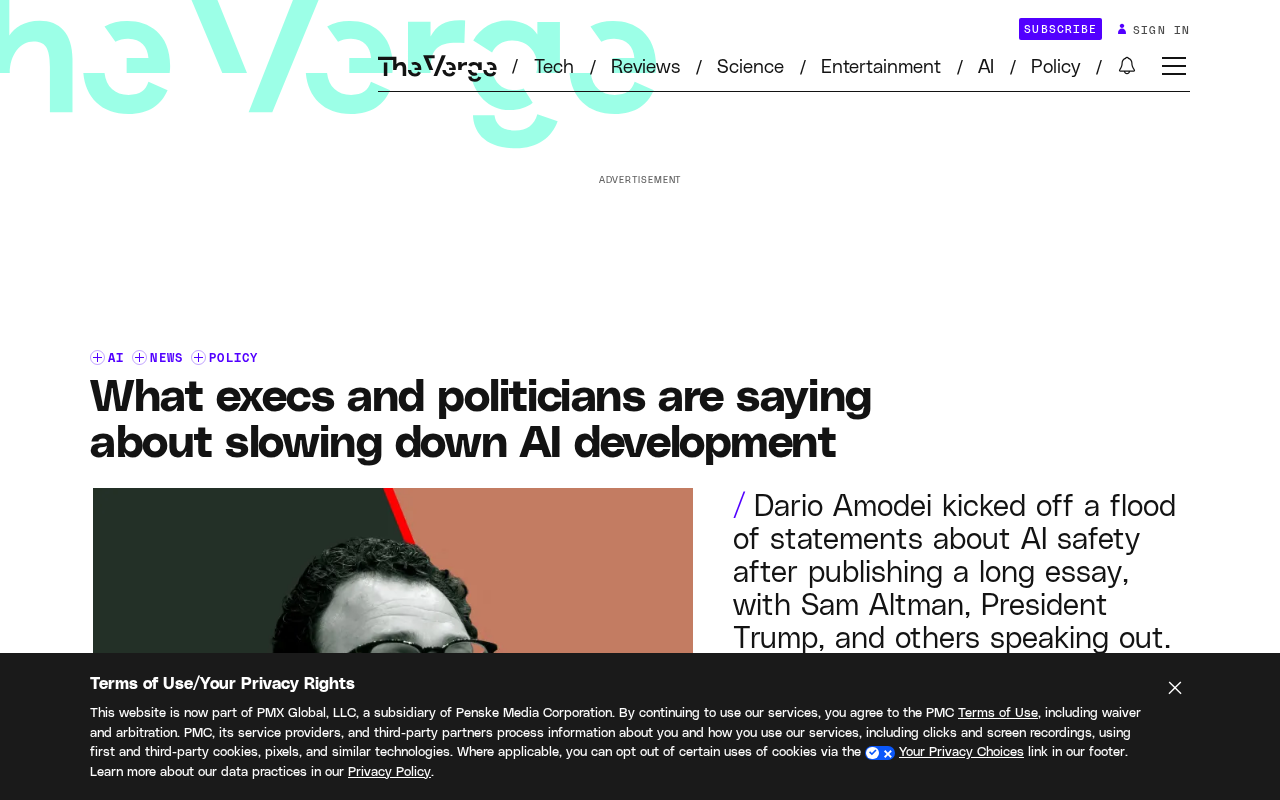
Amodei's call to pace AI frontier capabilities has divided the industry and political world into clear opposing camps.
Anthropic CEO Dario Amodei published an essay titled "We Must Pace the Frontier," arguing for a controlled cadence in advancing frontier AI capabilities — without halting R&D — so safety evaluations and regulatory frameworks can keep pace. The piece triggered a public split: supporters say current iteration speeds have outrun safety testing and alignment research; critics fear unilateral slowdowns will hand technological dominance to competitors who don't follow the same rules. The debate exposes three structural dilemmas in AI governance: the lack of an actionable definition for "slowing down," an unsolvable collective action problem, and the role of industry statements as de facto soft governance in the absence of formal regulation.
A Public Debate Over the Speed of AI Development
Anthropic CEO Dario Amodei recently published a lengthy essay titled We Must Pace the Frontier, laying out a systematic case for why the advancement of AI capabilities should be slowed. The piece quickly triggered a chain reaction across the tech industry and political world, prompting a wave of public statements from AI leaders and politicians alike — some in support, others in opposition — making it one of the most concentrated rounds of public debate on AI safety governance to date.
The core question at the heart of this debate is not new: has the rapid acceleration of AI capabilities outpaced society's, regulators', and even developers' own ability to understand and control it? But the fact that it's being raised by someone like Amodei — a CEO at the very frontier of the industry who has long positioned himself as a champion of "safety first" — gives the call to slow down a signal value far beyond that of an ordinary op-ed.
Amodei's Core Argument: Pacing the Frontier
Judging by the title and thesis of the essay, the key word Amodei emphasizes is "pace" — not "stop." This is a word choice worth examining closely. He is not arguing for a pause in AI research and development. Rather, he is calling on the industry to establish some form of controlled cadence for pushing the most frontier capabilities forward — giving safety evaluations, societal adaptation, and regulatory frameworks time to catch up with the technology curve.
For a company at the center of the large model arms race, having its CEO voluntarily talk about "slowing down" creates an inherent tension. Anthropic has positioned AI safety research as its brand identity since its founding, and Amodei's essay can be read as a continuation and escalation of that long-held stance — formally putting the question of "pace" on the table at a moment when capabilities are breaking new ground.
For and Against: A Fractured Industry
Based on the original reporting, multiple AI leaders and political figures have responded to Amodei's views, with positions clearly split.
The Logic of the Pro-Slowdown Camp
Voices in favor of slowing down typically operate within a risk-precautionary framework: the current iteration speed of AI capabilities is too fast, safety testing, alignment research, and external oversight mechanisms are not yet mature, and pushing forward recklessly could lead to irreversible social and safety consequences. For this camp, Amodei's call provides crucial endorsement from within the industry itself — it is no longer the concern of outside critics, but a self-warning from a core developer.
The Concerns of the Opposition
Opposing voices tend to focus on competition and dominance. In the context of a global AI race, unilaterally slowing down could mean ceding frontier advantages to competitors who don't play by the same rules — whether other companies or other nations. This logic is especially prevalent in statements from politicians: the moral appeal to slow down and the strategic imperative to maintain technological leadership are in deep, difficult-to-reconcile tension.
Why This Debate Matters
The real value of this round of discussion lies not in who is right or wrong, but in what it exposes about the structural dilemmas of AI governance.
First, "slowing down" lacks an actionable definition. Slow down what, exactly? Model parameter scale? Training compute investment? The release timeline for new capabilities? Without consensus metrics, "pace the frontier" looks more like a statement of values than an executable policy path.
Second, the collective action problem persists. Any self-restraint by a single company or nation can be rendered ineffective by the non-compliance of others. This is precisely the dilemma that global issues like climate governance have repeatedly faced — and it has now been transplanted into the AI domain.
Third, statements from within the industry are themselves becoming a form of soft governance. As more and more executives publicly discuss safety and pace, these pronouncements shape investor expectations, regulatory direction, and public perception — even in the absence of binding rules.
Conclusion: The Debate Has Only Just Begun
Amodei's essay is like a stone dropped into still water — the ripples are far from settling. Supporters see it as the conscience of a responsible industry leader; critics worry it will become a pretext for surrendering competitive advantage; and many more are asking: in the absence of consensus standards and enforcement mechanisms, what does "slowing down" actually mean?
What is clear is that this public debate over the pace of AI development marks a shift in AI governance discussions — from abstract ethical terrain toward a contest over specific timelines and the allocation of responsibility. For those watching the trajectory of the AI industry, the real thing to watch is what comes next: how the various parties involved — especially regulators — translate these public statements into concrete action.
Related articles
Claude Code v2.1.271 Update Deep Dive: Fast Mode, Sandbox Security, and Enterprise Improvements
Claude Code v2.1.271 adds fast mode for remote sessions, per-command sandbox network controls, enterprise policy fixes, MCP protocol improvements, and terminal/IDE enhancements.
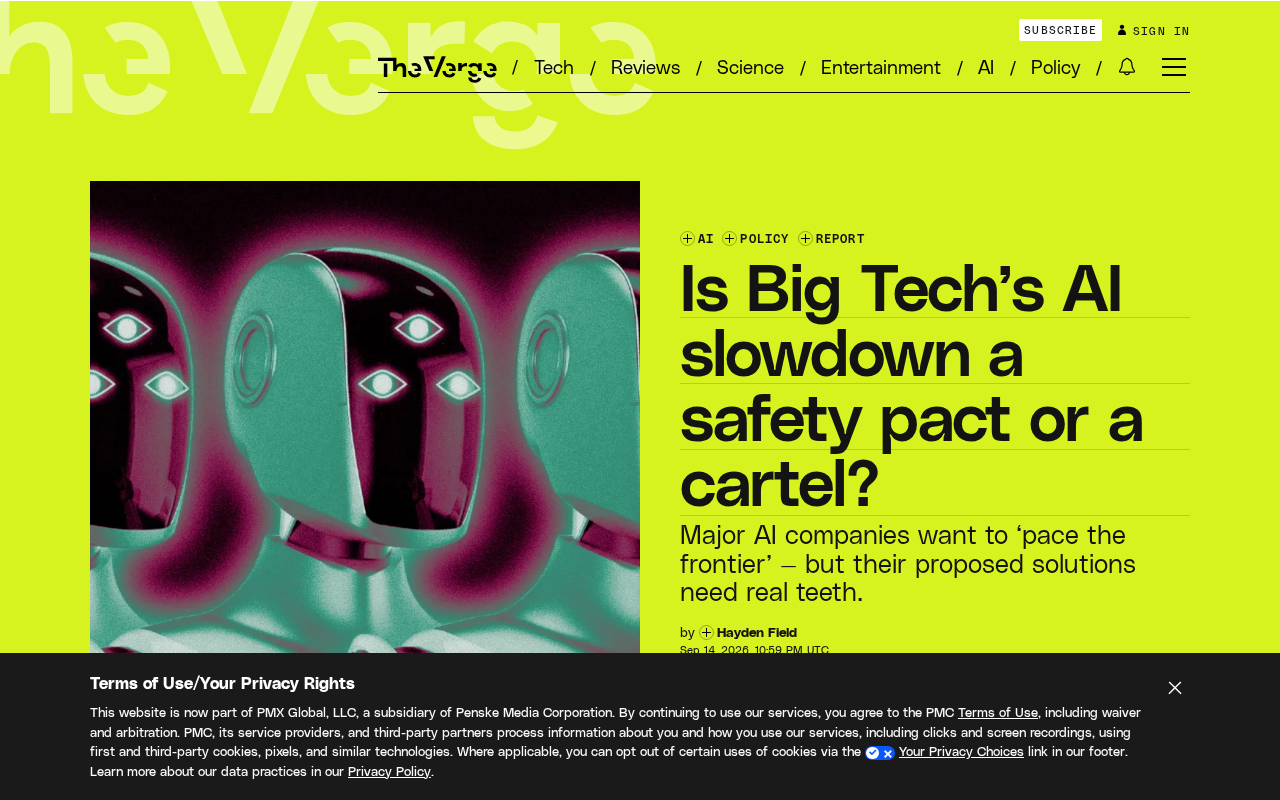
AI Giants Collectively Hit the Brakes: Safety Protocol or Industry Cartel?
OpenAI, Anthropic, Google DeepMind, and SpaceX leaders agree to slow AI development. Is this a responsible safety pact — or an oligopolistic cartel in disguise?

Apple Home Gets AI Camera Features with iOS 27: Up to $60/Month
iOS 27 and tvOS 27 bring Apple Intelligence to Apple Home with AI video summaries for HomeKit Secure Video — but unlocking them costs up to $60/month via subscription.