The AI Support Agent That Remembers Failed Solutions: Memory Mechanisms and the Evolution of Intelligent Customer Service

An AI support agent that remembers which fixes failed — using memory design to compensate for model limitations.
A developer shared on Reddit an AI customer service agent with "failure memory": it records and excludes solutions already proven ineffective, preventing repeated unhelpful suggestions. The mechanism addresses a core flaw in current AI support systems — stateless or short-context agents that loop through the same recommendations. Implementation involves three key components: persisting solution-outcome mappings via vector or structured storage, retrieving and filtering out past failures before generating new suggestions, and capturing explicit or implicit user feedback to close the loop. The project reflects a broader shift from single-turn Q&A toward AI Agents with persistent, long-term memory.
A Support Agent That Remembers Which Fixes Failed
A developer recently shared a project on Reddit: a support AI Agent with the ability to remember failed solutions. The idea sounds simple, but it cuts to the heart of a core problem in today's AI customer service systems — most conversational agents lack memory of past attempts, causing them to repeatedly recommend solutions that have already been proven ineffective.
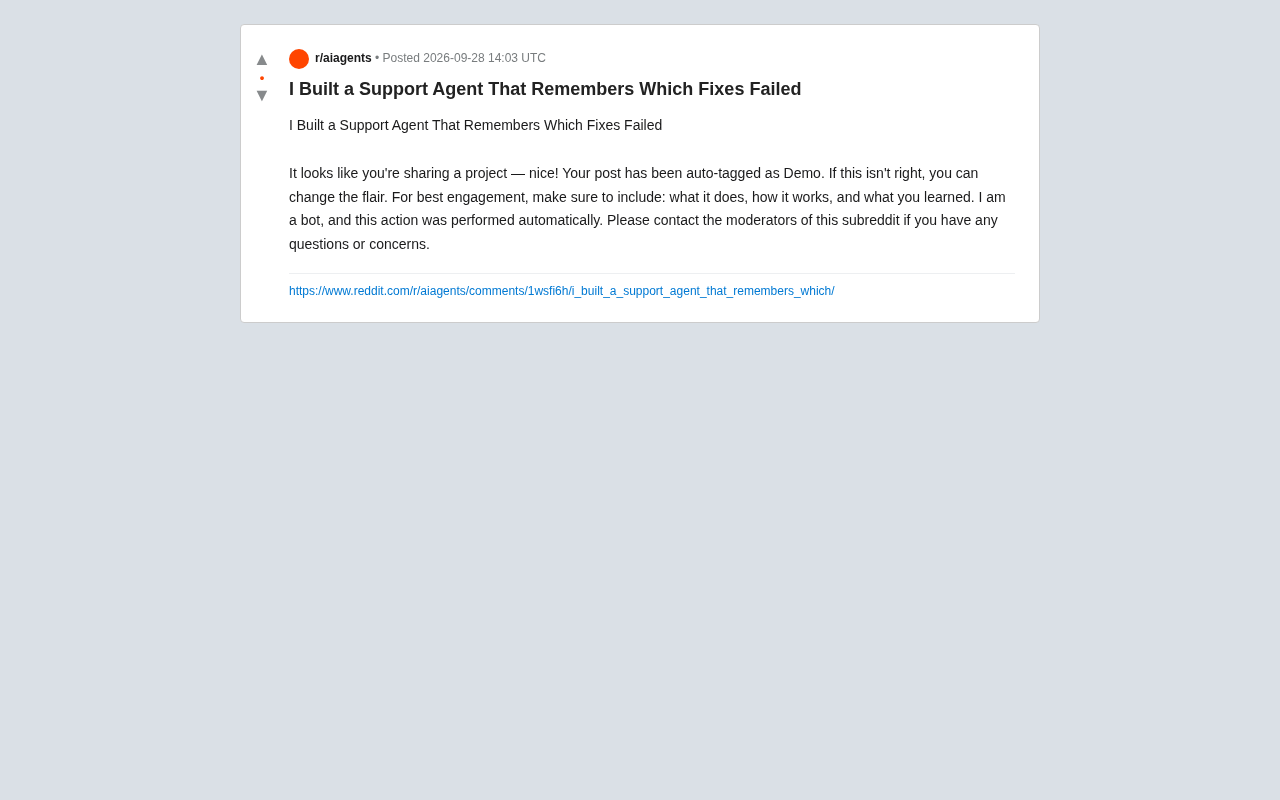
It's worth noting that the original post was quite brief — the body was mostly auto-generated subreddit tags (the post was automatically labeled as a Demo) with no technical details included. This article therefore focuses on the underlying concept and explores the value and implementation of the "failure memory" mechanism.
Why Remembering Failure Matters
Traditional customer service agents are typically stateless, or retain only short-term context. When a user says "that didn't work," many systems will still offer the same or similar suggestions in the next interaction. This kind of loop wastes user time and, more critically, erodes trust.
Human support agents are effective largely because of experience — they know which approaches tend to fail for certain types of problems and skip them entirely. Giving an AI Agent similar negative memory essentially simulates that process of accumulated experience.
From a product standpoint, remembering failed solutions delivers three direct benefits: fewer repeated suggestions, faster problem resolution, and higher user satisfaction. For scenarios involving high volumes of repetitive technical support tickets, the compounding effect of this optimization is especially significant.
How a Failure Memory Mechanism Might Be Implemented
Although the original post didn't reveal any specific architecture, common approaches to implementing "failure memory" typically involve several key components.
Persisting State and Memory
The agent needs to record each attempted solution along with the user's outcome (success or failure). This is typically done using a vector database or structured session memory storage. The key is saving the "solution → outcome" mapping as retrievable knowledge rather than letting it disappear when the conversation ends.
Vector databases (such as Pinecone, Weaviate, or Chroma) are a common choice for this type of use case: they convert solution text into high-dimensional vector embeddings, allowing the system to retrieve historically similar failed solutions through semantic similarity rather than exact keyword matching. Structured storage (such as a relational database or Redis) is better suited for storing explicit metadata — for example, failure counts, failure timestamps, or user types. These two approaches are often combined: the vector store handles "fuzzy semantic retrieval" while structured storage handles "precise conditional filtering," together forming a reliable knowledge base of failed solutions. It's important to note that cross-session persistence requires the system to uniquely identify users or problem entities — otherwise, the same user will still lack access to their own history across sessions.
Retrieval and Exclusion Logic
Before generating a new suggestion, the agent retrieves the history relevant to the current issue, identifies previously failed solutions, and excludes them from the candidate set. This step can incorporate semantic similarity matching to avoid "same advice, different wording" — solutions that are merely rephrased but functionally identical to what already failed.
Closing the Feedback Loop
The system needs to explicitly capture user feedback signals for each attempted solution. These can be explicit (the user clicks "Not resolved") or implicit (the user continues describing the same problem). The quality of feedback directly determines the accuracy of the failure memory.
Capturing implicit feedback is often more complex to engineer than capturing explicit feedback — but it also better reflects real user behavior. Users rarely click "Not resolved"; instead, they express dissatisfaction through action. Common implicit signals include: a user re-describing the same problem within the same session, conversation turns exceeding a threshold without resolution, or the user using negative phrasing ("still not working," "already tried that"). Detecting these signals typically requires a dedicated intent classifier built into the agent's prompt layer or post-processing logic. Misidentifying feedback signals is one of the biggest risks in a negative memory system: incorrectly marking an effective solution as failed means all future users with similar issues will be denied that solution — a systemic loss. For this reason, it's advisable to rely primarily on explicit feedback during the cold-start phase and gradually introduce implicit signals only after sufficient data has been accumulated.
What This Project Tells Us About the Future of AI Customer Service
This small project reflects a much larger trend: AI Agents are evolving from "single-turn Q&A" toward "persistent collaborators with long-term memory." Memory capability — especially memory of negative outcomes — is the critical dividing line between an agent that feels smart versus one that feels mechanical.
For developers, the value of this kind of project lies not in technical complexity, but in identifying a genuine pain point in real-world scenarios. A customer service agent that remembers failed solutions — even with a relatively limited underlying model — can deliver a dramatically better user experience through thoughtful memory engineering.
It's also worth noting that as memory-enabled agent frameworks mature, this capability may become standardized — a baseline feature of customer service systems rather than a standout differentiator. Early explorations like this in the developer community are exactly what drives that kind of broad adoption.
Several open-source frameworks and products aimed at memory-enabled agents are already pushing this capability toward standardization. LangChain's Memory module, MemGPT (which manages long-term memory through virtual context), and memory-layer tools like Mem0 are all working to make "remembering the past" a pluggable component. On the customer service side, some SaaS platforms (such as Intercom and Zendesk) have also begun introducing cross-ticket historical awareness into their AI features. As these tools mature, the barrier to implementing "failure memory" is dropping rapidly. The competitive focus will shift from whether an agent has memory to the quality and retrieval precision of that memory.
Conclusion
This Reddit project shares relatively little detail, but the underlying idea — remembering failure — has broad and practical relevance. For any team building a conversational AI or customer service system, incorporating negative memory is a direction worth investing in. It's a reminder that making AI more useful sometimes doesn't require a more powerful model. It requires memory and feedback design that is more closely aligned with real user needs.
Related articles

Cursor Can Now Control Your Computer: AI Agents Can Drive Desktop Apps for Testing
Cursor adds desktop control: AI agents can drive desktop apps like the iOS Simulator to test their own features. We analyze the impact on dev workflows, possible technical approaches, and reliability concerns.

Vibecoding a Custom Inference Engine: High Hopes, Harsh Reality
A Reddit developer shares the real experience of vibecoding a custom inference engine: running GGUF Q4 models in the browser with WebGL2 and GLSL, only to fall into tokenizer debugging hell. This article analyzes the engineering challenges of browser-side LLM inference and why cloning llama.cpp is the more rational choice.

How High Are Anthropic's Early Investor Paper Returns Ahead of IPO?
Anthropic's early investor paper returns draw attention ahead of IPO. This article analyzes sources of book gains, capital structure, pre-IPO games and risks, and implications for the AI startup ecosystem.