The AI Tamagotchis Are Coming: Meta and OpenAI Bet Big on AI Hardware

Meta and OpenAI are using cute AI software agents as a stepping stone to crack the dedicated AI hardware market.
After years of AI hardware failures, Meta and OpenAI are trying a new playbook: launch anthropomorphized, endearing AI software agents first, build emotional connections with users, then leverage that loyalty to drive hardware adoption. Dubbed the 'AI Tamagotchi' strategy, the approach mirrors how digital pets won hearts through emotion rather than function. The real competitive edge, the article argues, lies not in raw AI capability but in mastering human-AI emotional dynamics and converting software habits into hardware sales.
The Next Big Gamble in AI Hardware
Artificial intelligence has deeply embedded itself into our phones and computers, yet dedicated AI hardware devices have repeatedly stumbled. From the early AI Pin to various smart assistant gadgets, most products have failed to genuinely win over consumers. In the coming year, however, two AI heavyweights — Meta and OpenAI — are gearing up to change that.
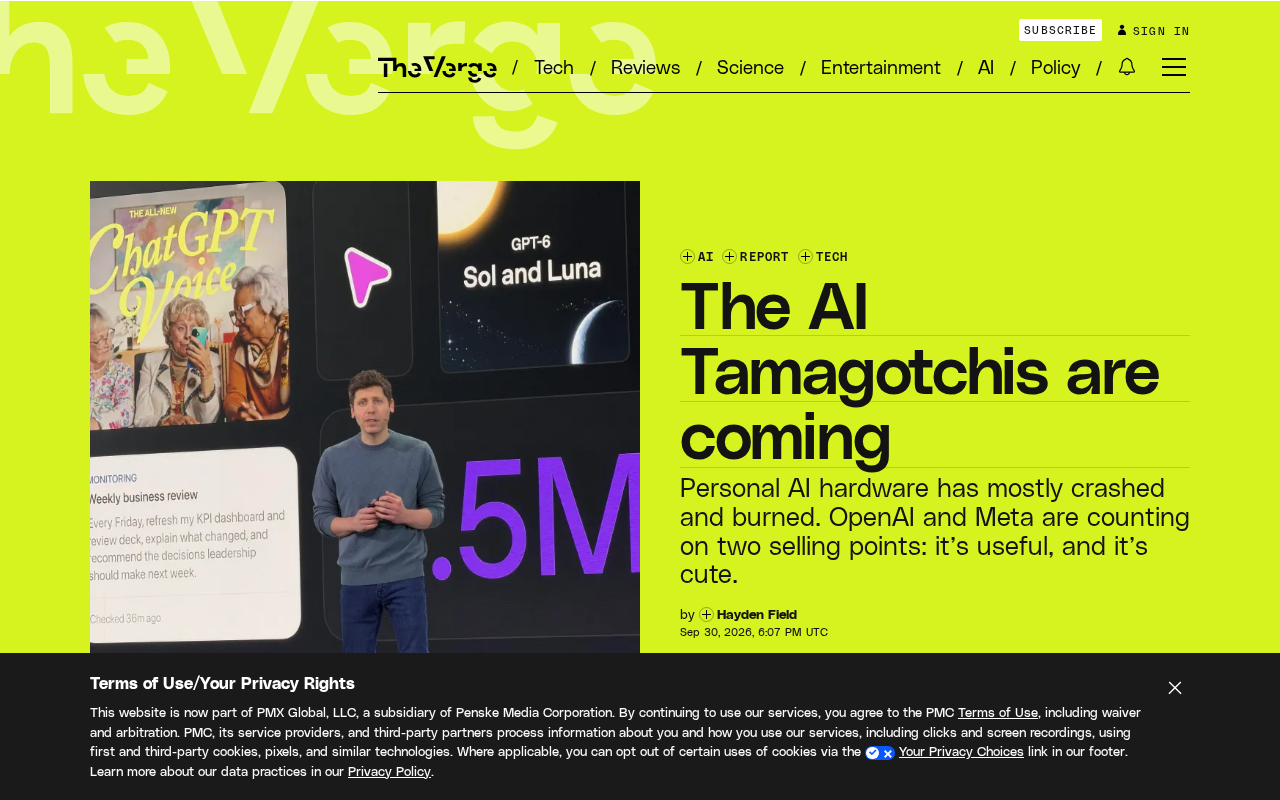
Intriguingly, both companies appear to have chosen a similar path: first deploying cute, endearing software agents to gauge consumer appetite for dedicated hardware. This approach has been colorfully compared to "AI Tamagotchis" — a nod to the wildly popular virtual pets of the 1990s — suggesting these AI companions might enter users' daily lives in a warm, anthropomorphized form.
Why the "Software-First" Strategy Makes Sense
One of the core reasons dedicated AI devices have failed is that consumers lack a clear motivation to use them. Unlike phones and computers, these devices typically require users to overhaul their existing interaction habits, while the payoff remains unclear. As the saying goes, "Hardware is hard" — from supply chains and manufacturing to user experience, every step is fraught with challenges.
Meta and OpenAI's logic is this: rather than launching expensive physical devices and absorbing the market risk upfront, why not first roll out software-based AI agents and observe whether users develop a dependency or emotional connection with these "anthropomorphized companions"? If a software-layer "digital pet" can cultivate sufficient user stickiness, the odds of a successful hardware follow-up improve dramatically.
The most instructive failure among early AI hardware is Humane's AI Pin: priced at $699, this brooch-style, screenless voice device launched in early 2024 but quickly ran into severe problems — sluggish responses, overheating, and incomplete functionality — triggering a wave of returns within months of launch, after which Humane was reported to be seeking a buyer. Similarly, Rabbit's R1 device marketed itself as "AI-native hardware," only to face ridicule for relying on cloud-based app scraping for its core features. These cases reveal a shared dilemma: when AI capabilities themselves are still unstable, locking them into dedicated hardware amplifies every flaw in the experience, leaving users far less forgiving than they would be with a software app. The essence of "software-first" is to continuously refine AI capabilities and interaction patterns through iterable software before committing them to hardware — avoiding the mistake of freezing an immature experience into an expensive physical product.
Emotional Connection Is the Critical Variable
The Tamagotchi analogy carries deeper meaning. The original digital pet succeeded not because of powerful features, but through emotional projection — users invested time and care into a virtual creature's survival. Today's AI agents are exploring the same path: through anthropomorphized, personalized interactions, they aim to foster genuine emotional attachment in users.
If this strategy works, AI devices stop being cold tools and become more like "digital companions." This explains why Meta and OpenAI are using "cutesy software agents" as their entry point — once an emotional bond is established, users' willingness to pay for physical hardware and their frequency of use are both likely to increase.
Two Giants Racing Down the Same Track
Meta already has hardware experience with its Ray-Ban smart glasses and Quest VR headsets, while OpenAI has signaled its consumer hardware ambitions through a collaboration with former Apple design chief Jony Ive. The fact that both companies are entering the same arena at the same time with similar strategies signals that AI hardware is poised to become the next fiercely contested battleground.
What's worth noting is that the outcome of this race may not hinge on who has the more powerful AI model, but on who better understands the emotional dynamics between humans and AI — and who can more seamlessly translate habits built up on the software side into hardware sales.
The OpenAI and Jony Ive collaboration deserves a closer look. Ive served as Apple's Chief Design Officer, leading the design of era-defining products including the iMac, iPod, iPhone, and Apple Watch — widely regarded as the defining figure in merging industrial design with technology experience. After leaving Apple in 2023, he founded the independent design firm LoveFrom, and reports soon emerged of a deep collaboration with OpenAI CEO Sam Altman, with the stated goal of creating an "AI-native device for the post-smartphone era." The symbolic weight of this pairing is immense: the world's most influential AI company teaming up with the premier designer who redefined consumer electronics, attempting to replicate the path iPhone took when it dismantled the Nokia era. That said, the specific form of the product remains undisclosed.
Closing Thoughts: A Trend Worth Watching
The history of dedicated AI devices is littered with failures, but Meta and OpenAI's "software-first, emotionally-led" strategy offers a fresh approach. The coming year will serve as a critical testing window for this model. If "AI Tamagotchis" genuinely succeed in shaping the habits of a generation of users, the AI hardware market may finally reach its real turning point. For anyone tracking the evolution of AI, this is a development well worth following closely.
Related articles

Workbuddy for Absolute Beginners: How a Desktop AI Agent Fits Into Real Workflows
A beginner's guide to the Workbuddy desktop AI agent: installation, claiming credits, file management, and building automated workflows—compared with CodeX for fit and cost, helping professionals shift from AI question-askers to AI managers.

OpenAI's New Agent Stack: Computer Use, Decisions API, and Ultra-Fast Workflows
OpenAI Dev Day unveiled a new agent stack: Computer Use outperforms humans, Decisions API delivers ultra-low-latency classification via Luna, Agents API opens the same Computer Use capabilities, and GPT-6.1 Sol costs only one-seventh of Astra. Core updates, benchmark data, and developer insights.

Liang Wenfeng Open-Sources DeepInfo Inference Framework, Takes On U.S. Ban
DeepSeek open-sources its DeepInfo inference framework after its models, featuring GPU/CPU cross-pipelining, small-model prediction with large-model verification, and full Huawei Ascend and NVIDIA chip support—facing the U.S. federal ban head-on. This article analyzes its significance for AI deployment and open-source strategy.