The Alien Space of Science: Coherent Yet Cognitively Unavailable Directions
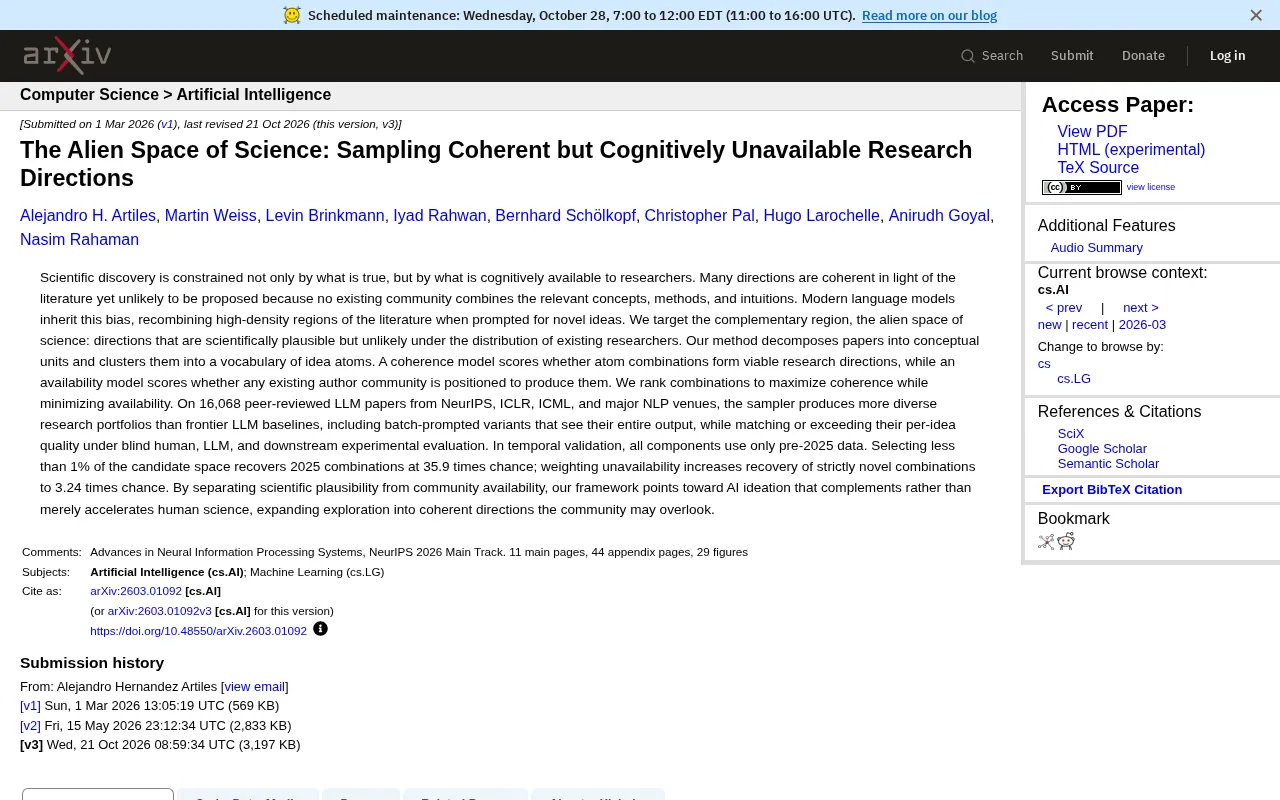
Some scientific directions are coherent yet forever incomprehensible due to human cognitive limits, and the AI era amplifies this separation.
The article explores whether 'coherent but cognitively unavailable' scientific directions exist. The core insight distinguishes 'unknown' (not yet found) from 'cognitively unavailable' (the human mind cannot grasp it). Human conceptual tools are optimized for medium-scale survival, and when theories require abandoning basic cognitive scaffolding, a crack appears between formal description and understanding. Quantum mechanics interpretation debates are cited as a partial example. If such directions exist, formal tools may let science advance, but would challenge science as a public knowledge system. The AI era makes machine-generated unverifiable theories commonplace, amplifying the separation between coherence and intelligibility. The article's value lies in framing a discussable structure rather than giving answers.
Scientific exploration is often imagined as an ever-expanding map, with blanks beyond the known boundaries waiting to be discovered. But there is a more unsettling possibility: some directions are logically fully coherent, yet because of the constraints of human cognitive architecture, we can never truly understand them. The article The alien space of science: Coherent but cognitively unavailable directions, which sparked discussion on Hacker News, is a speculative inquiry centered on this very proposition.
The Core Proposition: The Separation of Coherence and Cognizability
The core insight of this discussion is that a theory or direction can be "coherent"—internally logically consistent, mathematically non-contradictory, and not in conflict with other validated knowledge—while at the same time being "cognitively unavailable": the structure of the human brain determines that we cannot form an operational understanding of it.
This differs from "not yet discovered." The unknown is simply something we haven't found yet, whereas cognitively unavailable means that even if we stand right in front of it, or even derive its formal description, we still cannot truly "grasp" it at the intuitive and conceptual level. The author uses the term "alien space" to describe this region: it belongs to the topology of scientific possibility, yet lies beyond the reach of human cognition.
Why Such Directions Exist
The human mind is a product shaped by evolution, and its conceptual tools—causality, objects, time, space—are optimized for survival in the physical world at a medium scale. Every breakthrough in the history of science has tended to push these intuitive tools to their limits or even recombine them. But when certain theoretical structures require us to abandon the most basic cognitive scaffolding, a crack appears between formal description and understanding.
A frequently cited analogy is quantum mechanics: we have complete mathematical formalism and precise predictive power, but the debate over "what the wave function actually means" has continued for nearly a century. Some would say this shows that quantum mechanics itself is partially "cognitively unavailable"—we can calculate, yet it is difficult to truly understand. Further directions could be even more extreme: in theory they can be written down, but in practice no one can form a stable mental model of them.
"Cognitive scaffolding" is a commonly used concept in cognitive science and the philosophy of science, referring to the underlying psychological structures or external辅助 tools that humans rely on when thinking and reasoning. Internal scaffolding includes innate cognitive frameworks such as object permanence, causal intuition, and a linear sense of time; external scaffolding includes mathematical symbol systems, diagrams, computer simulations, and so on. If a scientific theory requires us to abandon some of the most basic internal scaffolding (for example, giving up "objects" or "causality" as fundamental categories), then even if formal equations can be written down, it is difficult to form an operational mental model. This concept helps explain why certain theoretical structures fall outside the reach of human cognition.
What It Means for Scientific Progress
If such directions truly exist, it would change our expectations for the future of science. One optimistic view is that science can continue to advance into the realm of the incomprehensible simply by relying on formal tools (mathematics, computation, AI-assisted derivation), and that understanding is not necessary. Another view is more cautious: without the constraint of human intelligibility, science would lose its character as a public knowledge system—would a science that no one can understand still count as human science?
The Hacker News discussion, though it has only a few comments, touches on a problem that is being amplified in the AI era: when machines can generate theories that we cannot verify or even understand, the separation between coherence and intelligibility will turn from philosophical speculation into everyday practice.
"Public knowledge system" means that scientific knowledge should be understandable, testable, criticizable, and transmissible by members of the community. Polanyi's "tacit knowledge" and Kuhn's "paradigm" both emphasize that science is not merely a set of formal propositions but also includes communicable understanding and practice. If a theory can only be derived by machines and no one can understand its meaning, then peer review, reproducibility checks, and science education will all face fundamental challenges—the legitimacy of science as a public knowledge system depends on the existence of human understanders.
Editorial Perspective
The value of this article lies not in providing answers but in organizing a set of vague intuitions into a discussable structure: distinguishing "unknown" from "unknowable," and distinguishing "computable" from "understandable." For readers concerned with the philosophy of science and the cognitive boundaries of AI, this is a framework worth following further. The original discussion is small in scale (21 points, 2 comments), and is more of a tentative exploration than a conclusive argument.
One-line Summary
Some scientific directions are logically coherent yet forever incomprehensible due to the constraints of human cognitive architecture, and the AI era amplifies this separation.
Paragraph Summary
The article explores whether "coherent but cognitively unavailable" scientific directions exist. The core insight is the distinction between "unknown" (not yet found) and "cognitively unavailable" (the structure of the human mind cannot grasp it). Human conceptual tools are optimized for survival at a medium scale, and when a theory requires abandoning basic cognitive scaffolding, a crack appears between formal description and understanding. The debate over the interpretation of quantum mechanics is seen as a partial example. If such directions truly exist, formal tools may allow science to continue advancing, but this would challenge the nature of science as a public knowledge system. The AI era makes it everyday practice for machines to generate theories that humans cannot verify, amplifying the separation between coherence and intelligibility. The value of the article lies in organizing a discussable structural framework rather than providing answers.
Related articles

OpenAI Breaks ETH? P=NP Could Upend the Cryptography World
OpenAI reportedly disproved ETH with a sub-exponential algorithm, sparking P=NP speculation. What it means for RSA, blockchain, and protein folding.
When an Anti-Fingerprinting Script Is …
When an Anti-Fingerprinting Script Is Flagged as a Bioweapon: The Detection Dilemma of Security Tools
An anti-fingerprinting script was flagged as a bioweapon by security scanning, sparking Hacker News debate. This analysis covers the causes of keyword-matching false positives, how developers respond, and the long-term imbalance between automation and precision in security tools.

41,000 DHS Employee Records Leaked, Including Undercover ICE Agents
Data breach exposes 41,000 DHS employees, including undercover ICE agents. Analysis of sensitive data risks, law enforcement security gaps, and protection measures like access control and auditing.