The Apollo Code Legend: Margaret Hamilton and the Moon Landing Software

Margaret Hamilton led the development of Apollo moon landing software, laying the foundation for software engineering.
This article revisits Margaret Hamilton's legendary contributions to the Apollo moon landing software through a memorial tweet. She led the MIT Instrumentation Laboratory team in designing the priority scheduling and error detection system for the Apollo Guidance Computer (AGC), saving the Apollo 11 landing from a radar data overload crisis. Hamilton also championed the term 'software engineering,' elevating software development to a rigorous discipline. Her 'Development Before the Fact' methodology resonates with today's formal verification and DevSecOps.
The Apollo Code Legend: Margaret Hamilton and the Moon Landing Software
Recently, a message from Twitter drew attention in the tech community. A developer posted a tribute to Margaret Hamilton, lamenting that they never had the chance to meet her, but noting that her contributions to the Apollo moon landing flight software were truly legendary. The tweet specifically mentioned a classic photograph—Hamilton standing beside stacks of Apollo code printouts piled as tall as a person, an image that has long become an iconic symbol in the field of software engineering.
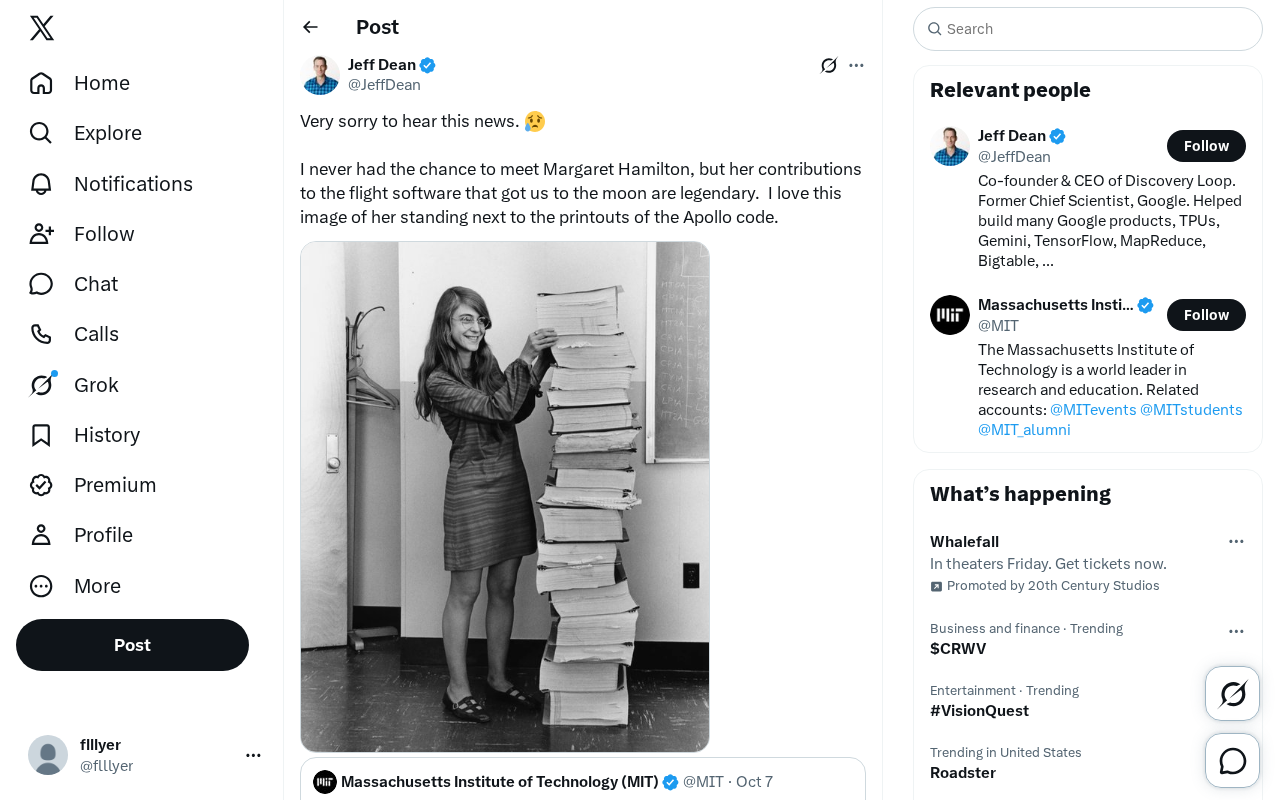
The Software Engineering Revolution Behind a Single Photograph
That widely circulated photograph was taken at the MIT Instrumentation Laboratory, with the code printouts beside Hamilton nearly matching her in height. These pages carried the flight software for the Apollo Guidance Computer (AGC)—a real-time system operating under extreme resource constraints. The AGC's memory was measured in bytes, yet it needed to accomplish critical tasks such as navigation, guidance, and control. Hamilton led her team in designing an entirely new software architecture for this system, and many of its concepts later became cornerstones of modern software engineering.
The tweet author's use of "legendary" to describe her contributions is no exaggeration. During the moon landing mission, the software needed to handle hardware failures, sensor anomalies, and other emergencies—any logical flaw could lead to catastrophic consequences. The priority scheduling mechanism and error detection system developed by Hamilton's team played a decisive role during the Apollo 11 landing—when radar data overloaded the system, it automatically shed low-priority tasks, preserving the critical landing calculations.
The Apollo Guidance Computer (AGC) was an onboard digital computer specially developed by NASA for the Apollo program, designed and built by the MIT Instrumentation Laboratory. It stands as a model of early embedded systems: main memory (core memory) was only about 72KB (16-bit words), read-only memory was about 36K words, and clock speed was on the order of 2MHz. Under such severe resource constraints, the AGC had to perform inertial navigation, celestial navigation, guidance control, engine commands, and human-machine interaction in real time. Its software was divided into two main parts: the Comanche program responsible for flight control and the Luminary program responsible for navigation (Apollo 11 used Luminary 099). The AGC employed a read-only storage technology called "core rope memory," where programs were hardwired by women workers manually weaving magnetic core coils in factories—once an error was made, it was nearly impossible to fix, hence extremely high demands for code correctness. It was precisely these extreme hardware limitations that forced Hamilton's team to make pioneering breakthroughs in software architecture, such as priority scheduling, task decoupling, and asynchronous execution models.
The priority scheduling mechanism was a real-time task management strategy designed by Hamilton's team for the AGC. During the final phase of the Apollo 11 landing, the rendezvous radar was accidentally turned on, flooding the computer with data and causing CPU load to spike. Without intervention, the system would be unable to complete the navigation and control calculations needed for landing. Hamilton's scheduler could identify task priorities and, when the system was overloaded, automatically abort low-priority radar data reception tasks and reallocate computing resources to high-priority landing tasks and display updates. This mechanism was essentially an early practice of priority-based preemptive scheduling, which later became one of the core features of real-time operating systems (RTOS). During the Apollo 11 landing, the AGC issued the famous 1202 and 1201 alarms—it was precisely this scheduling mechanism that saved the mission at the critical moment, proving that software could still ensure system safety through intelligent scheduling even when hardware resources were limited and unreliable.
From the Birth of the Term "Software Engineering" to Industry Standard
Another profound impact of Hamilton's was her advocacy for the formal use of the term "software engineering." In an era when software was often regarded as an accessory to hardware, she insisted that software development should receive the same rigor and respect as hardware engineering. In the 1960s, the Apollo software project she led introduced modular design, redundant backups, and rigorous testing processes—practices that were subsequently widely adopted in critical fields such as aerospace, healthcare, and finance.
The discussion sparked by the tweet also reflects the ongoing concern about software reliability today. From spacecraft to autonomous driving, from medical devices to financial trading systems, the core proposition Hamilton faced back then—how to build reliable software on unreliable hardware—remains a question engineers must answer to this day.
"Software Engineering" as a term was formally proposed and popularized by Hamilton in the late 1960s. At the time, software was typically regarded as an accessory to hardware, with development processes lacking standardization and projects frequently suffering from delays and defects. While participating in the Apollo project, Hamilton felt strongly that software development needed to establish rigorous design, testing, and verification processes just like hardware engineering. She began using the term "software engineering" to emphasize that software construction should possess the rigor, repeatability, and measurability of an engineering discipline. After the 1968 NATO Software Engineering Conference, the term gradually gained industry acceptance and gave rise to software engineering as an independent discipline. Hamilton's insistence not only changed people's perception of software but also laid the intellectual foundation for later methodologies such as CMMI, agile development, and DevOps.
A Legacy Ahead of Its Time and Its Relevance Today
Hamilton later founded Hamilton Technologies, continuing to deepen her work in systems design and software development methods. Her "Development Before the Fact" methodology, which emphasizes completing system modeling and verification before coding, resonates strongly with contemporary DevSecOps and formal verification movements.
For today's AI and software practitioners, Hamilton's career offers multiple insights. First, software quality is not an after-the-fact patch but the primary goal of architectural design; second, the fault tolerance of critical systems must be built into the code logic rather than relying on the absolute reliability of hardware; third, interdisciplinary collaboration skills are crucial—Hamilton herself had a background in both mathematics and philosophy, which enabled her to think about system problems at an abstract level.
Though the tweet author's tribute was brief, it touched upon an essential truth: Hamilton's work not only sent humanity to the moon but also launched software engineering onto the orbit of an independent discipline. That photograph of her with the code printouts thus transcends a historical moment to become a spiritual icon in the hearts of generations of developers.
"Development Before the Fact" (DBTF) is a system design and software development methodology proposed by Hamilton in the 1980s. Its core idea is to first perform formal modeling, requirements analysis, and verification of the system before coding, ensuring the correctness and consistency of system behavior. The method emphasizes the use of executable specifications, automated code generation, and system-level verification to reduce later defect repair costs. DBTF is highly consistent with contemporary formal verification (such as model checking and theorem proving) and the "shift-left security" philosophy in DevSecOps: moving quality and security activities earlier to the design phase. DBTF also gave rise to a toolset and modeling language called 001, used for building highly reliable systems. Hamilton believed that software complexity must be controlled through rigorous upfront modeling—a view that remains instructive for today's safety-critical domains such as autonomous driving, medical devices, and aerospace software.
One-line Summary
Margaret Hamilton led the development of Apollo moon landing software, laying the foundation for the software engineering discipline.
Paragraph Summary
This article revisits Margaret Hamilton's legendary contributions to the Apollo moon landing software through a memorial tweet. She led the MIT Instrumentation Laboratory team in designing the priority scheduling and error detection system for the Apollo Guidance Computer (AGC), successfully handling the radar data overload crisis during the Apollo 11 landing. Hamilton also championed the formal use of the term "software engineering," elevating software development to a rigorous independent discipline. Her "Development Before the Fact" methodology resonates with contemporary formal verification and DevSecOps concepts. The article emphasizes that Hamilton's legacy offers three key insights for today's critical system development: built-in software quality, fault-tolerant design, and interdisciplinary collaboration—and that photograph of her with the code printouts has become a spiritual icon in the field of software engineering.
Related articles

Chain of Thought Isn't Just for AI: How Humans Can Use CoT to Improve Thinking Quality
Chain of Thought isn't just a prompt trick for large models. Starting from a Hacker News discussion, this article analyzes why CoT works for human thinking too, breaks down actionable ways to transfer it, and highlights the key differences between human CoT and machine CoT.
Cloudflare Teams Up with OpenAI: Closi…
Cloudflare Teams Up with OpenAI: Closing the Loop from Vulnerability Discovery to Defense with AI
Cloudflare uses OpenAI Daybreak to investigate security vulnerabilities and generate reviewable remediation plans, while developers use Codex to boost coding efficiency and quality.

Orca Multi-Agent Orchestration in Practice: A Guide to Parallel Collaboration with Claude and Codex
Orca is Stable AI's free open-source agent workbench supporting 34 agents like Claude Code and Codex in parallel. Learn its Git worktree isolation, multi-model orchestration, and mobile management.