The Awkward Reality of Agent Payments: A Single Wallet Is Easy, but How Do You Bill a Half-Finished Task?

A unified wallet is easy to explain, but cost attribution and state visibility for half-failed multi-step AI tasks are the real challenges.
Based on Dreamtune's local backend tests, the article explores the deeper challenges of a unified wallet for AI agents. A two-step search-plus-summary task looked successful but yielded poor retrieval, showing that "request completion" is a low bar and payments can't judge task value. Idempotency keys prevent duplicate charges from timeout retries—same input returns the original run ID and cost, changed input returns a conflict—but only at the single-request level, not multi-step failure billing. One balance isn't atomic: if search succeeds and the model fails, the search cost is still incurred, so workflows must keep each step's status and charges visible. Dreamtune has no hard per-task spending cap yet, and the developer values balancing simplified fund consolidation with retained task detail over merely adding model options.
In multi-step AI tasks, a single wallet solves fund consolidation, but for half-finished tasks where "the search succeeded but the model failed," cost and state visibility are the real challenges.
A Single Wallet Isn't the Endgame: The Cost Attribution Problem in Multi-Step Tasks
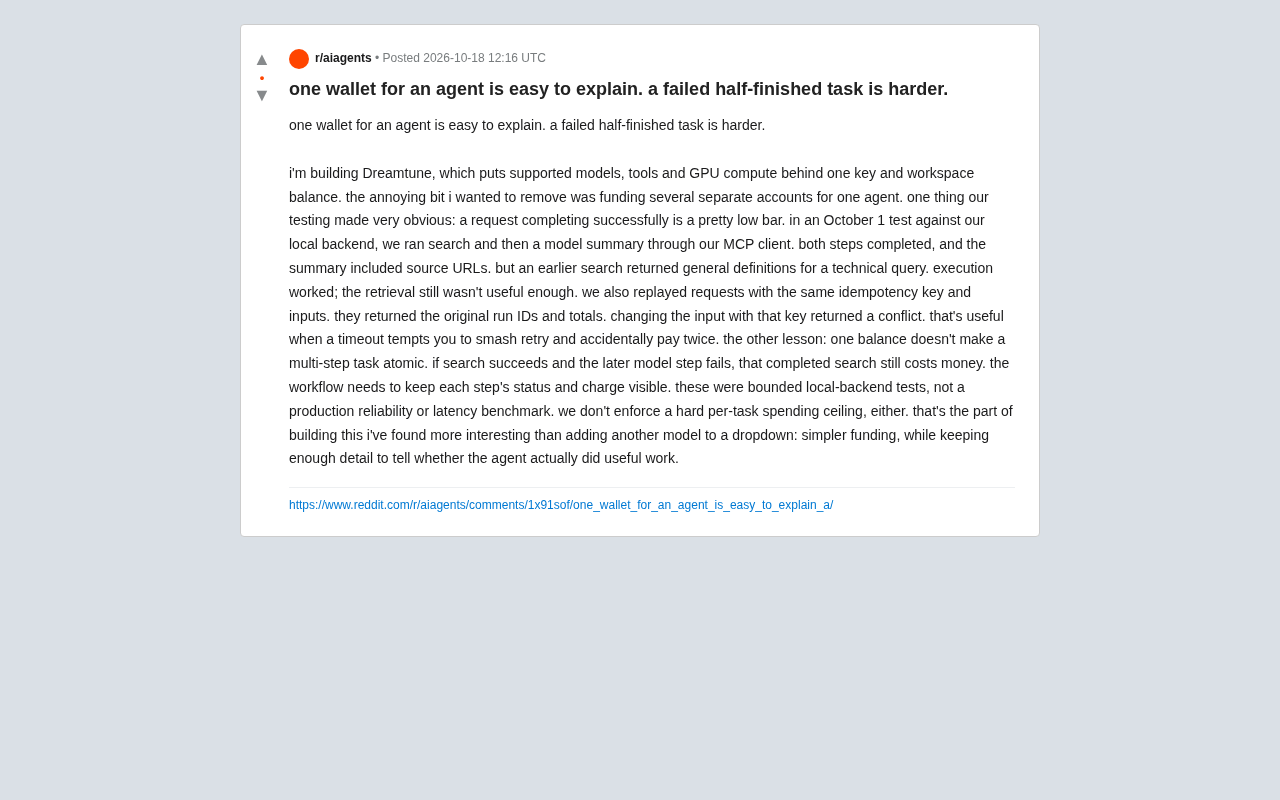
Providing agents with a single unified wallet is easy to explain conceptually: users need only one key and one workspace balance to access supported models, tools, and GPU compute. The pain point the developer building Dreamtune originally wanted to eliminate was the hassle of topping up multiple separate accounts for a single agent. However, during testing on a local backend, a thornier problem surfaced: a successfully completed request is a fairly low bar.
According to a Reddit post by the Dreamtune developer, in an October 1 test they used an MCP client to first run a search, then have the model generate a summary. Both steps completed, and the summary even included source URLs. On the surface, the entire flow executed successfully. But on closer inspection, the earlier search returned generic definitions for a technical query—execution was fine, but the retrieval results weren't useful enough. This reveals a key contradiction: the payment system can confirm that "a call happened," but it cannot automatically judge whether "the task produced value."
The Practical Value of Idempotency Keys: Preventing Duplicate Charges After Timeouts
In testing, the developer also replayed requests using the same idempotency key and the same input. The system returned the original run ID and total cost. When the same idempotency key was used but the input was changed, the request returned a conflict. This mechanism is very practical from an engineering standpoint: when a timeout makes you want to hammer the retry button, the idempotency key prevents you from accidentally paying twice for the same computation.
However, idempotency keys only solve the "duplicate request" problem—they don't address the core issue of "how to bill after a multi-step task fails." The developer explicitly noted that these tests were bounded local backend tests, not production reliability or latency benchmarks. This means the observations above are more directional than performance conclusions.
A Single Balance Doesn't Equal Atomicity
Another lesson highlighted by the testing: a single balance does not make a multi-step task an atomic operation. If the search step succeeds but the subsequent model step fails, that completed search still incurs a charge. The user's money is deducted, but the task isn't complete. The developer pointed out that workflows need to keep the status and charges of each step visible. Otherwise, users are left with a "half-finished" task and no clear way to know where their money went or which step should be held responsible for the failure.
Idempotency Key is a common design in distributed systems and payment interfaces: the client generates a globally unique string (usually a UUID) for an operation and carries the same key with every retry. After receiving the request for the first time, the server records the key and the execution result; subsequent requests carrying the same key are not actually executed but instead return the cached result directly. This way, even if a network timeout causes the client to resubmit, there will be no duplicate charges or duplicate side effects.
In AI agent scenarios, a multi-step call can take anywhere from seconds to minutes, making the probability of timeouts and retries significantly higher than with ordinary APIs. Idempotency keys thus become cost-control infrastructure. But note their boundary: they bind to a "single request," not to "the entire task." If a workflow consists of multiple independent requests—search, model generation, and so on—each request being individually idempotent does not guarantee task-level atomicity. When an intermediate step is successfully charged and a later step fails, the idempotency key can do nothing. This is exactly why the article emphasizes that "idempotency keys only solve duplicate requests, not billing for multi-step failures."
Atomicity originates from database transaction theory and refers to a set of operations either all succeeding or all having no effect, with no intermediate state of "partial completion." In payment and billing systems, atomicity is typically achieved through transactions, two-phase commit, or compensation mechanisms.
Multi-step AI tasks are inherently difficult to make atomic: each step is an independent billing call (search API, model inference, GPU compute), and there are no shared transactions among the various service providers. A unified wallet merely consolidates the "deduction account" into one; it does not consolidate the "deduction action" into a single transaction. So when the search succeeds and the model fails, the search cost has already actually been incurred and cannot be automatically rolled back. The engineering alternative is usually not to pursue strict atomicity but to adopt the Saga pattern or compensating transactions: record an explicit success/failure status and corresponding cost for each step, and when a task fails, decide according to predefined rules whether to refund or mark a sunk cost. This requires the payment layer to upgrade from "one-time deduction" to "step-by-step accounting"—exactly the billing and state tracking aligned with the task lifecycle that the article calls for.
The Missing Hard Spending Ceiling and Visibility Design
Dreamtune does not currently enforce a hard per-task spending ceiling. The developer candidly admitted that the more interesting part of the build isn't adding another model to a dropdown menu, but simplifying fund consolidation while retaining enough detail to judge whether an agent actually did useful work.
This points to a deeper need in the agent economy: the payment layer must not only be able to "collect money" but also to "keep the books"—recording status and cost by step so that sunk costs in failed tasks become traceable and explainable. For teams building multi-step AI agents, a unified wallet is only the starting point; the real challenge is designing a billing and state-tracking mechanism aligned with the task lifecycle.
These findings currently come from limited-scope local testing and have not yet been validated in production. But the observation that "a completed request doesn't mean a useful task" is already enough to make developers rethink the evaluation criteria for agent payment systems.
Hard Per-task Spending Ceiling refers to setting an insurmountable budget threshold for a single task before it begins. Once accumulated costs reach that threshold, the system immediately halts subsequent steps and rejects new billing calls, rather than merely issuing a post-hoc alert. It is the opposite of a "soft ceiling" (notifying the user when the threshold is reached but allowing continuation).
In agent scenarios, a hard ceiling is especially important because multi-step tasks can spiral out of control due to retry loops or models repeatedly calling tools. In implementation, it requires an atomic budget check and reserve before each billing, settling after the step completes and releasing the reserved amount on failure. This is closely tied to observability design: a total cap alone isn't enough—you also need to expose "how much each step cost and what its status was" so users can judge whether the sunk cost of a failed task is reasonable. Dreamtune does not currently offer this capability, which also shows that agent payment systems are still in an early stage when it comes to cost guardrails. A unified wallet only solves fund consolidation; budget control and fine-grained accounting still need to be designed separately.
One-line Summary
A unified wallet is easy to explain, but in multi-step AI tasks, the cost attribution and state visibility of half-finished failures are the real challenges.
Paragraph Summary
Based on the Dreamtune developer's local backend tests, the article explores the deeper challenges of providing AI agents with a unified wallet. In testing, a two-step task of search plus model summary appeared successful, but the retrieval quality was poor, revealing that "request completion" is only a low bar and the payment system cannot judge whether a task produced value. Idempotency keys prevent duplicate charges from timeout retries—the same input returns the original run ID and cost, while changed input returns a conflict—but they only address the single-request level and don't touch billing for multi-step failures. A single balance doesn't equal atomicity: when the search succeeds and the model fails, the search cost is still incurred, and workflows need to keep each step's status and charges visible. Dreamtune currently has no hard per-task spending ceiling, and the developer believes balancing simplified fund consolidation with retained task detail is more valuable than simply adding more model options.
Related articles

Kimi K3.1 Hands-On Test: Open-Source Model Nears Opus, Video Generation Steals the Show
Kimi K3.1 completed motion graphics, 3D rendering, mini-games, and video generation in a live test. Analysis of its 2.8T MoE architecture, gap vs Opus/GPT, and hidden video generation.

Sam Altman: Why Life's Biggest Advice Should Still Come from Humans
OpenAI CEO Sam Altman on the limits of AI advice: AI can talk you out of an impulsive email, but life's biggest advice should still come from humans.

"Black October": Did AI Uncover 3% of All Critical Vulnerabilities Ever?
A Reddit post claims 3% of all critical software vulnerabilities ever were found in the past month, dubbed 'Black October.' We break down the statistical issues, how AI-assisted code auditing accelerates discovery, and how developers should respond.