The Battle Over Open Weights Intensifies: The Interest Politics Behind AI Regulation

Is AI regulation being weaponized by closed-source vendors to suppress open-weights models like Llama and Mistral?
Illinois Governor Pritzker's executive order establishing an AI Cabinet has sparked heated debate on Reddit, with users alleging that such regulatory moves may serve the interests of closed-source API vendors — using "safety guardrails" as a pretext to raise compliance costs and suppress open-weights models like Llama and Mistral. The poster questions whether "industry leaders" calling for caution are themselves beneficiaries of closed-source dominance, raising concerns about regulatory capture. The article urges critical thinking about who truly benefits from AI regulation, while noting that no direct evidence links Illinois's policy to closed-source vendor lobbying.
Open-weights AI models are facing mounting regulatory pressure. A widely discussed Reddit post argues that state-level AI regulatory measures — exemplified by Illinois Governor J.B. Pritzker's newly established "AI Cabinet" — are proliferating rapidly, and may be concealing the interests of closed-source API vendors. This debate over open weights is spilling from the tech world onto the political stage.
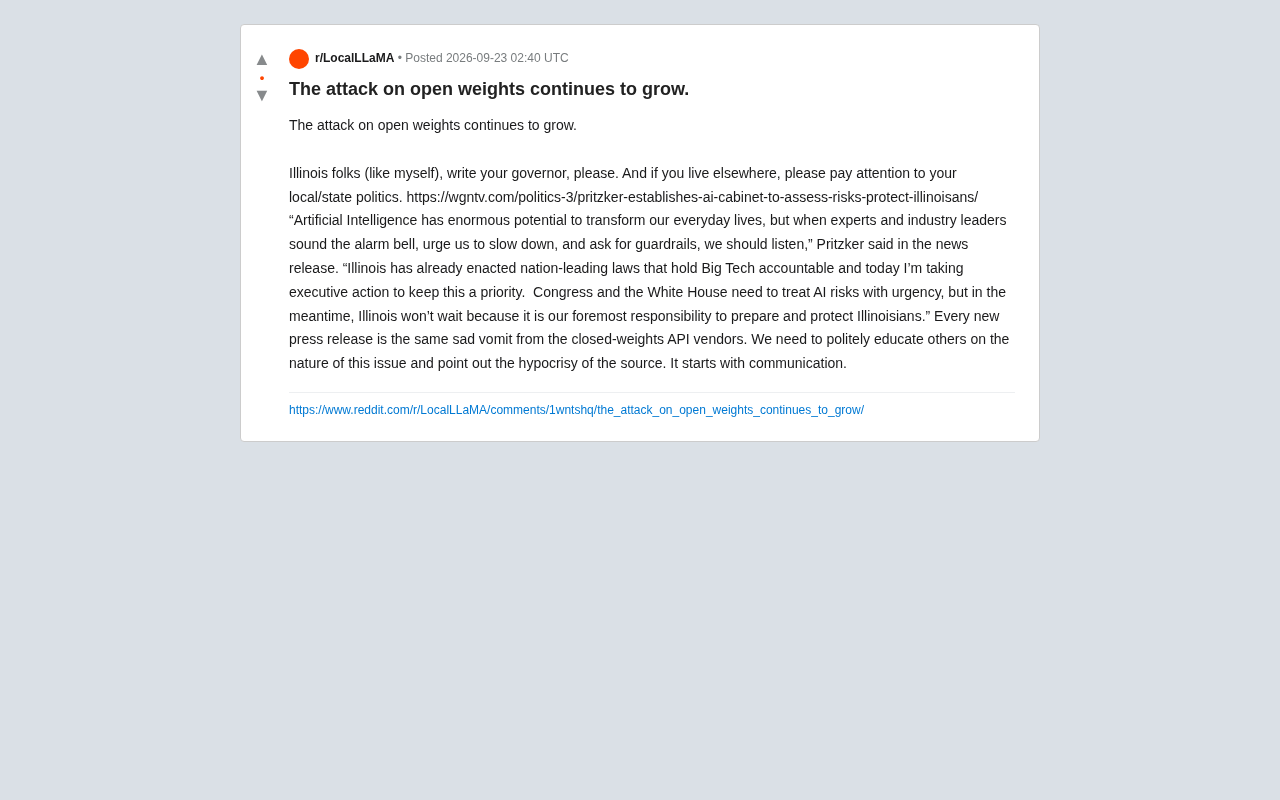
Illinois's Regulatory Move
According to WGN TV, Governor Pritzker issued an executive order establishing an AI Cabinet to assess AI risks and "protect Illinois residents." In his press release, Pritzker stated: "Artificial intelligence has enormous potential to transform our daily lives, but when experts and industry leaders sound the alarm, urging us to slow down and calling for guardrails, we should listen."
He also emphasized that Illinois has enacted "nationally leading" laws to hold big tech companies accountable, adding that "Congress and the White House need to treat AI risks with urgency, but in the meantime, Illinois will not wait."
On the surface, this looks like a routine risk-mitigation measure. But the Reddit poster argues that these policy statements share remarkably similar language, repeatedly citing "warnings from experts and industry leaders" — warnings that often originate from specific, interested parties.
The Core Tension in the Open Weights Debate
The poster chose a combative title — "The attack on open weights continues to grow" — and his central concern is this: policies framed as regulating "AI risks" may, in practice, raise compliance barriers in ways that suppress the release and distribution of open-source models.
Open-weights models are AI models whose parameters are publicly released, allowing anyone to download, run, and fine-tune them (such as the Llama and Mistral model families). They lower the barrier to accessing AI technology and allow researchers and small teams to bypass the API fees charged by large vendors.
On the other side are closed-source API vendors — companies that offer only API access without releasing model weights. The poster states plainly that every new regulatory press release reads like "the same sad vomit from the closed-weights API vendors," implying that the real drivers behind these regulatory calls are commercial companies seeking to use compliance costs to squeeze out open-source competition.
Challenging the "Hypocrisy" Behind Calls for Regulation
The sharpest point the poster raises is the "hypocrisy of the source." When the "industry leaders" advocating for "slowing down and adding guardrails" are themselves the entrenched beneficiaries of closed-source models, he argues, their safety appeals should not be accepted uncritically.
This line of reasoning is not unique in the AI community. In recent years, debate has intensified around "AI safety" and "regulatory capture" — critics worry that large AI companies will use safety as a pretext to push for rules that only they can afford to comply with, effectively shutting out open-source projects and smaller competitors.
It should be noted that this perspective represents a single Reddit user's position and provides no direct evidence that Illinois's policy was driven by closed-source vendors. Pritzker's official statements do not target open-source models specifically. Readers should therefore treat "regulation as suppression of open source" as a concern and interpretation within the community, not an established causal relationship.
From a Technical Issue to Political Engagement
Another notable feature of the post is its call to action. The poster urges Illinois residents to write to the governor, and reminds people in other regions to pay attention to local and state-level political developments. He emphasizes: "We need to politely educate others about the true nature of this issue and point out the hypocrisy of the source. It all starts with communication."
This reflects a growing awareness within the open-source AI community that the openness of model capabilities is not just a technical choice — it is increasingly a public policy issue requiring active engagement. While regulatory frameworks are still taking shape, whether the community's voice can enter legislative discussions may substantially affect the future viability of open-source models.
How to Think Critically About This Debate
For practitioners and enthusiasts who follow the AI ecosystem, this discussion offers several angles worth considering:
-
Distinguish between regulatory intent and regulatory effect: Even if a policy is genuinely aimed at mitigating risk, its real-world impact may fall asymmetrically on the open-source ecosystem — high compliance costs naturally favor well-resourced large companies.
-
Scrutinize the interests behind information sources: When "safety appeals" come from parties that stand to benefit, critical thinking is essential — but that doesn't mean dismissing all AI safety concerns as illegitimate.
-
Engage rather than observe: Regardless of which side you support, AI regulatory trajectories are being shaped right now by real legislative and executive actions. Constructive participation from the community is more valuable than passive frustration.
The open-source vs. closed-source debate, and the safety vs. openness debate, are at their core a deeper struggle over how AI technology takes root in society. While this Reddit post clearly reflects a particular viewpoint, the question it raises — who truly benefits from regulation — is one that everyone who cares about the future of AI should take seriously.
Background Notes
It is worth noting that open-weights models differ in important ways from traditional "open-source software." Open-source software typically makes all source code publicly available for anyone to audit, modify, and redistribute; open-weights models release the trained model parameters (weight files), while training data, training code, and algorithmic details are not necessarily disclosed. Take Meta's Llama series as an example: the weight files are freely downloadable, but usage is governed by a license agreement (e.g., commercial use requires an application for authorization), making it, strictly speaking, "open weights" rather than fully open source. This distinction is especially important in a regulatory context: policymakers discussing "open-source AI risks" often conflate the two concepts, leaving the actual scope of regulation ambiguous and creating rhetorical space for arguments on all sides.
"Regulatory capture" is a classic concept in political economy, referring to the process by which a regulatory agency comes to be dominated by the interests of the industry it is supposed to regulate, such that its policies serve those regulated parties rather than the public interest. The phenomenon was first systematically described by economist George Stigler in 1971. In the AI domain, concerns about regulatory capture operate on two main levels: first, large tech companies embed their preferences into regulatory frameworks through lobbying, participation in policy consultations, and funding think tanks; second, high-threshold compliance requirements (such as model safety audits and dangerous-capability assessments) objectively function as market entry barriers that benefit well-funded incumbent firms, while startups, academic institutions, and open-source communities struggle to absorb the associated costs. The EU AI Act's tiered regulation of "high-risk AI systems" and the Biden administration's AI executive order requiring developers of large models to submit safety reports have both sparked similar controversies.
Related articles

Workbuddy for Absolute Beginners: How a Desktop AI Agent Fits Into Real Workflows
A beginner's guide to the Workbuddy desktop AI agent: installation, claiming credits, file management, and building automated workflows—compared with CodeX for fit and cost, helping professionals shift from AI question-askers to AI managers.

OpenAI's New Agent Stack: Computer Use, Decisions API, and Ultra-Fast Workflows
OpenAI Dev Day unveiled a new agent stack: Computer Use outperforms humans, Decisions API delivers ultra-low-latency classification via Luna, Agents API opens the same Computer Use capabilities, and GPT-6.1 Sol costs only one-seventh of Astra. Core updates, benchmark data, and developer insights.

Liang Wenfeng Open-Sources DeepInfo Inference Framework, Takes On U.S. Ban
DeepSeek open-sources its DeepInfo inference framework after its models, featuring GPU/CPU cross-pipelining, small-model prediction with large-model verification, and full Huawei Ascend and NVIDIA chip support—facing the U.S. federal ban head-on. This article analyzes its significance for AI deployment and open-source strategy.