The Bolsonaro Coup Attempt: From Election Loss to a 27-Year Sentence

Bolsonaro lost, fled to Florida, plotted a coup, and was sentenced to 27 years in prison.
In Brazil's 2022 presidential election, Bolsonaro narrowly lost to Lula, refused to concede, and fled to Florida. His supporters stormed the presidential palace and Congress in scenes echoing the U.S. Capitol riot. Federal investigators later uncovered documents proving Bolsonaro had planned not just to incite unrest but to stage a full military coup — including an assassination plot targeting the Supreme Court justice, the president-elect, and the vice president-elect. The coup failed after two of three military branch commanders refused to participate. Brazil's Supreme Court found Bolsonaro guilty and sentenced him to 27 years and 3 months in prison, ending his political career and providing a landmark case study in how democracies can resist authoritarian challenges to election results.
Former Brazilian President Jair Bolsonaro's political career came to an end with an unprecedented trial. From refusing to concede defeat and fleeing to Florida, to the violent assault on Brasília, to a final sentence of 27 years and 3 months in prison — this chain of events sketches the full outline of a failed coup attempt. Drawing on a Last Week Tonight segment, this article reconstructs that turbulent political journey.
The Defeat and the Escape: A World Leader's Ignominious Exit
In the presidential election, Lula defeated incumbent President Bolsonaro by a margin of less than two percentage points. Bolsonaro's response to the loss was anything but graceful — he never formally conceded, and he left Brazil before the new president's inauguration, flying to Orlando, Florida.
In Florida, the former president cut a rather sorry figure. He was spotted taking selfies with fans, standing in line at Publix, and at one point photographed eating fried chicken straight from the box while seated. The show's host quipped that the scenes looked less like a world leader in exile and more like "the world's saddest warehouse employee on a lunch break."

Meanwhile, the situation inside Brazil was heating up. Bolsonaro's supporters flooded the streets in mass protests, demanding that the military overturn the election results. That simmering tension eventually exploded into an event that shocked the world.
Luiz Inácio Lula da Silva's election victory carried special historical weight. He had previously served as Brazil's president from 2003 to 2010, but was imprisoned in 2018 on corruption charges and stripped of his eligibility to run for office. In 2021, Brazil's Supreme Court ruled that the court that had convicted him lacked jurisdiction, restoring his political rights and allowing him to run again. This meant Bolsonaro, as a sitting president, lost to a man who had been behind bars — already a dramatic turn in Brazilian political history, and one that helps explain why Bolsonaro's camp so fiercely questioned the legitimacy of the results.
The Brasília Assault: A Disturbingly Familiar Scene
The fervor of the protests eventually turned violent. Thousands of demonstrators stormed the presidential palace and Congress building in the capital, Brasília, in scenes that bore a striking resemblance to the U.S. Capitol riot two years earlier. Rioters clashed with police, tear gas filled the air, government buildings were vandalized, and everyone involved insisted Bolsonaro had not truly lost the election.
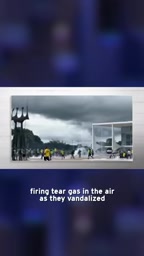
The show captured the historical echo in a single quip: "History doesn't repeat itself, but sometimes it gets dubbed into Portuguese." The analogy was pointed — the same narrative logic, the same refusal to accept defeat, just playing out in a different country. It's worth noting that at the time of the assault, Bolsonaro himself was in Florida.
From Incitement to Coup: The Full Plot Exposed
As the investigation deepened, the full picture began to emerge. What Bolsonaro and those around him had done went far beyond simply tolerating the protests. He was soon formally placed under investigation on suspicion of inciting the unrest.

Months later, federal police made a major discovery: Bolsonaro hadn't merely been stoking a riot — he had been orchestrating a full-scale military coup. Investigators uncovered a trove of documents that included an assassination plan targeting Supreme Court Justice Moraes, President-elect Lula, and Vice President-elect Geraldo Alckmin. More astonishing still, this plan had been printed out on a computer inside the presidential palace by one of Bolsonaro's former military aides.

The show's commentary was razor-sharp: the entire operation was "thoroughly documented and thoroughly incompetent." They actually printed the coup plan out — which, as any reasonable person might note, is about the worst possible way to keep a military coup secret. It creates a completely unnecessary paper trail.
Justice Alexandre de Moraes is a key figure for understanding this political crisis. He serves on Brazil's Federal Supreme Court (STF) and also served as president of the Superior Electoral Court (TSE), overseeing the 2022 election. During Bolsonaro's presidency, Moraes had repeatedly ordered the takedown of social media accounts spreading election misinformation and launched investigations into the Bolsonaro camp — making him a long-standing adversary. Bolsonaro publicly accused him of abusing his power, while Moraes became the top target of the coup plotters. This was no coincidence: seizing control of the Supreme Court was considered central to the takeover plan.
Why the Coup Failed — and How It All Ended
Fortunately, the plan to overturn the election results and seize control of the Supreme Court ultimately collapsed. The critical reason: the top commanders of two out of the three armed services refused to participate. It should be noted that Bolsonaro himself was not charged in connection with the assassination component of the plan.
But once the broader evidence of the coup plot surfaced, Brazil's Supreme Court ordered Bolsonaro to stand trial. He was found guilty and sentenced to 27 years and 3 months in prison — a ruling that also bars him from running for president again.
This case is not only the end of Bolsonaro's personal political ambitions; it has become a landmark example of how democratic institutions can come under threat in today's world. It demonstrates the role that the judiciary and portions of the military can play as counterweights at critical moments, and it serves as a reminder of just how far the posture of refusing to accept election results can push a country toward the abyss.
Brazil's constitution assigns the armed forces a role in upholding "constitutional order" under certain conditions — a vague clause that has historically been invoked to justify military intervention. Brazil endured a military dictatorship from 1964 to 1985, a period that remains a raw nerve in Brazilian society. Bolsonaro, himself a former military officer, deliberately cultivated ties with the military throughout his presidency and repeatedly hinted that the armed forces might intervene if things got out of hand. Yet at the crucial moment, the top commanders of two of the three military branches chose to stand aside. This signals that Brazil's military establishment is not a monolith, and that the legitimacy of civilian government still holds meaningful support within its ranks — a factor many analysts regard as the decisive variable in the survival of Brazilian democracy.
Related articles

Workbuddy for Absolute Beginners: How a Desktop AI Agent Fits Into Real Workflows
A beginner's guide to the Workbuddy desktop AI agent: installation, claiming credits, file management, and building automated workflows—compared with CodeX for fit and cost, helping professionals shift from AI question-askers to AI managers.

OpenAI's New Agent Stack: Computer Use, Decisions API, and Ultra-Fast Workflows
OpenAI Dev Day unveiled a new agent stack: Computer Use outperforms humans, Decisions API delivers ultra-low-latency classification via Luna, Agents API opens the same Computer Use capabilities, and GPT-6.1 Sol costs only one-seventh of Astra. Core updates, benchmark data, and developer insights.

Liang Wenfeng Open-Sources DeepInfo Inference Framework, Takes On U.S. Ban
DeepSeek open-sources its DeepInfo inference framework after its models, featuring GPU/CPU cross-pipelining, small-model prediction with large-model verification, and full Huawei Ascend and NVIDIA chip support—facing the U.S. federal ban head-on. This article analyzes its significance for AI deployment and open-source strategy.