The Border Is Everywhere: How Security Surveillance Technology Is Infiltrating Everyday Life

Security surveillance technology is spreading from national borders into every corner of society, eroding civil liberties.
The security industry leverages "fear economy" logic, using immersive violent scenario marketing to amplify social insecurity and drive surveillance technology expansion from traditional borders into cities, schools, and commercial spaces. The deep fusion of AI and surveillance shifts systems from passive recording to active prediction, but algorithmic bias and function creep seriously threaten civil rights. Society urgently needs public dialogue on the boundaries between security and freedom, supported by legislative governance.
Gunshots Echoing Through the Convention Center: The Marketing Floor of the Security Industry
Nobody flinches at the gunshots echoing through the convention center. They're realistic enough—accompanied by screams, like extras from Law & Order—these recordings recreate scenarios ripped from news headlines: kidnappings, shootings, violent attacks… But this isn't a crime scene. It's an immersive demonstration at a security technology exhibition.
This unsettling opening comes from an in-depth report examining the expansion of modern border and security technologies. It reveals a profound shift quietly underway: the surveillance and security infrastructure that once existed only at national borders is spreading into every corner of society at an unprecedented pace.
Global security technology exhibitions have formed a massive industrial ecosystem. In the United States alone, the International Security Conference & Exposition (ISC West) attracts over 30,000 professionals annually, showcasing products ranging from physical security to cybersecurity. These trade shows aren't just product launch platforms—they're critical channels for influencing government procurement decisions. Immersive demonstrations at these events—simulating school shootings, terrorist attacks, and similar scenarios—have become standard marketing tactics designed to make decision-makers feel the urgency of threats on an emotional level, thereby shortening procurement cycles. The rise of this marketing approach is directly linked to the frequency of school shootings in America; after every major incident, security equipment orders spike noticeably.
The Concept of "Border" Is Being Redefined
From Geographic Boundary to Invisible Surveillance Network
Traditionally, a "border" was a clear geographic dividing line—a physical boundary between nations. But with the rapid advancement of security surveillance technology, the concept of the border has undergone a fundamental transformation.
It is no longer merely a line on a map. It has become an invisible network woven from cameras, sensors, algorithms, and databases. This network blankets city streets, airport corridors, school hallways, and even our phone screens.
The kidnapping simulations at security technology exhibitions are a microcosm of this expansion. The security industry no longer serves only border agencies—its client list has expanded to include municipal governments, school districts, commercial real estate developers, and private enterprises. Every public safety incident becomes an opportunity to pitch new products; every fear-inducing headline is converted into a sales talking point.
The Fear Economy: The Underlying Business Logic of the Security Industry
Behind this expansion lies a clear commercial logic. The security industry deeply understands how the "fear economy" operates: first, stimulate potential clients' sense of insecurity by recreating realistic scenes of violence, then offer technological solutions as the "antidote."
The concept of the "fear economy" can be traced back to sociologist Barry Glassner's 1999 book The Culture of Fear, in which he systematically analyzed how media, politics, and commerce collaborate to amplify public fear for profit. Within the security industry context, this logic was pushed to its extreme after 9/11—the establishment of the U.S. Department of Homeland Security gave birth to a homeland security market now worth over $80 billion annually. Scholar Naomi Klein termed this "disaster capitalism" in The Shock Doctrine: crises become windows for capital expansion, and fear becomes a commodity that can be priced and traded.
The gunshots and screams playing in convention centers are, in essence, carefully designed marketing strategies. They make visitors viscerally feel the "reality" of the threat, making them more willing to accept hefty security equipment procurement budgets.
This model has created a self-reinforcing cycle:
- Social insecurity generates demand for security
- The security industry amplifies insecurity to expand its market
- More security infrastructure reinforces the narrative that "we live in danger"
Fear creates demand, demand spawns products, and products reinforce fear—this closed loop makes the security industry one of the few sectors that can continuously profit from social anxiety.
The Deep Fusion of AI and Surveillance Technology
From Passive Recording to Active Prediction: The Leap of Intelligent Surveillance
The most significant trend in the current security technology landscape is the deep integration of artificial intelligence with traditional surveillance methods. Facial recognition, behavioral analysis, predictive policing algorithms—technologies that once existed only in science fiction films are now standard exhibits at security trade shows.
The addition of AI has enabled a qualitative leap in surveillance: systems no longer merely record what has happened passively—they attempt to actively predict what is about to happen. A person's walking trajectory in a shopping mall, their dwell time, their facial expressions—all can be analyzed by algorithms in real time and flagged as "anomalous."
Representative predictive policing systems include PredPol (now renamed Geolitica) and HunchLab. Their core technical principle involves feeding historical crime data, geographic information, temporal patterns, and other inputs into machine learning models to generate crime hotspot prediction maps. However, these systems face fundamental methodological flaws: historical crime data reflects "recorded crime" rather than "actual crime," and recorded crime is heavily dependent on police deployment density. This means algorithms form feedback loops—the more heavily patrolled a community is, the more crime gets recorded there, and the more the algorithm recommends increased patrols in that area. In 2020, the Los Angeles Police Department announced it would stop using PredPol under sustained pressure from civil society organizations.
This capability enhancement is impressive on a technical level, but raises profound ethical concerns—when machines begin to "prejudge" human behavior, who judges whether the machine's judgment is fair?
Technological Neutrality Is an Illusion
Proponents of security technology often emphasize its "neutrality"—it's just a tool, and what matters is who uses it. But reality is far more complex.
Multiple independent studies have repeatedly demonstrated:
- Facial recognition systems have significantly higher misidentification rates for ethnic minorities
- Predictive policing algorithms tend to direct more law enforcement resources toward communities already subject to over-surveillance
- Training datasets carry historical biases that are inherited and even amplified by algorithms
The "Gender Shades" study published in 2018 by MIT Media Lab researcher Joy Buolamwini was a milestone in this field. The research found that facial recognition systems from IBM, Microsoft, and Face++ had error rates as high as 34.7% for dark-skinned women, compared to just 0.8% for light-skinned men. This disparity stems from representational imbalances in training datasets—early datasets like LFW (Labeled Faces in the Wild) contained over 77% male faces and over 83% white faces. A large-scale test by the National Institute of Standards and Technology (NIST) in 2019 further confirmed that in one-to-one matching scenarios, false positive rates for African and Asian faces were 10 to 100 times higher than for white faces.
Biases embedded in algorithms, imbalances in datasets, and power asymmetries in deployment decisions all mean these technologies are far from neutral in actual operation. As the "border" extends from national boundaries to every street corner, decisions about who is considered a "threat" and who is allowed to move freely are increasingly handed over to algorithms—and the decision-making process of these algorithms is often a black box.
Social Costs and the Struggle for Civil Rights
The Balance Between Security and Freedom Is Tilting
The reality of "borders everywhere" pushes the classic tension between security and freedom to new heights. When every public space can become a surveillance node, when every trip may be recorded and analyzed, citizens' rights to privacy and freedom of movement are being continuously eroded.
What's even more alarming is that this erosion often occurs under the banner of "protection." People are told that surrendering some privacy is the necessary price for security. But history has repeatedly shown that once surveillance infrastructure is established, its uses rarely remain confined to the scope originally claimed. Databases built for counter-terrorism may be used to track protesters; cameras installed for campus safety may be used to monitor teachers' speech.
This phenomenon is academically known as "Function Creep"—the gradual use of a technology system for purposes beyond its original design intent. Typical cases include: the UK's Automatic Number Plate Recognition (ANPR) system, initially built to track stolen vehicles, later used to monitor the movements of environmental protesters and journalists; the NSA's metadata collection program, originally authorized in the name of counter-terrorism, whose true scale was revealed by Snowden to far exceed counter-terrorism needs; China's social credit system, which started with financial credit reporting and gradually expanded to comprehensive scoring of citizens' daily behavior. These cases collectively demonstrate that once surveillance infrastructure is built, the expansion of its uses is an almost irreversible institutional inertia.
We Urgently Need a Public Conversation
Facing the limitless expansion of security surveillance technology, society needs to engage in a serious public dialogue:
- The cost question: How much freedom are we willing to sacrifice for security?
- The power question: Who has the authority to decide where surveillance devices are deployed?
- The accountability question: What kind of independent review should algorithmic decisions be subject to?
- The boundary question: What legal limits should be placed on the scope of security technology applications?
Notably, global legislative practice is already responding to these questions. The EU's AI Act, passed in 2024, classifies real-time remote biometric identification systems as "high-risk" and in principle prohibits real-time facial recognition in public spaces, retaining only a very limited number of exceptions. The United States presents a pattern of federal-level absence with local jurisdictions leading the way—cities like San Francisco, Boston, and Minneapolis have passed legislation banning government use of facial recognition technology, but there is still no unified federal legislation. Illinois's Biometric Information Privacy Act (BIPA) has become the most deterrent state-level regulation because it allows individuals to file lawsuits, resulting in Facebook (now Meta) paying a $650 million settlement. These legislative practices show that the public conversation on technology governance is moving from theory to institutionalization.
These questions have no simple answers, but the cost of avoiding them may be greater than we imagine. Every day of silence means the surveillance network extends one step further.
Finding Boundaries in a World of Ubiquitous Surveillance
The gunshots in the convention center will eventually stop, but the trend they represent will not.
As borders spread from national boundaries to every corner of our lives, as security technology evolves from a protective tool into an omnipresent surveillance network, each of us needs to seriously consider a question: in this world where "the border is everywhere," are we truly safer—or have we simply grown accustomed to being watched?
Technology itself won't answer this question. The answer depends on what boundaries we, as a society, are willing to draw—and the first step in drawing boundaries is recognizing that they are disappearing.
Related articles
Meta Muse Hits 900K Downloads in Six D…
Meta Muse Hits 900K Downloads in Six Days: The AI Agent Era Has Officially Arrived
Meta's AI agent Muse hit 902K downloads in 6 days, topping US App Store and Google Play charts above ChatGPT and Claude. A deep dive into Muse's capabilities and the AI Agent race.
 Industry Insights
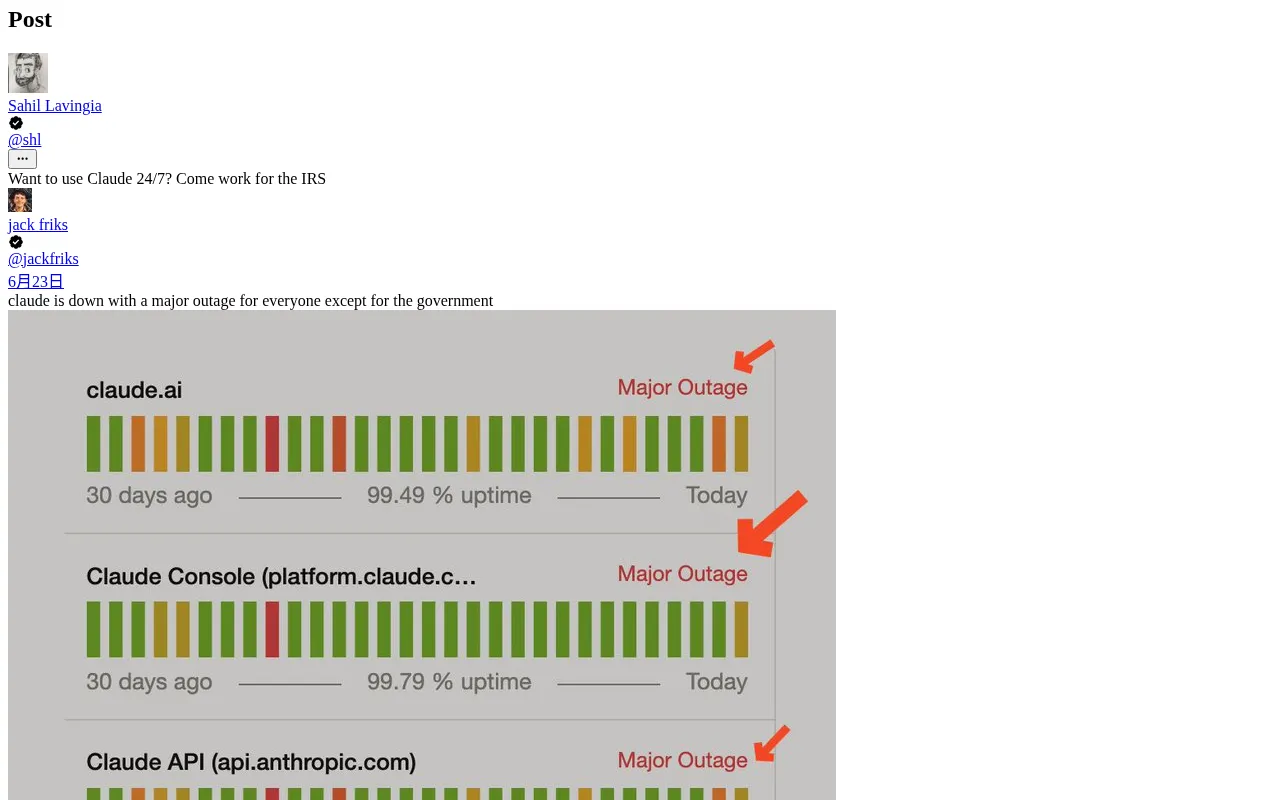
IRS Fully Embraces Claude AI, Accelerating Federal Government's AI Adoption
The IRS is recruiting staff with 24/7 Claude AI access, marking Anthropic's breakthrough into the federal government. Explore the strategic implications and tax use cases.
 Industry Insights
The IRS Mobile App Debate: A Trust Crisis in Government Digital Transformation
The IRS's proposed mobile app has sparked heated debate. This article analyzes the core arguments, exploring data security, privacy, and the trust crisis in government digital transformation.