The Cognitive Divide of AI Anxiety: Why Is Online Panic So Detached from Offline Calm?

Tim Urban's tweet reveals the cognitive divide between online panic and offline calm in AI discussions, analyzing its causes and how to cope.
Starting from a resonant Reddit post, the article uses Tim Urban's tweet to describe a common experience: after intensively consuming AI discussions, stepping away from the screen reveals a calm world, raising doubts about whether it's an information bubble or an unawakened public. It attributes this divide to uneven technology diffusion and media amplification with emotional contagion. The article suggests that this dissonance itself is a valuable reminder—online offers a forward-looking view but over-focuses on extremes, while offline provides a reality baseline but may lag. It recommends comparing real adoption data and broadening information sources, noting that acknowledging the tension is more meaningful than forcibly resolving it.
In the r/meirl subreddit, a post struck a widespread chord: it quoted a tweet from Tim Urban (author of Wait But Why), describing a increasingly common cognitive dissonance—when you finish scrolling through a round of intense discussions about AI, then step outside, only to find the world around you calm and ordinary, with no one showing any sign of anything unusual. This sense of dislocation makes you wonder: are we trapped in a paranoid information bubble, or has the public simply not woken up yet?
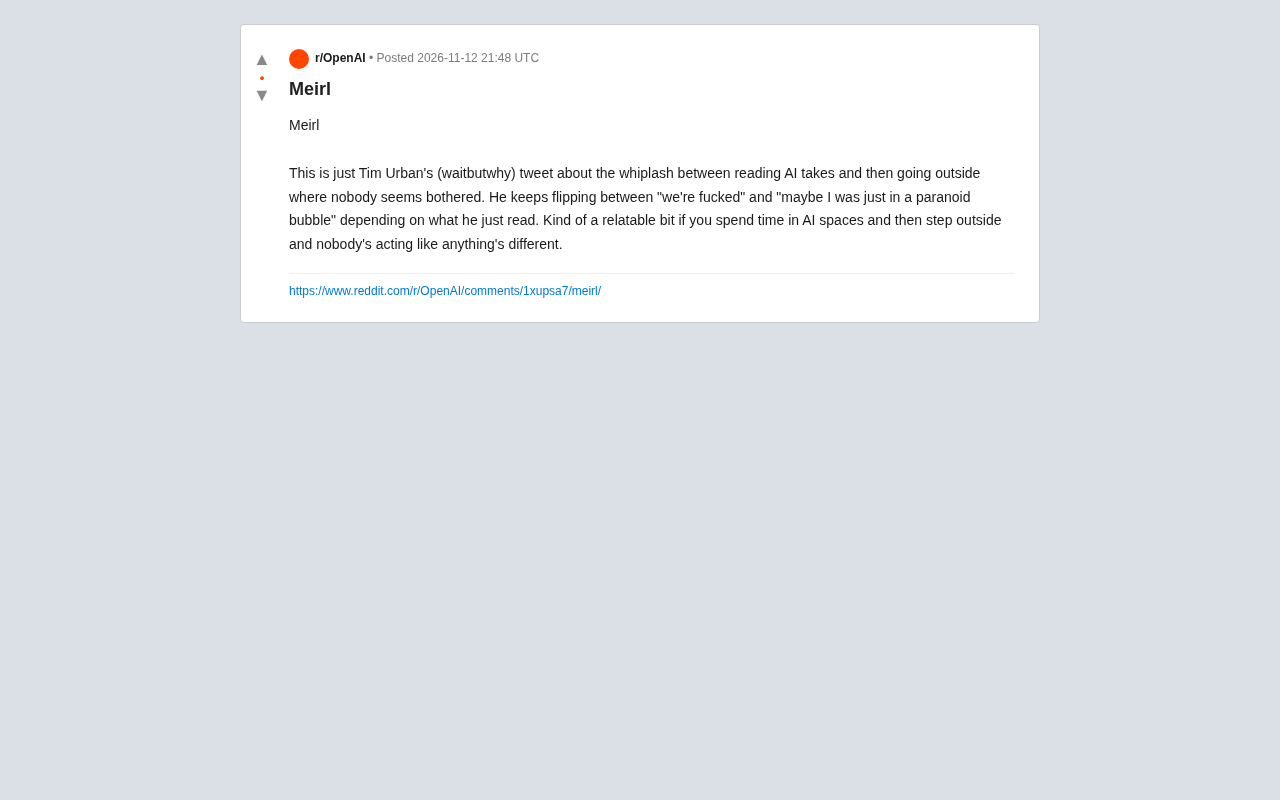
The Disconnect Between Online Panic and Offline Calm
What Tim Urban captured in his tweet is a typical "information environment switch" experience. In AI communities, tech media, or social platforms, discussions about AGI, waves of job losses, and existential risks are extremely dense, and the language is often charged with urgency. Yet the moment you leave the screen, the real world—cafés, streets, offices—seems utterly unruffled. This contrast creates an absurd sense of drama and keeps you swinging between two emotions: one moment you feel "we're doomed," the next you think "maybe I'm just getting worked up over nothing."
This oscillation is not unfounded. The information cocoon effect is especially pronounced in the AI space—algorithmic recommendations amplify extreme views, and professional discussions tend to concentrate within specific circles. When these voices make up the vast majority of your information intake, they become the default background noise through which you perceive the world.
Why Does This Cognitive Dislocation Occur?
The Uneven Diffusion of Technology
The penetration rate of AI technology varies enormously across industries and regions. Tech workers may use Copilot and ChatGPT every day, while people in traditional industries may not encounter them once a month. This imbalance creates a "time lag" in how the same technological shift is perceived. Participants in online discussions are often early adopters, whose anxiety is built on daily hands-on experience, while the calm of the offline public stems from a pace of life that has not yet been directly disrupted by the technology.
Diffusion of Innovations theory, proposed by sociologist Everett Rogers in 1962, divides adopters of new technology into five stages: innovators, early adopters, early majority, late majority, and laggards, with significant time gaps between groups. This model explains why the same AI technology is already an everyday tool in tech circles but remains a distant topic in traditional industries. Rogers also noted that technology diffusion typically follows an S-shaped curve: slow penetration at first, accelerating after crossing a critical threshold, and eventually leveling off. AI's penetration in many fields is still in the early part of the S-curve, which is precisely the structural reason why "online is already boiling while offline remains calm." In addition, the "chasm" theory in the technology adoption lifecycle also suggests a cognitive and trust gap between early adopters and the mainstream public.
Media Amplification and Emotional Contagion
Tech media and KOLs tend to report the most impactful viewpoints, because fear and controversy attract more attention. Tim Urban's own tweet is an example—he openly admits to swinging back and forth between two emotions, which in itself demonstrates the power of media content to shape emotions. When you consume this kind of content intensively over a short period, it's easy to develop the illusion that "crisis is imminent," while the slow pace of the real world provides a counterpoint.
Information Cocoon, proposed by Harvard Law School professor Cass Sunstein in his 2006 book Infotopia, refers to people's tendency to seek out information that pleases them and confirms their existing views, eventually trapping themselves in a closed information environment. In the age of algorithmic recommendation, this phenomenon has been greatly intensified: platforms continuously feed homogeneous content based on user profiles, making the exposure frequency of certain viewpoints far higher than their actual distribution in reality. Closely related to the information cocoon is the echo chamber effect, where similar views resonate repeatedly and become increasingly polarized within closed circles. Understanding these two concepts helps explain why the urgent narrative of the AI community seems overwhelming online yet almost silent offline—online density is the result of algorithmic filtering, not a mapping of genuine social consensus.
Emotional Contagion is a classic concept in social psychology, referring to the unconscious imitation and internalization of emotional states when individuals observe others' emotional expressions. In social media environments, this contagion is significantly amplified due to the speed of transmission and instant feedback. Paired with this is Negativity Bias: humans naturally pay more attention to and remember threatening information more strongly than neutral or positive information, so media tend to amplify fear and controversy to compete for attention. Availability Heuristic further causes frequently encountered extreme narratives to be overestimated in judgment, creating a subjective probability illusion that "crisis is right around the corner." Together, these three form the psychological mechanism behind the dense spread of online AI panic narratives and their continuous shaping of individual emotions.
What Does This Sense of Dislocation Mean?
From a positive perspective, this cognitive dissonance is actually a reminder: neither should you be fully immersed in online narratives, nor should you underestimate the long-term impact of technological change just because things are calm offline. Online discussions provide a forward-looking perspective but may focus excessively on extreme scenarios; offline life provides a reality baseline but may lag behind change.
For content creators and tech professionals, acknowledging the existence of this dissonance is valuable in itself. It shows that AI topics have not yet become a regular part of public conversation, and public awareness is still at an early stage. This means both enormous room for communication and the possibility that panic narratives may not spread as rapidly as they do online.
How to Navigate Between Two Realities?
Tim Urban's tweet resonated because it honestly portrays an unstable psychological state. Rather than forcing yourself to choose between "panic" and "calm," it's better to accept that this oscillation is itself the norm of the information age. A practical approach: regularly compare online discussions with real-world adoption data and the genuine feedback from people around you, so that no single information source dominates your judgment.
In addition, being aware of the existence of "information bubbles" and actively broadening the diversity of your information intake can also reduce the anxiety caused by cognitive dissonance. For example, beyond following cutting-edge AI discussions, also pay attention to application cases in traditional industries, the slow process of policymaking, and the everyday usage feedback of ordinary users. These perspectives help build a more three-dimensional cognitive picture.
Ultimately, online panic and offline calm are both part of the real world, and the tension between them precisely reflects the incomplete social diffusion of technological change. Acknowledging this dissonance is more meaningful than forcibly resolving it.
One-line Summary
Tim Urban's tweet reveals the cognitive divide between online panic and offline calm in AI discussions, and analyzes its causes and how to cope.
Paragraph Summary
The article starts from a resonant post on Reddit, using Tim Urban's tweet to describe a common contemporary psychological experience: after intensively consuming AI discussions, you step away from the screen only to find the real world calm and ordinary, sparking doubts about whether it's an "information bubble or an unawakened public." The article points out that this dissonance stems from two aspects: first, the uneven diffusion of technology—there is a time lag in how tech workers and traditional industry workers perceive AI's impact; second, media amplification and emotional contagion—fear narratives attract more attention and shape readers' emotions. The article argues that this sense of dissonance itself has value as a reminder—online provides a forward-looking perspective but tends to over-focus on extreme scenarios, while offline provides a reality baseline but may lag. Finally, it suggests reducing anxiety by comparing real adoption data and broadening information sources, and notes that acknowledging the tension is more meaningful than forcibly resolving it.
Related articles

Abnormal Error Rate Spike in Claude Mythos 5.2 and Fable 5.2
Claude Mythos 5.2 and Claude Fable 5.2 show an abnormal spike in request error rates, marked as investigating on the official status page. This article covers the incident overview, practical impact on developers, and recommended responses.

ReAct Runtime Context Trimming: Why Claude Code Acts at 70%
A deep dive into ReAct runtime context trimming: why Claude Code compresses at ~70% usage, why tool calls dominate, why messages must be dropped in pairs, and why codebases don't need RAG.

AI Agent vs LLM: How Cursor and Claude Code Actually Work
An in-depth analysis of the essential difference between AI Agents and LLMs: LLMs generate code suggestions, while Agents modify files and run tests via tool calls. Using a Spring Boot bug fix as an example, it breaks down the workflows, permission control, and verification mechanisms of Cursor and Claude Code.