The Complete AI Agent Development Roadmap: A Four-Stage Guide from Zero to Production

A four-stage roadmap for mastering AI Agent development from core theory to production deployment.
This guide breaks down AI Agent development into four progressive stages: mastering LLM fundamentals and the three core modules (Planning, Memory, Tool Use); understanding ReAct and CoT paradigms; advancing with reinforcement learning and multi-agent collaboration; and finally implementing real-world projects to solidify skills and build a competitive portfolio.
Why AI Agent Development Is the Core Competency of the LLM Era
As large language models continue to evolve at a rapid pace, simple API calls and basic prompt engineering are no longer scarce skills. What truly sets developers apart is the ability to independently build intelligent Agents.
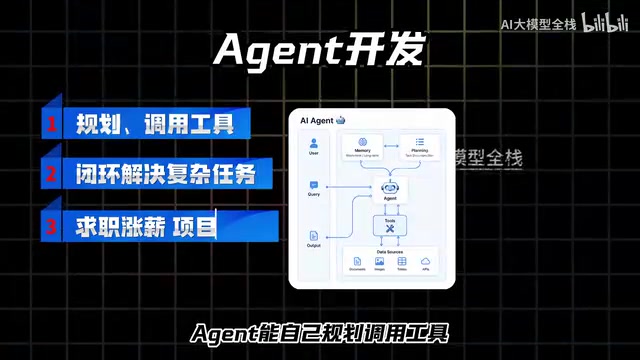
The biggest difference between an Agent and a traditional AI application lies in autonomy and goal-orientation. Traditional AI applications are essentially "stimulus-response" systems: given an input, return an output, with each interaction being independent. An Agent, by contrast, can autonomously plan tasks, invoke external tools, and form closed-loop feedback cycles to solve complex problems — all without step-by-step human instruction. Agents in the LLM era are especially powerful because the LLM serves as the "brain," providing robust natural language understanding and reasoning capabilities that allow Agents to handle open-ended, unstructured, complex tasks rather than being constrained by predefined rule-based workflows.
Whether you're looking to stand out in job applications, take on freelance projects, or build complete intelligent products, Agent development has become an essential hard skill. The earlier you systematically master it, the better positioned you'll be to ride this technological wave. This article outlines four key stages for building an AI Agent from scratch.
Stage 1: Build a Solid Foundation — Master Core Agent Theory
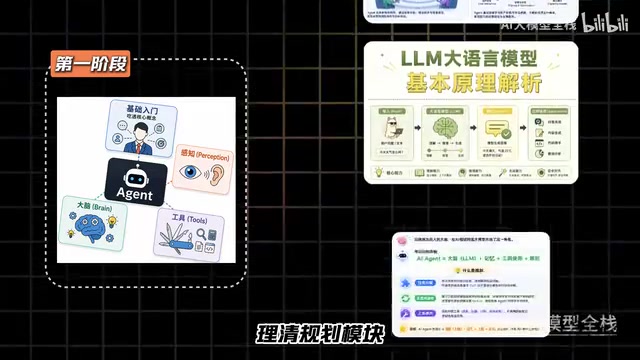
Many people rush to write code while neglecting the underlying logic of Agents, which causes them to hit a wall later on. The focus of Stage 1 is building fundamentals — truly understanding what an Agent is and what core components it consists of.
Understanding LLMs and the Three Core Modules
At this stage, you need to become familiar with how large language models (LLMs) work at a basic level, and clarify the three core modules of an AI Agent:
- Planning Module: Responsible for breaking down complex tasks into executable sub-steps — this is the core of an Agent's autonomy. Technically, it relies on Task Decomposition, including hierarchical planning and self-reflection mechanisms. Representative methods include HuggingGPT and the Plan-and-Execute framework.
- Memory Module: Enables the Agent to retain context and interaction history, supporting coherent execution of long-horizon tasks. Technically, this breaks down into four types: sensory memory (current context window), short-term memory (In-context Learning), long-term memory (external vector databases like Pinecone and Chroma), and parametric memory (knowledge encoded in model weights).
- Tool Use: Gives the Agent the ability to interact with the external world — such as searching the web, performing calculations, or calling APIs. OpenAI formalized the Function Calling mechanism in 2023, allowing models to output structured function call instructions that are executed by external systems, with results returned to the model to form a perception-action loop.
These three modules weren't invented from scratch — they are an engineering mapping of human cognitive architecture. Planning corresponds to the executive functions of the prefrontal cortex, memory corresponds to the hippocampus and long-term memory systems, and tool use corresponds to the human instinct to extend capabilities through the use of instruments. Internalizing these foundational concepts into your own cognitive framework is the only way to lay a solid groundwork for everything that follows.
Stage 2: Core Advancement — Master ReAct and CoT Paradigms
With the basics in place, Stage 2 is about moving from "understanding concepts" to "understanding principles." The key here is developing a deep understanding of how Agents actually work, and learning to tackle the real challenges you'll encounter in development.
ReAct and CoT: The Two Core Paradigms of Agent Development
This stage requires a solid grasp of two classic Agent paradigms:
-
CoT (Chain of Thought): Introduced by the Google Brain team in 2022 in the paper "Chain-of-Thought Prompting Elicits Reasoning in Large Language Models." The core finding: when models are asked to "think step by step," accuracy on arithmetic and commonsense reasoning tasks improves dramatically. This revealed the emergent abilities of large models — capability leaps that appear suddenly once a model exceeds a certain scale threshold. CoT guides models to reason step by step, significantly improving performance on complex problems.
-
ReAct (Reasoning + Acting): Proposed by Yao et al. in 2022. Its innovation was interleaving CoT's internal reasoning chain with external environment interactions (Actions), forming an iterative "Thought → Action → Observation" loop. This paradigm addresses the disconnect between pure reasoning models and the real world — the model no longer just "thinks," it can "act" and refine its approach based on real feedback. Mainstream Agent frameworks like LangChain and AutoGPT both use ReAct as their core operating logic.
Mastering these two paradigms gives you a true understanding of why Agents work the way they do, which paradigm to choose in a given scenario, and the ability to independently debug and optimize when problems arise — rather than just copying example code.
Stage 3: Advanced Optimization — Improve Outputs and Multi-Agent Collaboration
Once you're comfortable building individual Agents, Stage 3 focuses on optimizing output quality and moving toward multi-agent collaboration.
Reinforcement Learning and Prompt Tuning
This stage has two main focus areas.
First, incorporating Reinforcement Learning (RL) to continuously optimize an Agent's decision-making quality through feedback mechanisms. Practical applications include: RLHF (Reinforcement Learning from Human Feedback), which OpenAI used to train ChatGPT for alignment with human preferences; RLAIF (Reinforcement Learning from AI Feedback), where another model replaces human annotators to provide feedback signals at lower cost; and Self-Play mechanisms, where an Agent accumulates experience through repeated trial and error in a simulated environment.
Second, mastering Prompt tuning techniques — including few-shot example optimization, chain-of-thought template design, and output format constraints — so your Agent produces more precisely the results you actually want. Combining RL with prompt tuning can significantly improve an Agent's usefulness and stability without retraining the underlying model.
Multi-Agent Collaboration
The core design challenges in multi-agent systems involve two dimensions: role allocation and coordination mechanisms. Common role allocation patterns include:
- Hierarchical: One Orchestrator Agent directs multiple Worker Agents — as seen in MetaGPT's "software company" role system (product manager, architect, engineer, etc.).
- Parallel: Multiple peer-level Agents each independently handle sub-tasks and then aggregate results.
- Debate-style: Multiple Agents provide different perspectives on the same problem and challenge each other, improving answer quality.
For coordination, inter-Agent communication is typically implemented via shared message queues or a Blackboard System. Mainstream frameworks like AutoGen (Microsoft) and CrewAI have already productionized multi-agent collaboration, significantly lowering the barrier to building complex intelligent systems. The core value here is that while a single Agent is constrained by its context window and capability limits, a multi-Agent system can overcome those single-point bottlenecks through specialization and handle truly complex end-to-end business workflows.

Stage 4: Real-World Implementation — Connect to Actual Business Scenarios
No matter how well you understand the theory, it all has to land in a real project. The focus of Stage 4 is production implementation — integrating everything from the first three stages and completing two to three full AI Agent projects hands-on.
Recommended Project Directions
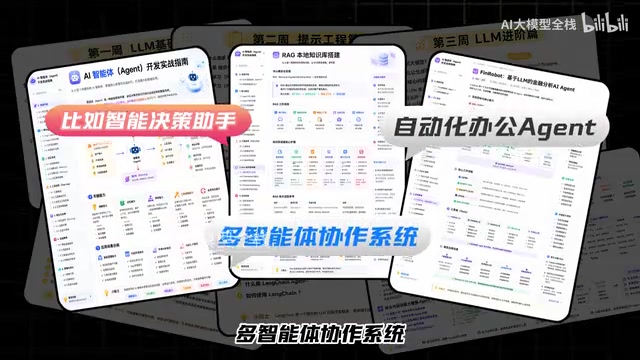
- Intelligent Decision Assistant: Combining planning and tool use to help users make decisions in complex scenarios.
- Office Automation Agent: Automatically handling repetitive office tasks to achieve process automation.
- Multi-Agent Collaboration System: Having multiple Agents divide and conquer to fully run through a complex business workflow end to end.
Throughout this process, you'll experience the full development-debug-optimize cycle, truly bringing the technology to life in real business contexts and transforming abstract theoretical knowledge into tangible, demonstrable results. These projects not only strengthen your resume directly but also significantly boost your competitiveness in job applications and client work.
Conclusion: Systematic Learning Is the Only Way to Stay Ahead
From building fundamentals and understanding principles, to advanced optimization and production deployment — this four-stage roadmap covers the complete journey from beginner to proficient AI Agent developer. The core philosophy is progressive: first understand core Agent components and LLM fundamentals, then deeply internalize runtime paradigms like ReAct and CoT, next push capability ceilings through reinforcement learning and multi-agent collaboration, and finally validate and solidify your skills through real projects.
As LLM capabilities continue to advance, simply knowing how to call an API is no longer enough to differentiate yourself. The real barrier in Agent development lies in a deep understanding of underlying principles — knowing why something is designed a certain way is what enables you to quickly pinpoint issues when a system breaks and flexibly adjust architecture when business requirements change. Only by systematically mastering Agent development can you truly capture the value this technological wave has to offer.
Key Takeaways
Related articles

The Truth Behind Codex 'Build a Website in 5 Minutes': AI Isn't Creating Sites—It's Helping You Copy Them
Exposing the truth behind viral Codex 5-minute website videos: creators aren't building original sites with AI—they're copying shared prompts or scraping others' work. Learn AI coding tools' real limits.

Getting Started with AI Agent Development: A Complete Guide from Concept to Practice
A comprehensive guide to AI Agent architecture and development, covering automated marketing, intelligent customer service, and investment analysis scenarios with single and multi-agent collaboration.

The Truth Behind Codex 'Build a Website in 5 Minutes': AI Isn't Creating Sites — It's Helping You Copy Them
Exposing the truth behind viral Codex 5-minute website videos: creators aren't building original sites with AI — they're copying shared prompts or scraping others' work.