The Complete Guide to AI Agent Development: A Four-Stage Progressive Roadmap

A four-stage roadmap for AI Agent development: from LLM basics to multi-agent collaboration.
This article presents a systematic four-stage learning roadmap for AI Agent development. It covers LLM fundamentals and prompt engineering, the ReAct paradigm and Function Calling, memory mechanisms with tool usage, and multi-agent collaboration patterns. Each stage builds progressively, with practical project recommendations and realistic expectations for skill development.
Why Now Is the Best Time to Learn AI Agents
AI Agents are becoming the core paradigm for bringing large language models into real-world applications. Compared to simple conversational AI, Agents can think autonomously, invoke tools, and execute multi-step tasks—truly transforming LLMs from "chat toys" into "productivity tools." This is precisely why the demand for talent with Agent development skills is surging.
From a technological evolution perspective, AI Agents represent the third stage of artificial intelligence applications. The first stage was rule-driven expert systems, the second was conversational LLMs exemplified by ChatGPT, and the third is intelligent agents capable of autonomous decision-making and execution. The fundamental difference between Agents and traditional software automation (such as RPA) is that traditional automation relies on preset, fixed workflows, whereas Agents can dynamically adjust strategies based on their environment and handle open-ended problems. Since 2024, leading companies like OpenAI, Google, and Anthropic have all made Agent capabilities a core product direction, and enterprise use cases have rapidly expanded from customer service and data analysis to code generation, research assistance, supply chain management, and beyond.
According to views shared in related tutorials on Bilibili, a systematic learning roadmap combined with sufficient hands-on practice can bring a complete beginner to the level of competence for enterprise AI positions in roughly three months. While this timeframe carries some marketing flavor, the underlying four-stage progression logic does align with the natural learning curve of the Agent technology stack.
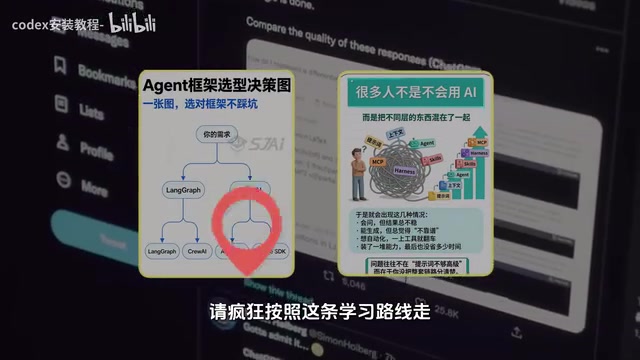
It's worth noting that any "crash course" promises should be viewed rationally. Agent development involves LLM fundamentals, engineering practices, system design, and more. True mastery requires continuous project refinement, not just copying code from video tutorials.
Stage One: Building a Solid LLM Foundation
The first step in learning AI Agents isn't rushing to pick up frameworks—it's understanding the underlying logic of how large models work. This includes the basic principles of the Transformer architecture, how LLMs acquire capabilities through pre-training, and how key inference parameters (such as temperature, top-p, etc.) affect output.
Since Google introduced the Transformer architecture in the 2017 paper Attention Is All You Need, it has become the cornerstone of virtually all modern large models. Its core innovation is the Self-Attention mechanism: when processing each token in a sequence, the model can simultaneously "attend to" information from all other positions in the sequence and determine each position's importance through learned weights. This enables the model to capture long-range dependencies—for example, correctly linking a person's name mentioned at the beginning of a long text with a pronoun at the end. Current mainstream LLMs like GPT-4, Claude, Gemini, and Llama are all built on the Decoder-only variant of Transformer, acquiring emergent capabilities in reasoning, summarization, programming, and more through autoregressive pre-training (i.e., predicting the next token word by word) on massive text corpora. Understanding this foundational architecture helps learners grasp why Agents can "think" and where their capability boundaries lie.
Regarding inference parameters, temperature controls the randomness of output (higher values lead to more creative but less controllable results), while top-p (nucleus sampling) balances diversity and quality by truncating the probability distribution. In Agent scenarios, the choice of these parameters directly affects the Agent's decision-making stability—steps requiring determinism, such as tool invocations, typically use low temperature settings, while creative generation tasks can use higher values.
Prompt Engineering Is the Core Entry Point
Prompt Engineering is the top priority at this stage. Every "thought" an Agent makes is essentially a carefully crafted prompt call. Mastering techniques like few-shot prompting, Chain-of-Thought (CoT), and role assignment directly determines the upper bound of an Agent's performance.
Specifically, few-shot prompting guides the model to understand the task format and expected behavior by providing several input-output examples in the prompt, allowing the model to adapt to new tasks without any fine-tuning. Chain-of-Thought (CoT), proposed by Google in 2022, asks the model to "think step by step" in the prompt, decomposing complex reasoning into intermediate steps, which significantly improves model performance on mathematical and logical reasoning tasks. This technique directly gave rise to the reasoning mechanism in Agents—the reason Agents can perform multi-step decision-making is fundamentally an extension of CoT. Role assignment (System Prompt) constrains the model's output style and decision logic by giving it a specific identity and behavioral guidelines, serving as the foundational technique for building specialized Agents.
API Integration Is the Engineering Foundation
At the same time, you need to become proficient with API calls to mainstream LLMs, understanding request parameters, streaming output, token-based billing, and other practical engineering details. This is the bridge from theory to runnable code and the foundation for all subsequent Agent development.
On the practical side, major API providers currently include OpenAI (GPT series), Anthropic (Claude series), Google (Gemini series), as well as Chinese providers like Zhipu AI, Baidu's ERNIE, and Alibaba's Tongyi. Streaming output uses the Server-Sent Events (SSE) protocol, allowing tokens generated by the model to be returned to the frontend one by one, greatly improving user experience. This is especially important for Agent scenarios, as complex tasks may take tens of seconds to complete full reasoning, and streaming output lets users see the Agent's "thinking process" in real time. Regarding token billing, learners need to understand how tokenizers work (e.g., the BPE algorithm) and be able to estimate costs for inputs/outputs of varying lengths—this directly impacts the operational economics of Agents in production environments.
Stage Two: Mastering the Core Agent Paradigm—ReAct and Function Calling
This stage dives into the technical core of Agents, centered around understanding the ReAct paradigm (Reasoning + Acting). ReAct enables Agents to follow a "Think—Act—Observe" loop: first reason about what to do, then execute a specific action (such as calling a tool), then observe the result and decide on the next step.

The ReAct paradigm was first proposed by Yao et al. in the 2022 paper ReAct: Synergizing Reasoning and Acting in Language Models. Before this, researchers typically handled reasoning (e.g., Chain-of-Thought) and acting (e.g., tool calls) separately. ReAct's innovation lies in interleaving both within a unified framework: at each step, the model generates a "Thought" (reflecting on current state and strategy), an "Action" (the specific operation to execute), and receives an "Observation" (the operation's result). This interleaving enables the model to dynamically adjust subsequent reasoning based on intermediate results, rather than planning all steps upfront. Compared to pure CoT, ReAct's advantage is its ability to obtain external information to correct hallucinations during reasoning; compared to pure action execution, it provides better interpretability and error recovery through explicit reasoning.
Beyond ReAct, there is the Function Calling mechanism, which allows LLMs to invoke external functions and APIs in a structured way. Understanding this "Think-Act-Observe" loop is the foundational mental model for building any complex Agent.
Function Calling was first introduced by OpenAI in June 2023 and was subsequently adopted widely by other model providers. Its technical implementation works as follows: developers declare available functions' names, parameters, and descriptions in JSON Schema format within the API request; when the model determines it needs to call a function during generation, it outputs a structured JSON object (containing the function name and parameter values) instead of natural language text; the application parses this JSON, executes the corresponding function, and sends the result back to the model as a new message for continued reasoning. This mechanism solved the frequent errors that plagued early Agents that relied on "text parsing" to extract tool-call intents, making Agent interactions with external systems reliable and controllable. Currently, GPT-4, Claude 3.5, Gemini, and other models natively support Function Calling, including the ability to call multiple functions in parallel within a single response.
At the framework level, you need to become proficient with mainstream Agent development frameworks such as LangChain and LlamaIndex. These frameworks encapsulate a great deal of underlying complexity, enabling developers to quickly build prototypes, but they also require users to understand the mechanisms behind their abstractions to avoid a superficial understanding.
LangChain is currently the most comprehensive Agent development framework ecosystem. Its core abstractions include: Chain (sequential calls), Agent (autonomous decision-making), Tool (tool encapsulation), and Memory (memory management) modules. In 2024, LangChain launched the LangGraph sub-project, which supports defining complex Agent workflows as directed graphs, solving the problem of linear Chains being unable to express loop and branching logic. LlamaIndex focuses more on data connection and Retrieval-Augmented Generation (RAG), excelling in Agent scenarios that require extensive knowledge base interactions. Learners should first understand the design philosophy and core abstractions of these frameworks before building projects on top of them, rather than memorizing framework APIs.
Stage Three: Memory Mechanisms and Tool Usage
A truly practical Agent must possess memory capabilities. The focus of this stage is understanding two types of Agent memory:
- Short-term memory: Maintains the current conversation context, typically implemented through a conversation history window
- Long-term memory: Persistent storage across sessions, commonly implemented using vector databases (such as Chroma, Pinecone) for semantic retrieval

The core challenge of short-term memory is the limited context window of LLMs. Even though GPT-4 Turbo supports a 128K token context, it can still overflow during extended conversations or when processing large amounts of data. Common optimization strategies include: sliding window (keeping only the most recent N rounds of conversation), summary compression (using the model to compress conversation history into summaries), and importance-based selective retention.
Long-term memory implementation relies on vector databases and Embedding technology. Embedding is the process of converting text into high-dimensional numerical vectors, where semantically similar texts are close to each other in vector space. When an Agent needs to recall historical information, the system converts the current query into a vector and performs approximate nearest neighbor (ANN) search in the vector database to retrieve the most semantically relevant historical records. This mechanism is closely related to the RAG (Retrieval-Augmented Generation) architecture—RAG enhances model response quality by retrieving relevant knowledge before generation, and an Agent's long-term memory is essentially a RAG system oriented toward conversation history and user information. Mainstream Embedding models include OpenAI's text-embedding-3, Cohere's embed-v3, and open-source options like BGE and E5. On the vector database side, lightweight Chroma is suitable for prototype development, while Pinecone, Milvus, and Weaviate offer high availability and horizontal scaling capabilities for production environments.
Tool Invocation Connects Agents to the Real World
Beyond memory, tool invocation capabilities enable Agents to operate in the real world—querying databases, calling search engines, executing code, sending emails, and more. This step is the critical leap from an Agent that can "talk" to one that can "do."
Tool invocation design requires consideration of several key dimensions: the quality of tool descriptions directly affects the model's accuracy in selecting the right tool—descriptions should clearly state the tool's functionality, applicable scenarios, and parameter requirements; error handling mechanisms are crucial because external APIs may time out, return abnormal data, or have insufficient permissions, and the Agent needs retry, fallback, or error-reporting capabilities; security boundaries prevent the Agent from executing dangerous operations (such as deleting data or transferring funds), typically enforced through Human-in-the-Loop confirmation mechanisms. The MCP (Model Context Protocol) introduced by Anthropic in late 2024 is emerging as a standardization solution for tool invocation, defining a unified interface specification for model-tool interactions that promises to simplify the fragmentation of the tool ecosystem.
At this stage, it's recommended to build a memory-enabled intelligent customer service project. The customer service scenario requires both long-term memory for user information and tool calls for order queries, knowledge base retrieval, and more—making it an ideal entry point for comprehensively practicing memory and tool capabilities.
Stage Four: Multi-Agent Collaboration
As task complexity increases, a single Agent often falls short. Multi-Agent collaboration becomes the advanced direction, where multiple Agents with different specializations work together to accomplish complex tasks.
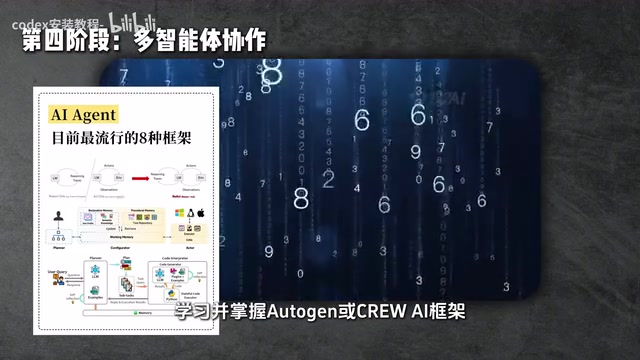
The theoretical foundation of multi-agent systems can be traced back to distributed artificial intelligence and game theory, but Multi-Agent systems in the LLM era have unique advantages: each Agent can have different system prompts (i.e., different "professional personas"), be equipped with different tool sets, and even use different underlying models. The core value of this design lies in separation of concerns—decomposing complex tasks into subtasks handled by specialized Agents, which both reduces the prompt complexity for individual Agents (minimizing confusion and hallucinations) and makes the system easier to debug and iterate.
Common Multi-Agent Collaboration Patterns
There are several typical collaboration patterns in multi-agent systems:
- Manager-Executor pattern: One Agent handles task decomposition and scheduling, while others handle specific execution
- Debate pattern: Multiple Agents offer different perspectives on the same problem, improving final answer quality through "debate"
- Pipeline pattern: Multiple Agents process different stages of a task sequentially
The Manager-Executor pattern (also known as the Orchestrator-Worker pattern) is currently the most commonly used architecture. The manager Agent receives a complex user request, decomposes it into several subtasks, assigns them to executor Agents with corresponding expertise, and finally aggregates the executors' outputs to generate the final result. The debate pattern is particularly effective in fact-checking and creative generation scenarios—research shows that having multiple Agents examine the same problem from different angles can significantly reduce hallucination rates and improve reasoning depth. The pipeline pattern resembles the microservices architecture in software engineering, suitable for tasks with clearly defined stages, such as "research → writing → review → optimization."
At the framework level, tutorials mention multi-agent collaboration frameworks such as AutoGen and CrewAI (the original terms "OptiGain" and "Tree" appear to be speech recognition errors, likely referring to mainstream frameworks like AutoGen).
AutoGen is Microsoft's open-source multi-agent framework, designed around modeling Agent interactions as "conversations"—multiple Agents collaborate on tasks by sending messages to each other, with developers defining each Agent's role and capabilities while the framework manages conversation flow. CrewAI adopts a more intuitive "role-playing" paradigm, where developers define a "Crew" and assign each member a Role, Goal, and Backstory, with the framework automatically orchestrating their collaboration. Additionally, LangGraph also supports multi-Agent orchestration through directed graphs, offering more granular process control. When choosing a framework, you need to balance flexibility and ease of use: AutoGen is suitable for scenarios requiring complex conversation protocols, CrewAI for rapid prototyping, and LangGraph for production environments requiring precise process control.
At this stage, it's recommended to complete 2-3 comprehensive projects that integrate everything learned from the previous stages.
A Realistic Perspective on This AI Agent Learning Roadmap
This "four-stage" roadmap is logically coherent and sound: progressing from LLM fundamentals to the ReAct core paradigm, then to memory and tools, and finally to multi-agent collaboration—each stage builds on the last and aligns with the actual structure of the Agent technology stack.
However, learners should remain clear-headed about claims like "become a talent companies fight over in three months" or "qualify for 90% of AI positions." There are no shortcuts to building technical competence—real competitive advantage comes from solid project experience and deep understanding of underlying principles. This roadmap is better suited as a reference for structuring your learning, not a guarantee of rapid mastery.
From an industry reality perspective, what enterprises expect from Agent developers goes far beyond "knowing how to use frameworks." Production-grade Agent systems also require consideration of: observability (how to monitor Agent decision-making processes), cost optimization (how to reduce API call frequency while maintaining effectiveness), security protection (how to prevent prompt injection attacks and data leaks), evaluation systems (how to quantify Agent performance and continuously optimize), and other engineering concerns. These capabilities need to be accumulated gradually through real projects and cannot be achieved through tutorials alone.
Learners are advised to use "building projects" as their core driving force, producing runnable, demonstrable work at each stage—this is the only way to truly solidify your skills. At the same time, stay current with cutting-edge developments in the Agent space. This is a field where technology iterates extremely fast; best practices from 2024 may already be outdated by 2025. Maintaining a habit of continuous learning is far more important than a one-time "crash course."
Key Takeaways
Related articles

Kimi 3 Added to Pro Subscription: Accelerating Commercialization of Chinese LLMs
Kimi 3 joins the Pro subscription plan, giving paying users direct access to the latest flagship model. Analysis of Kimi 3's upgrades, Moonshot AI's subscription strategy, and China's evolving LLM landscape.

Kimi 3 Included in Pro Subscription: Accelerating Commercialization of Chinese LLMs
Kimi 3 is now included in the Pro subscription plan, giving paying users direct access to the latest flagship model. This article analyzes Kimi 3's upgrades, Moonshot AI's subscription strategy, and shifts in China's LLM competitive landscape.

Claude Paid Subscription Down for Over a Week with No Response: The Pain Points of AI Service Support
Claude AI paid subscription down for over a week with no support response, exposing systemic gaps in AI service customer support. Analysis of impact, industry shortcomings, and user strategies.