The Complete Guide to AI Agent Development: From Concepts to Enterprise Deployment

A structured guide to building AI Agents — from core concepts and tech stacks to enterprise-ready deployment.
This article systematically covers the complete path from understanding AI Agents to deploying them in production, based on a beginner-friendly tutorial series. It clarifies the key difference between Agents and traditional programs (the autonomous "perceive–decide–act" loop), introduces the three core modules — MCP (standardized tool protocol), RAG (retrieval-augmented generation), and Skills (capability encapsulation) — and breaks the development workflow into five stages: goal definition, framework selection, data preparation, tool orchestration, and deployment. It also emphasizes that for beginners, shipping a minimal viable prototype and avoiding common pitfalls matters more than perfecting the tech stack.
Why Everyone Is Talking About AI Agents
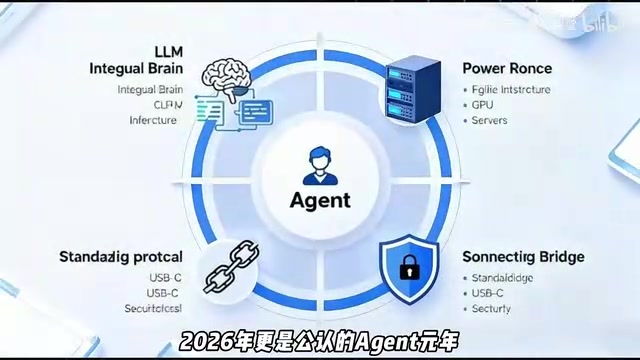
Open any tech community and you'll find endless discussions about AI Agents (intelligent agents). The market widely views this as a breakout moment for Agent technology — enterprise demand is surging, and related job postings, projects, and investments are heating up in tandem. Behind all this buzz lies a glaring gap: almost everyone is telling you that Agents are the next big thing, but very few people actually explain how to build one.
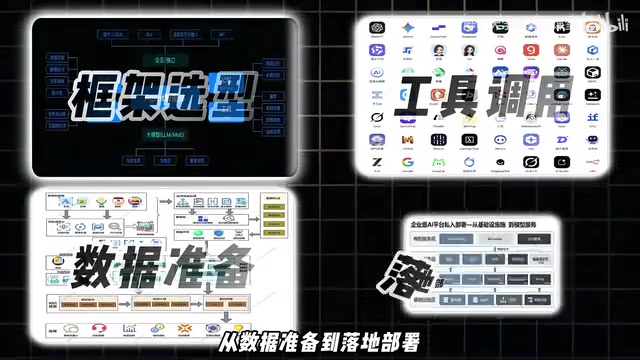
From framework selection to tool calling, from data preparation to production deployment, the intermediate steps are often a complete blur for beginners. No one systematically walks through the workflow, practical techniques go unshared, and common pitfalls rarely come with a warning. This article is based on a beginner-friendly Bilibili tutorial series, offering a structured overview of the complete Agent development landscape — so you can avoid the most common mistakes right from the start.
What Is an Agent, and How Is It Different from a Regular Program?
To understand Agents, you first need to draw a clear line between them and traditional programs. A regular program executes fixed, pre-written logic: given an input, it produces an output according to predetermined rules — the flow is deterministic and linear. The fundamental difference with an Agent lies in its autonomous decision-making and tool-calling capabilities — it can dynamically plan steps toward a goal, select the right tools, observe execution results, and decide what to do next.
In other words, a traditional program is like a fixed assembly line, while an Agent is more like an "executor" that can think, call tools, and iterate in loops. It typically uses a large language model (LLM) as its brain, paired with external tools, memory, and environmental feedback to complete complex tasks. This "perceive–decide–act" loop is precisely what sets Agents apart from conventional automation scripts.
The "perceive–decide–act" cycle maps academically to classic Agent paradigms like ReAct (Reasoning + Acting). In each iteration, the LLM first outputs a "thought" step, then selects a tool to call, receives the tool's result (Observation), and enters the next round of reasoning — until it determines the task is complete. This loop gives Agents the ability to handle multi-step, cross-tool complex tasks, but it also introduces new engineering challenges: how to cap loop iterations to prevent infinite loops, how to handle tool call failures, and how to design effective termination conditions are all questions that require careful design in real-world development. Multi-Agent architectures take this further by orchestrating multiple specialized Agents to tackle even more complex business scenarios.
The Core Tech Stack for Agent Development
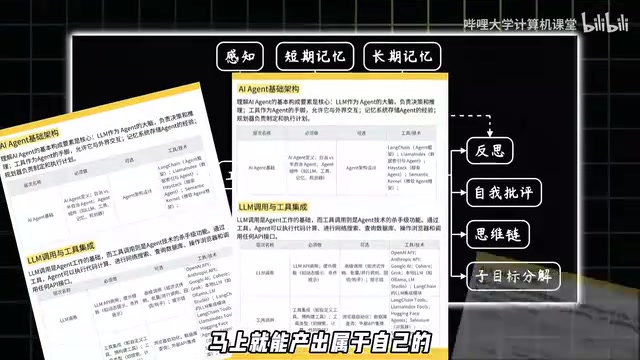
Based on what the tutorial covers, a complete Agent development skillset spans several modules, which together form a technical map from prototype to production.
MCP: A Standardized Tool Connection Protocol
MCP (Model Context Protocol) addresses the connectivity problem between Agents and external tools and data sources. In the past, every new tool integration required custom adapter code. MCP provides a standardized interface specification that lets models call external resources — file systems, databases, APIs, and more — through a unified approach. For developers, this means lower integration overhead and far better reusability.
MCP was introduced and open-sourced by Anthropic in late 2024 and has since gained support from major AI vendors including OpenAI and Google, gradually becoming a de facto industry standard. Its architecture has three layers: the MCP Host (the application that runs the Agent), the MCP Client (the protocol client responsible for communicating with Servers), and the MCP Server (the service layer that encapsulates specific tool capabilities). Developers can wrap database queries, file I/O, web search, and other capabilities into independent MCP Servers, which Agents then call on demand through a unified protocol — no custom adapter code needed for each tool. This "plugin-style" design philosophy significantly reduces fragmentation in the tool ecosystem and makes sharing and reusing tools across the community much easier.
RAG: Giving Agents Domain-Specific Knowledge
RAG (Retrieval-Augmented Generation) is the key technology for giving Agents access to "your own data." It works by vectorizing enterprise documents and knowledge bases, retrieving relevant content before generating a response — bridging the gap left by LLMs whose knowledge is outdated or doesn't cover private data. In enterprise scenarios, RAG is virtually standard practice, as it directly determines the accuracy and trustworthiness of an Agent's responses.
The RAG workflow consists of two phases: an offline "indexing phase" and an online "retrieval-generation phase." During indexing, raw documents are split into appropriately sized text chunks, converted into high-dimensional vectors via an Embedding model, and stored in a vector database (such as Chroma, Pinecone, or Milvus). During retrieval, the user's query is similarly vectorized and used to perform a similarity search in the database; the most relevant text chunks are retrieved, concatenated into the prompt, and passed to the LLM to generate the final answer. RAG quality depends heavily on the document chunking strategy, the choice of Embedding model, and retrieval recall precision — which is exactly why the tutorial emphasizes the quality of the data preparation phase so strongly.
Skills: Encapsulating and Reusing Capabilities
Skills refer to packaging specific capabilities into modules that an Agent can call. Well-designed skills make Agent behavior more controllable and easier to maintain, and they're portable across different projects.
The Development Workflow: From Zero to Production
What truly trips up beginners isn't usually any single technical concept — it's the absence of a clear development through-line. Based on the tutorial's emphasis on a "hand-holding" approach, the workflow can be broken into several stages:
Step 1: Define the goal and use case. Start by thinking clearly about what specific problem this Agent needs to solve, what the inputs and outputs are, and where the boundaries lie. The more concrete the goal, the less likely you'll drift during implementation.
Step 2: Choose a framework. Select an Agent framework that fits the task complexity and your team's tech stack. Avoid chasing the "most comprehensive" option right out of the gate.
Step 3: Prepare your data. If private knowledge is involved, complete document cleaning, chunking, and vectorization first. The quality of this step directly affects RAG performance.
Step 4: Integrate tools and orchestrate capabilities. Connect the required tools via MCP or similar protocols, and design the Agent's decision logic and skill invocations.
Step 5: Deploy and iterate. Move from a test environment to production, continuously observing real-world issues and optimizing.
This roadmap may sound straightforward, but for beginners, having clear phase definitions turns scattered knowledge points into an executable path.
Learning Advice: Ride the Wave, but Don't Skip the Fundamentals
Technical trends do create real opportunities, but Agent development is far from a "copy-paste and ship" situation. The value the tutorial emphasizes is helping you avoid common pitfalls: blindly chasing the newest framework, rushing through data preparation, skipping error handling in tool calls, or jumping straight to production without testing. In real projects, these issues are often far more damaging than a suboptimal technology choice.
For developers looking to get started, the recommendation is to first build a minimal viable Agent — even if it's simple — to bridge the gap between concept and reality end-to-end. Once you have your first working prototype, you can gradually layer in advanced capabilities like RAG and MCP, and the learning curve will feel much more manageable. The wave will keep rolling, but what truly sticks is the hands-on ability to run the full workflow and come out the other side knowing exactly which potholes to avoid.
Related articles

JobRunner MCP Server: AI Agents Can Now Fix Failed Java Jobs
JobRunner launches an open-source MCP server enabling AI agents to view cluster status, diagnose failures, and recover Java jobs—incident response from any cloud coding environment or existing agent.

MLAI Digital Launches 9 Security Agents: MCP Server Safeguards the Full Lifecycle of Agentic AI
MLAI Digital launches Security MCP Server with nine built-in specialized security agents covering vulnerability discovery, attack simulation, prompt injection detection, API and infrastructure assessment, and accelerated remediation—embedding security validation across the full Agentic AI lifecycle from development to production.

Running Isaac Lab on H100 GPUs: Exploring Better Approaches
Exploring optimization methods for running Isaac Lab on NVIDIA H100 GPUs, including MIG configuration, mixed precision, TensorRT acceleration, and community experience to improve robotics simulation and reinforcement learning efficiency.