The Complete Guide to AI Software Factories: Rebuilding the Entire Development Workflow with Agents

A complete guide to building AI-agent-driven development pipelines that automate the journey from ticket to PR.
This guide explains the AI Software Factory concept — embedding AI agents into existing development loops to automate ticket refinement, implementation, testing, and PR creation. It covers manual agent workflows, the open-source Factory project (Rust-based), scheduled bug-finding jobs, sandboxing strategies, and why workflow definitions matter more than which agent you choose.
What Is an AI Software Factory
The hype around "AI Software Factories" is everywhere, and many developers are skeptical — which is perfectly reasonable. But when a content creator actually applied this concept to his own workflow, he admitted it completely changed how he thinks about "building software with AI agents." This article systematically walks through the complete thinking behind building an AI Software Factory: what it is, how to set it up, and how to integrate it into your existing development workflow.
The so-called "Software Factory" isn't fundamentally a new concept — it's a natural extension of what we've always done as developers. The only difference is that we're embedding AI agents into our existing systems and processes.
Whether you're a solo developer looking to boost productivity or an engineering lead pursuing quality standards in a large enterprise, this topic deserves serious attention. The author repeatedly emphasizes one core point: The heart of software engineering has always been systems thinking and systems design, and the Software Factory is a product of that mindset.
Understanding the AI Software Factory Through the Traditional Development Cycle
Think about the typical workflow of any software team — whether it's a team at Google, Netflix, Amazon, or a solo developer. The path is remarkably similar.
A Closed-Loop Development Cycle
The process typically looks like this:
- Intent emerges: From customer feedback, product manager requirements, or the developer's own ideas
- Requirements refinement: Clarifying vague ideas into something concrete
- Design and planning: Thinking through "what to build, why to build it, how to build it," and breaking it down into individual tickets
- Development cycle: Writing code, local testing, code review, submitting a Pull Request
- Inspection and iteration: Running tests, finding bugs, looping back when issues arise
- Merge and deploy: Merging to production once code quality meets the bar
The author points out that CI/CD is the best analogy for a Software Factory. In great engineering teams, you almost never need to deploy manually — the system automatically checks code, runs tests, pushes to production, and even rolls back on failure. After deployment, user feedback and monitoring data flow back to the starting point, forming a complete loop.
Introducing AI agents is essentially about applying agents to each stage of this loop.
The Manual Factory: Agent Workflow from Task to PR
The first component the author demonstrates is a "task-to-merge-request" workflow.
How an Agent Handles a Vague Ticket
He starts by creating an intentionally "terribly defined" issue — no description, no acceptance criteria. This is precisely the predicament common in real engineering organizations: an agent simply can't work with a ticket like this.
The solution is to first "refine" the ticket through an automated process. The agent fills in the description, clarifies acceptance criteria, and produces a "ready for implementation" ticket before moving to the implementation phase.
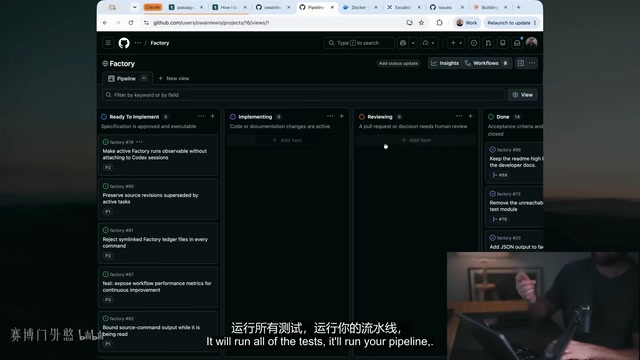
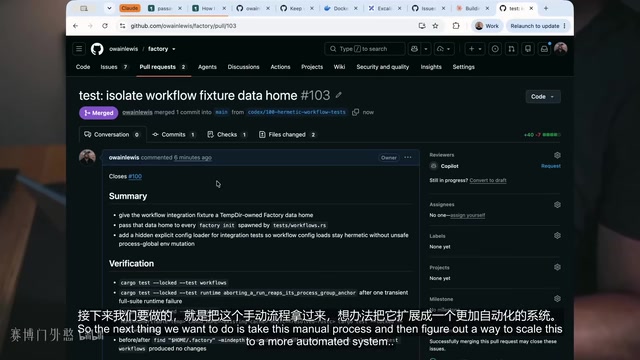
During the implementation phase, the agent spins up in a sandbox or remote VM, creates an independent Git worktree, reads the ticket, outlines a plan, modifies code, runs tests, addresses review comments, and ultimately produces a Pull Request ready for human review.
The author specifically emphasizes that he's not "casually prompting the agent" — rather, he has pre-defined complete workflows for the agent to follow. This ensures a high degree of consistency in the development process. He reveals that a simple "task-to-PR" skill already covers 99% of his development work, and he now spends nearly all his time on planning and design.
Agent-Agnostic: Workflow Definition Is What Matters
A noteworthy point: which AI agent you use doesn't really matter that much.
Whether it's Claude Code, Codex, or any other coding agent, the author believes "all agents are roughly at the same capability level right now." What truly determines success or failure is the workflow definition behind them. This explains why he focuses his energy on polishing reusable workflow templates like "plan," "triage," and "implementation" rather than agonizing over which model to choose.
Each workflow is essentially a structured prompt describing how the agent should execute when given a task — understand the work, make a plan, write code, run tests, review, and submit. This logic is no different from the steps any developer at a large company follows.
The Factory Open-Source Project: Automating Manual Processes
Next, the author showcases the open-source project he's been developing called Factory (written in Rust), which codifies the concept of building an AI Software Factory.
A Complete Automated Development Loop
Factory's process starts from an idea:
- Intake
- Agent writes a technical spec and creates tasks
- Build phase: testing, review
- Code merge
The entire process runs as a continuous loop. The project can run on a local machine or be deployed to a cloud VM, monitoring ticket queues 24/7.
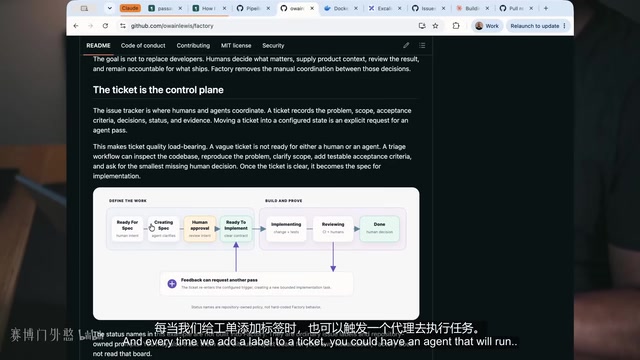
The author uses GitHub Issues labels as triggers: when an issue gets labeled factory: ready for spec, the daemon takes over, delegates to Codex, and creates a new Git worktree. The agent reviews the code, locates bugs, reproduces issues, and updates the ticket with complete information — transforming originally "vague and unclear" problems into actionable, well-defined tasks.
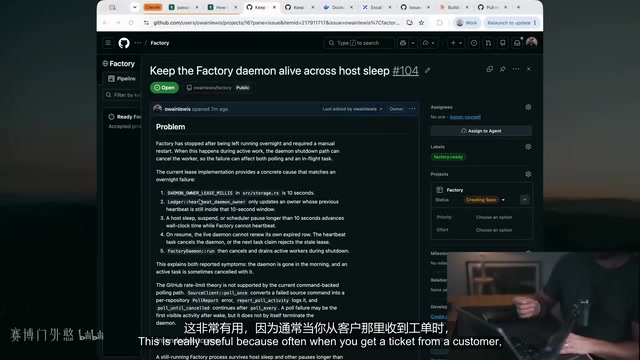
This mechanism is highly customizable. The author gives an example: public-facing teams receive a flood of vague bug reports daily. An automated workflow can transform these fuzzy ideas into actionable tickets for developers to pick up.
Scheduled Jobs and Autonomous Bug Discovery
Another major highlight of Factory is scheduled jobs.
An Automated Bug Finder
One of the author's favorite features is the "bug finder" — a workflow that can be triggered on a schedule or manually. When run, it creates a new worktree, scans the codebase, discovers bugs, and automatically opens tickets.
He emphasizes that all automated workflows can be version-controlled, which is especially important for team collaboration. As your trust in the system grows, you can even allow agents to create PRs directly — or even auto-merge them.
Cost control is worth mentioning. Factory's design philosophy is "highly deterministic": polling GitHub for tasks uses regular code that consumes zero tokens; agents only spin up when there's actual work to do. This means it can run around the clock without "burning money recklessly."
Sandbox and Security Boundary Design
When systems like this enter production, sandboxing becomes critical — you need to ensure worker nodes can't break anything.
The author admits he's still exploring sandboxing techniques: for local development, Git worktrees provide isolation; for team or VM environments, more robust solutions are needed, such as Docker's recently released sandbox features or plain Docker containers. This is a topic he plans to explore in much greater depth separately.
Common Objections to AI Software Factories and Responses
The author doesn't shy away from common criticisms of this approach, offering quite pragmatic responses:
Cost, Capability, and Human Judgment
- Cost concerns: Running AI agents does cost money, but this is more of a tool for engineering organizations operating at scale, not for "doing work that doesn't need doing."
- AI isn't smart enough yet: Fully agree. For tasks requiring critical thinking, you still want to be hands-on.
- I want interactive work: Totally fine. This pipeline isn't a silver bullet — you can choose whether to intervene based on the situation.
He specifically highlights a counterintuitive conclusion: As agents become more capable, these pipelines actually become more important. Right now, a single task might take an agent 20 minutes to an hour — running code reviews on one side, CI checks on the other. Staring at a terminal waiting is both painful and inefficient. By offloading work to a VM, you can "fire and forget," come back two hours later to review the results, and not be chained to your keyboard.
From CI/CD to AI Factory: The Underlying Logic of Quality Leaps
The author closes with an elegant analogy.
From Manual Deployment to Automated Pipelines
Before CI/CD, software deployment was manual, error-prone, and stressful. After CI/CD was introduced, we built systematic automation around the release process, resulting in dramatically improved quality — whether junior or senior engineers, everyone uses the same standardized process, and anyone can have a "perfect deployment workflow."
The AI Software Factory is doing the same thing for the development phase. Those mechanical tasks — security upgrades, bug fixes, the tedious work developers never enjoyed — can all be confidently handed to agent pipelines, establishing greater consistency.
But the author also warns senior engineers to stay vigilant: introducing these concepts to a team requires great care, and a culture of "not abusing the pipeline" must be established. You still need human critical thinking, judgment, and engineering mindset threaded through every stage. The Software Factory doesn't replace engineers — it frees people from the mundane so they can focus on where thinking truly matters.
Related articles

DeepCell: One-Click AI Generation of Documents, Spreadsheets, and Slides
DeepCell tops Product Hunt with one-click generation of documents, spreadsheets, and slides, using the .deepcell format for linked updates, designed for System 2 tasks like modeling and sales reviews.

Doneas: 15-Minute Daily Accountability Calls That Keep Indie Developers From Procrastinating
Doneas is a daily accountability tool for indie developers: plan tasks on Monday, join a 15-minute call with five builders each day, and log deliveries on a public progress page. This article analyzes its core mechanics, effectiveness, and potential issues around retention and matching.

Fastlane 2.0: Fully Automated AI Ad Campaigns, From Creative to Optimization
Fastlane 2.0 is an AI ad automation tool: enter your website and it learns your brand, generates video and image ads, and runs and optimizes them on Meta, TikTok, Instagram, and YouTube.