The Complete Guide to Automated AI Research Resources: Papers, Tools, and Labs

A comprehensive guide to the awesome-auto-ai-research project covering papers, tools, and labs for AI-driven autonomous research.
This article explores the awesome-auto-ai-research GitHub project, a community-driven resource hub for automated AI research. It covers the field's foundations including NAS and LLMs, highlights key players like Sakana AI and DeepMind, examines breakthroughs such as The AI Scientist and AlphaFold, discusses recursive self-improvement implications, and outlines future trends in AI Agent frameworks for autonomous scientific discovery.
What Is Automated AI Research?
Automated AI Research is one of the most cutting-edge directions in artificial intelligence — enabling AI systems to autonomously conduct scientific research, from formulating hypotheses and designing experiments to writing papers, achieving full automation of the research process. The open-source GitHub project awesome-auto-ai-research serves as a community-driven resource collection for this emerging field, covering papers, tools, key figures, labs, and more.
Automated AI research builds upon several key technologies, including large language models (LLMs) for code generation and reasoning, automatic reward design in reinforcement learning, Neural Architecture Search (NAS), and Meta-Learning. Neural Architecture Search was proposed as early as 2017 by the Google Brain team, using reinforcement learning to automatically design neural network architectures — an early form of automated AI research. Today's automated research systems go much further: they not only design model architectures but also autonomously propose research questions, design experimental protocols, interpret results, and generate academic papers, forming a complete research loop.
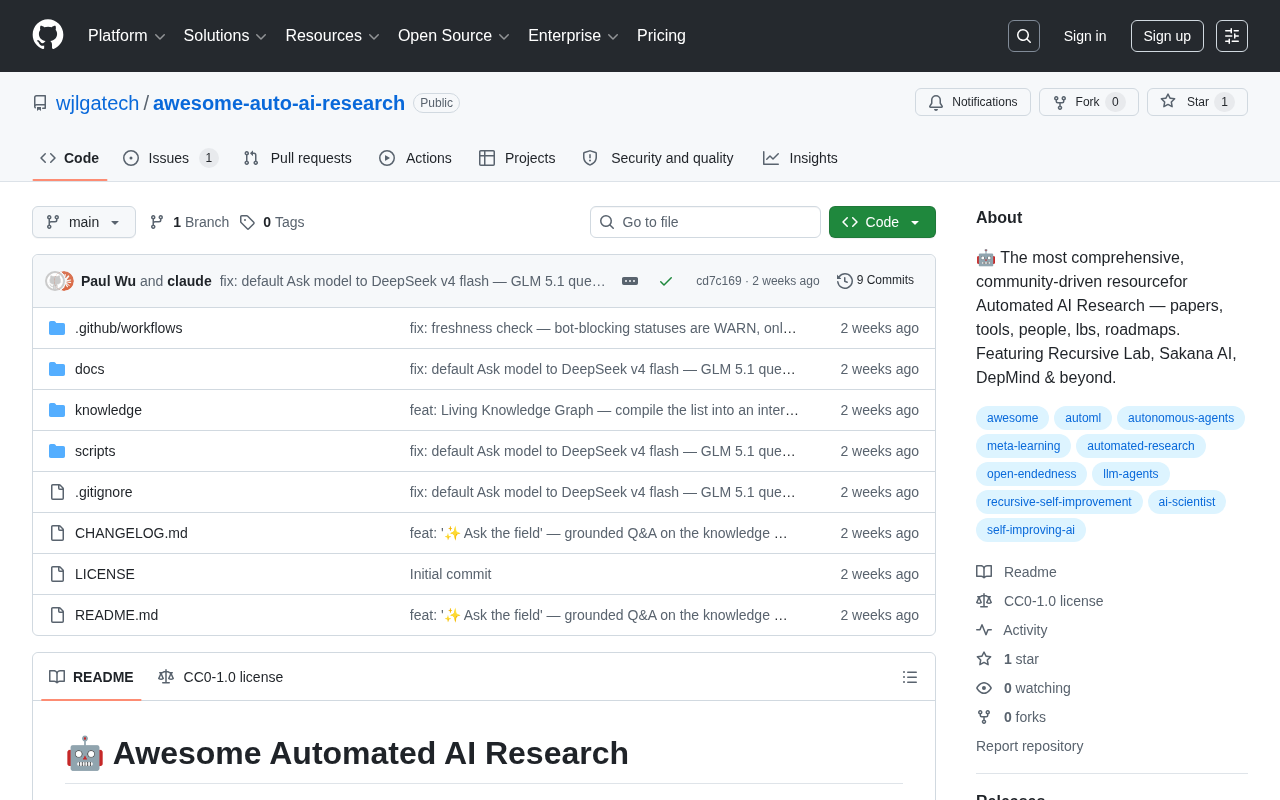
awesome-auto-ai-research Project Overview
Core Positioning and Background
Created by user wjlgatech, this project positions itself as "the most comprehensive community-driven resource library for automated AI research." The project highlights several representative organizations in this field:
- Recursive Lab: Focused on recursive AI research automation
- Sakana AI: Known for evolution-driven AI research, whose "AI Scientist" project has attracted widespread attention
- DeepMind: Demonstrated the enormous potential of AI-driven scientific research through projects like AlphaFold
Resource Classification Structure
Organized using Python, the project categorizes content along the following dimensions:
- Papers: Key academic papers in the automated AI research field
- Tools: Open-source tools and frameworks for automated research
- People: Core researchers and contributors in the field
- Labs: Research institutions active in this direction
- Roadmaps: Macro-level perspectives on the field's development

Why Automated AI Research Deserves Attention
A Fundamental Shift in Research Paradigms
Traditional AI research relies on human researchers to manually design model architectures, tune hyperparameters, and analyze experimental results. The vision of automated AI research is to have AI systems handle most or even all of these tasks. This represents not merely an efficiency improvement but a fundamental transformation of the scientific research paradigm.
This direction has clearly accelerated in recent years:
- Sakana AI released "The AI Scientist," capable of autonomously completing the entire research workflow from ideation to paper writing
- Multiple DeepMind projects have demonstrated AI's autonomous reasoning capabilities in mathematics and scientific discovery
- Several startups have begun exploring AI-driven drug discovery and materials science research
Sakana AI's AI Scientist Project in Detail
Sakana AI is a company founded in Tokyo in 2023 by former Google Brain researcher David Ha and Llion Jones (co-author of the Transformer paper). Their "The AI Scientist" project, released in 2024, is the first system to achieve end-to-end automated scientific research. The system can autonomously generate research ideas, write experimental code, execute experiments, analyze results, and compose complete academic papers — it can even perform peer-review-style self-evaluation. In experiments, the system generated multiple papers in areas such as diffusion models, language models, and learning dynamics at a cost of approximately $15 per paper. While the quality of these papers has not yet reached top conference standards, it demonstrates a viable path for AI-driven autonomous research.
DeepMind's Milestones in Autonomous AI Research
DeepMind has accumulated several landmark achievements in AI-assisted scientific discovery. AlphaFold (2020) solved the protein structure prediction problem that had puzzled biologists for 50 years; AlphaGeometry (2024) achieved near-gold-medalist performance on International Mathematical Olympiad-level geometry problems; FunSearch (2023) was the first to prove that large language models can make genuinely new discoveries in mathematics, finding combinatorial mathematics constructions that surpass the best known human solutions through evolutionary search. While each project focuses on a specific domain, together they validate AI systems' autonomous capabilities in scientific reasoning and discovery, establishing technical confidence for fully automated AI research.
Recursive Self-Improvement: Opportunities and Controversies
The most exciting yet controversial aspect of automated AI research lies in the possibility of recursive self-improvement — AI systems researching how to improve AI systems themselves. Once this positive feedback loop is established, it could lead to exponential capability growth. The "Recursive Lab" mentioned in the project focuses precisely on this direction.
The concept of Recursive Self-Improvement originates from mathematician I.J. Good's 1965 "intelligence explosion" hypothesis — a superintelligent machine could design machines superior to itself, triggering a chain reaction of capability growth. In the modern AI context, this means AI systems could improve their own training algorithms, architecture designs, or data processing pipelines. Organizations like OpenAI and Anthropic have identified this as one of the key paths toward Artificial General Intelligence (AGI), while it also represents a core concern for AI safety research — how to ensure that self-improving AI systems remain aligned with human values.
Project Status and Field Development Trends
Current Project Stage
It should be noted objectively that this project is still in a very early stage, with community attention not yet fully established. As an "awesome list" type resource aggregation project, its long-term value largely depends on subsequent content enrichment and community participation.
Future Development Directions
Although the project itself is still in its infancy, the direction it points to is undoubtedly one of the most transformative frontiers in AI. As LLM capabilities continue to improve and Agent frameworks mature, automated AI research is likely to move from proof-of-concept to practical application within the next few years.
AI Agent frameworks are critical infrastructure for achieving automated research. An Agent refers to an AI system capable of perceiving its environment, making plans, using tools, and autonomously executing multi-step tasks. Current mainstream Agent frameworks include LangChain, AutoGPT, CrewAI, and others, which allow large language models to invoke external tools (such as code executors, search engines, databases) to complete complex tasks. In automated research scenarios, Agents need to coordinate multiple capabilities including literature retrieval, hypothesis generation, experimental design, code writing and debugging, and result analysis. Multi-Agent collaborative architectures (such as having different Agents play the roles of researcher, reviewer, experimenter, etc.) are becoming an important technical paradigm in this field.
For AI researchers and practitioners, continuously following developments in this direction and familiarizing themselves with relevant tools and methodologies will help maintain competitiveness amid the paradigm shift in research.
Conclusion
Although the awesome-auto-ai-research project is just getting started, it provides a valuable resource aggregation entry point for automated AI research. For researchers looking to understand and enter this field, this kind of systematic resource compilation can significantly lower the barrier to entry. It's recommended to follow the project's updates while also keeping an eye on the latest achievements from Sakana AI, DeepMind, and other institutions in the automated AI research space.
Related articles

DeepCell: One-Click AI Generation of Documents, Spreadsheets, and Slides
DeepCell tops Product Hunt with one-click generation of documents, spreadsheets, and slides, using the .deepcell format for linked updates, designed for System 2 tasks like modeling and sales reviews.

Doneas: 15-Minute Daily Accountability Calls That Keep Indie Developers From Procrastinating
Doneas is a daily accountability tool for indie developers: plan tasks on Monday, join a 15-minute call with five builders each day, and log deliveries on a public progress page. This article analyzes its core mechanics, effectiveness, and potential issues around retention and matching.

Fastlane 2.0: Fully Automated AI Ad Campaigns, From Creative to Optimization
Fastlane 2.0 is an AI ad automation tool: enter your website and it learns your brand, generates video and image ads, and runs and optimizes them on Meta, TikTok, Instagram, and YouTube.