The Complete Guide to FDE (Forward Deployment Engineer): A New Species Born in the AI Era

FDEs embed top engineers at client sites to bridge AI product gaps — and build reusable products in the process.
Forward Deployment Engineer (FDE) is a role pioneered by Palantir, defined by embedding top engineers directly at client sites to close the gap between product capabilities and real-world needs. The role became viable in the AI era because AI tools have dramatically cut prototyping and custom development costs. Unlike traditional outsourcing, FDEs must distill their work into a reusable product foundation. Technically, FDEs choose between an ontology-driven approach (Palantir-style) and a scenario-driven AI Agent approach, progressing from Agent development through fine-tuning, SFT, and pre-training. Their dual role — client-facing solution deliverer and internal product sharpener — is what sets them apart.
What Is an FDE? A New Species Born in the AI Era
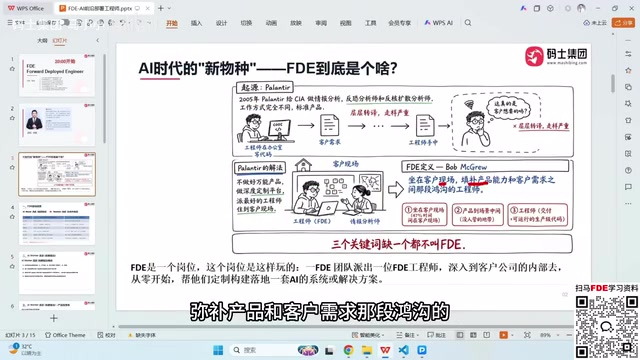
FDE stands for Forward Deployment Engineer — a role that's rapidly gaining attention in the AI deployment space. As the name suggests, the defining characteristic of this role is "forward deployment" — rather than writing code in isolation at the office, FDEs embed themselves directly at customer sites to bridge the gap between product capabilities and real-world client needs.
The concept traces its origins to Palantir. The company initially built intelligence analysis tools for agencies like the CIA, and quickly discovered a critical problem: counterterrorism analysts and counterproliferation analysts worked in completely different ways, and no standardized product could serve all use cases. Palantir's answer wasn't to build a one-size-fits-all product — it was to build a deep customization platform and send its best engineers directly to the client's site.
Why Did FDEs Only Emerge in the AI Era?
To truly understand FDEs, you need to answer one question: project outsourcing has existed for decades — so why is the "Forward Deployment Engineer" role only rising to prominence now, in the AI era?
The core reason is the dramatic shift in delivery costs. Building a prototype or demo used to take enormous time, making it hard for companies to justify sending their top engineers to live at a client site. Consider the math: a senior engineer earning ¥800K per year costs the company well over ¥1M all-in. Deploy that person on-site while requirements shift daily — "we need this today, that tomorrow, please don't leave" — and the monthly burn becomes enormous. These prohibitive costs pushed companies toward the old model of multi-layered subcontracting.
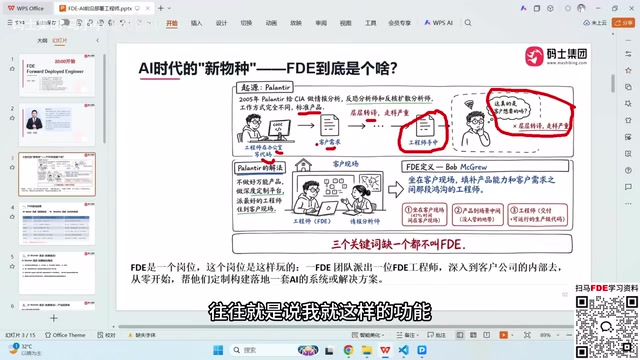
But the cost of multi-layered subcontracting is severe requirement distortion. A client originally wants A; by the time the request passes through product managers, project managers, and engineers, what gets delivered might be C, D, or even E. This is the endemic failure of traditional software outsourcing — programmers writing features in the office based on guesswork, completely disconnected from what the client actually needs. AI tools have drastically compressed the cycle time for prototyping and custom development, making it economically viable — for the first time — to put top-tier engineers directly on-site.
The Fundamental Difference Between FDEs and Traditional Project Outsourcing
From a developer's perspective, an FDE embedding in a client organization to build an AI system from scratch might look a lot like "doing a project." But there is one fundamental distinction: productization and reusability.
The key point is this: if you're an FDE who starts from scratch with every new client and can't reuse anything from previous engagements, you are no different from a traditional outsourcer. A true FDE operates on top of a reusable product foundation. For example, having a proven AI transformation framework for the financial industry means that when you arrive at a new client, you're just mapping their requirements, adjusting parameters, and modifying environment variables — not rebuilding from zero.
This is precisely why FDEs often take on product manager responsibilities. As the most technically fluent person in the room, the FDE must understand business pain points and feed on-site customization needs back into the standard product. From the client's perspective, the FDE is a "solution delivery specialist"; from the company's perspective, they're a "product sharpener." This dual identity is what truly sets the FDE apart from an outsource contractor.
Two Schools of FDE Practice: Ontology-Driven vs. Scenario-Driven
In practice, FDE implementation broadly falls into two technical approaches.
The Palantir School: Ontology-Driven
The approach pioneered by Palantir centers on Ontology — first abstracting and modeling the entities, relationships, and rules of the client's business world, then building applications on top of this unified ontological layer. This approach suits scenarios with complex business logic and dense data relationships, delivering a deeply customized platform rather than individual features.
Ontology originates from philosophy; in information systems, it refers to the formal representation of entities, concepts, and their relationships within a given domain. Palantir brought this thinking to enterprise data platforms: business entities like "people, locations, events, and organizations" serve as nodes, with the relationships between them as edges, forming a knowledge graph that covers the client's entire business world. Search, analytics, and decision-making applications all build on this unified ontological layer rather than maintaining isolated data models. The benefit: when business rules change, you only update the ontology layer and all upstream applications inherit the change automatically. Data from different systems can also be interconnected through shared entity alignment. For an FDE, mastering the ontology-driven approach means investing heavily upfront in collaborative business modeling with the client — high initial cost, but significantly better scalability and maintenance efficiency compared to piecemeal feature development.
The AI Agent School: Scenario-Driven
The second approach is scenario-driven, focused on rapidly building intelligent agents (Agents) to solve specific business problems. This aligns more closely with mainstream large language model application development today. Both schools have their appropriate contexts, and FDEs need to choose flexibly based on each client's actual situation.
What Technical Skills Does an FDE Need?
The following is a clear skill progression path for anyone looking to pursue the FDE route.
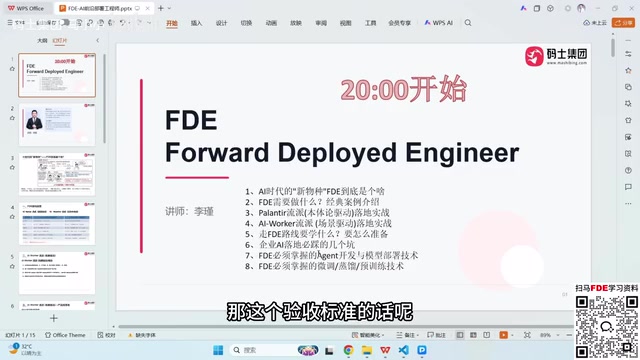
Phase 1: Agent Development and Model Deployment. Don't start by diving into low-level algorithms. Begin with AI Agent development and private/local model deployment — this is the baseline entry point for the FDE field.
Phase 2: Fine-tuning, SFT, and Pre-training. Here's a useful analogy: if you only work at the agent layer, your output quality might plateau at 90 — never quite reaching 95. But many enterprise projects have explicit acceptance criteria, and hitting that 95 threshold requires bringing in model fine-tuning techniques.
There's a clear difficulty gradient: Fine-tuning < SFT (Supervised Fine-Tuning) < Pre-training. The recommended learning sequence is to start with fine-tuning before progressing to deeper training stages. The logic of this path is to move from the application layer progressively into the algorithm layer, ultimately building end-to-end delivery capabilities from foundational algorithms to production applications.
RAG (Retrieval-Augmented Generation) is one of the most commonly used techniques in enterprise AI deployment today. The core idea: rather than storing enterprise-proprietary knowledge inside the model itself, RAG retrieves relevant document fragments from an external knowledge base before generating a response, then injects those retrieved results into the prompt as context — enabling the model to give grounded, verifiable answers. This mechanism effectively mitigates hallucination and knowledge cutoff issues while avoiding compliance risks associated with training on sensitive data. SFT (Supervised Fine-Tuning), by contrast, continues training a pre-trained base model on labeled input-output pairs, teaching the model a specific output style or domain knowledge. Compared to RAG, SFT changes the model's "inner behavior" and is better suited for scenarios requiring fixed output formats or reinforced reasoning chains — but it demands high-quality labeled data, and any change in business rules requires retraining, making it relatively more costly. A key competency that distinguishes FDEs from ordinary application developers is knowing when to use RAG, when to use fine-tuning, and when to combine both.
Common Pitfalls in Enterprise Deployment
FDEs are fundamentally in the business of enterprise deployment — and that almost guarantees stepping into a variety of traps. A few high-risk patterns stand out: requirements that keep shifting on-site and never converge; customized deliverables that can't be distilled into a reusable product foundation; agent-layer performance that falls short of acceptance criteria, forcing the team into more complex model training. These are the problems a skilled FDE must anticipate and mitigate before they escalate.
Final Thoughts
The FDE represents a fundamental shift in how AI gets deployed in the real world — moving from "delivering standardized products" to "sending top engineers on-site to co-create and then productize the results." It demands solid Agent development and model deployment skills, the ability to go deep into fine-tuning and pre-training, and at the same time, product thinking and strong client communication skills. For engineers looking to build a career in AI deployment, this is a high-barrier path — but one with correspondingly high rewards.
Related articles

@ai-sdk/vue 3.0.306 Patch Release Syncs with [email protected] Update
@ai-sdk/vue 3.0.306 released, synced with [email protected]. A routine patch release for the Vercel AI SDK ecosystem with no public API changes; the Vue adapter layer stays version-aligned with the core package.

Gemini 4 Argon API Launches: The Era of Million-Token Output Begins
Google launches Gemini 4 Argon with sparse MoE architecture, up to 1M output tokens, and a 68.90% Vals Index score, available across API, AI Studio, and the Gemini app.

DukaanAI: Turning Product Photos into Inventory Lists with Open-Source AI
DukaanAI is an AI inventory tool for small retailers that turns product photos into inventory entries using the open-source Gemma 3 model, with local inference, editable fields, and CSV export.