The Complete Ollama Guide: The Simplest Way to Run LLMs Locally

Ollama makes running large language models locally as simple as using Docker.
Ollama is the leading open-source tool for running LLMs locally, combining a Docker-style CLI, OpenAI API compatibility, and broad model support. With 9 million active developers and 170K GitHub stars, it addresses cloud AI pain points around data privacy, cost, and offline availability through an elegant four-layer architecture built on llama.cpp.
In an era dominated by cloud-based AI, data privacy and cost control are becoming unavoidable pain points for a growing number of developers and enterprises. As we continuously upload sensitive data to the cloud and hand our budgets over to APIs billed per API call, a new trend is quietly emerging — putting AI control back in the hands of users. Ollama is the most representative open-source tool in this local-first movement.
The rise of this local-first trend has deep structural roots. Cloud-based AI models face three core pain points: regulations like GDPR and HIPAA prohibit sensitive data from leaving organizational boundaries; commercial APIs like GPT-4 charge per token, making costs staggering in high-frequency use cases; and they fail completely in low-connectivity or offline environments. These pain points collectively gave rise to a local inference ecosystem led by llama.cpp and Ollama, signaling a paradigm shift in AI infrastructure from "cloud-centralized" to "edge-distributed."
This article provides a comprehensive overview of Ollama — covering its definition and core value, features, technical architecture, business model, and real-world use cases — to help you understand why it has become a phenomenon in the local AI space in such a short time.
What Is Ollama: Redefining Local AI Deployment
Simply put, Ollama is an open-source tool that lets you easily run large language models (LLMs) on your local machine. Its design philosophy is clear — make running AI locally as simple as using Docker.
Comparing Ollama to "the Docker of AI" is far more than a marketing tagline — it reflects a deeply inherited design philosophy. Docker transformed software deployment in 2013 by wrapping complex Linux container technology into a simple image-and-CLI paradigm. Ollama replicates this success: it treats model weights as "images" and inference processes as "containers," using familiar commands like pull, run, and rm to minimize cognitive overhead. This "convention over configuration" approach means developers can obtain a production-ready inference service without needing to understand low-level details like GGUF quantization formats, CUDA driver configuration, or inference parameter tuning.
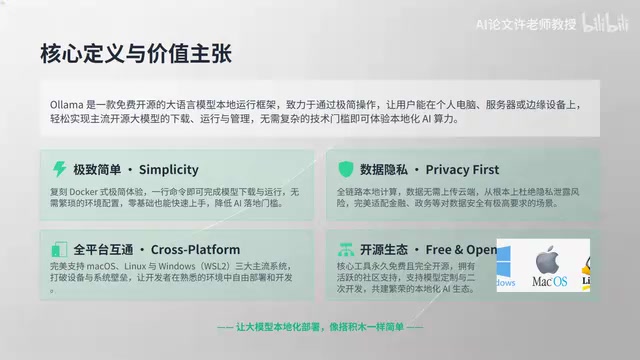
Its core value can be summarized in four points:
- Extreme simplicity: Anyone can get started quickly with no complex environment setup required;
- Absolute data privacy: All data is processed locally and never sent to the cloud;
- Broad cross-platform compatibility: Supports all major operating systems;
- Fully open-source and free: Core features are permanently available at no cost.
Ollama's success is no accident. According to available data, it has nearly 9 million active developers, has earned over 170,000 GitHub stars, and has been adopted by more than 85% of Fortune 500 companies. These numbers powerfully demonstrate the market's strong demand for local AI solutions and Ollama's leadership position within that space.
Core Features: A Powerful Ecosystem Behind a Minimal Interface
Managing LLMs Like Docker
Ollama's most intuitive appeal lies in its minimal command-line interface. Developers can download, run, manage, and delete models using Docker-style commands like run, pull, list, and rm — the entire workflow is fluid and nearly frictionless to learn.
For developers already familiar with containerized workflows, this design means an extremely low migration barrier — the habits you've already built can be applied directly.
A Large and Active Open-Source Model Ecosystem
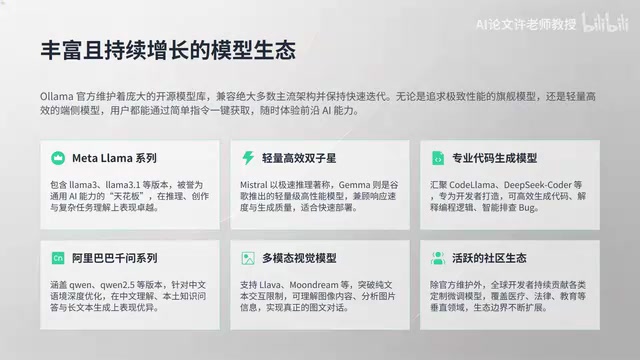
Ollama is backed by a rich model library. From Meta's Llama 3 and Google's Gemma to Alibaba's Qwen, virtually all mainstream open-source LLMs can be fetched and run with a single command through Ollama. This means you always have access to the latest open-source AI technology without being locked into any single vendor.
OpenAI API Compatibility for Near-Zero Migration Cost
A key advantage for developers is that Ollama doesn't just provide a native API — it is fully compatible with the OpenAI API specification. The strategic significance of this compatibility goes far beyond the technical level. OpenAI's /v1/chat/completions endpoint has become the de facto industry standard for LLM calls, with a vast toolchain ecosystem built around it — including LangChain, LlamaIndex, AutoGen, and more. By exposing the same interface spec locally (default port 11434), Ollama enables countless applications built on the OpenAI SDK to switch to local execution by changing just one line of base_url configuration. This "interface as moat" strategy allows Ollama to inherit the developer toolstack accumulated by cloud AI over years, without needing to rebuild its own ecosystem — dramatically reducing migration friction for users.
Model File: Build Your Own Custom Private Models
Another highlight of Ollama is the Model File, which works similarly to a Dockerfile. Through a simple configuration file, you can create model variants tailored to specific needs based on existing models.
The Model File mechanism elevates prompt engineering from ad hoc string concatenation to a version-controllable engineering artifact. Developers can use FROM to specify a base model, SYSTEM to define a system prompt, PARAMETER to adjust inference parameters (such as temperature and top_p), and TEMPLATE to customize conversation formatting. This means enterprises can package specialized roles — such as a "medical consultation assistant" or "legal document reviewer" — into reproducible, distributable standardized model packages. Combined with version control tools like Git, the iteration and collaborative management of private models becomes entirely consistent with software development workflows. This customizability makes Ollama not just a model runner, but an engineering starting point for private AI deployment.
Technical Architecture: An Elegant Four-Layer Design
Ollama's technical architecture encapsulates complex low-level details very cleanly, using a classic four-layer design:
- Application Interaction Layer: At the top, it provides a minimal CLI and API interface for zero-barrier model access;
- Core Scheduling Layer: Acts as the "brain" of the entire system, intelligently managing resources and tasks to ensure stable operation;
- Lightweight Runtime: Uses containerization technology to enable fast model startup and environment isolation;
- Model Layer: At the bottom, it handles complex compute tasks and leverages hardware acceleration for improved performance.
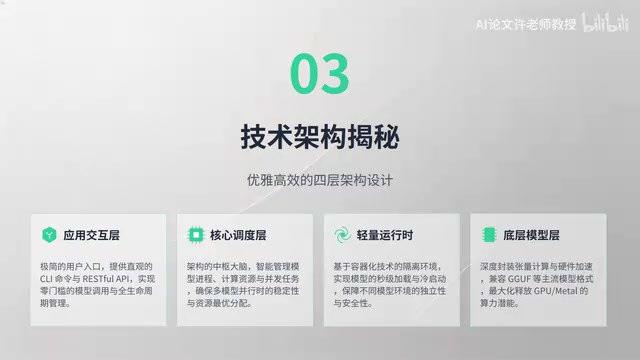
This layered design ensures both efficient operation and a flexible, extensible overall architecture.
From a working-principle perspective, Ollama uses a classic client-server model: a persistent service runs in the background, while the CLI or API interacts with it in the foreground. At its core, Ollama is a high-level wrapper around lower-level inference engines such as llama.cpp. llama.cpp was implemented in pure C/C++ by Georgi Gerganov in 2023, with its core innovation being the GGUF quantization format — by compressing model weights from 32-bit floating point to 4–8-bit integers, it reduces the memory footprint of a 70B parameter model from 140GB to approximately 40GB, while leveraging Apple Silicon's unified memory architecture and NVIDIA CUDA for hardware acceleration. Ollama builds a service layer on top of llama.cpp, providing a unified REST API, model version management, and concurrent request scheduling — upgrading a command-line tool into an integrable microservice. This also explains how it achieves extreme ease of use while maintaining high inference performance.
Business Model: Open-Source Free Core + Paid Premium Services
How an excellent open-source project achieves long-term commercial sustainability is worth examining. Ollama's answer is a clear "free core + paid premium" strategy.
Core local execution features are permanently free, ensuring community engagement and user scale; for users requiring greater compute power or cloud deployment capabilities, paid tiers such as Pro and Max are available.

Particularly noteworthy is its GPU-hour-based billing model, which has been well received by enterprise users. This pay-per-actual-compute model is both transparent and fully aligned with enterprise cost management logic. Compared to cloud-based models that charge per API call or per token, GPU-hour billing ties AI budgets directly to actual compute resources, eliminating cost uncertainty caused by token length fluctuations. This commercial design sustains a thriving open-source community while also providing a stable foundation for the company's long-term growth.
Use Cases: From Enterprise Knowledge Bases to Offline AI Assistants
Ollama's real-world applications are remarkably broad:
- Enterprise private knowledge bases: Build intelligent Q&A systems locally where data never leaves the organization;
- Edge device deployment: Push AI inference capabilities down to the network edge;
- Developer testing sandboxes: An ideal environment for rapid local experimentation and prototype validation;
- Offline AI assistants: Still fully functional in completely disconnected environments like airplane mode.
Edge AI deployment represents an important evolutionary direction for AI infrastructure. In industrial IoT scenarios, production-line quality inspection models require millisecond-level response times — cloud round-trip latency is completely unacceptable. In healthcare settings, patient data compliance requirements prohibit uploading data to third-party servers. In emergency communications, offline environments are the norm rather than the exception. By supporting quantized lightweight models (such as Phi-3 and Gemma 2B at the 1–3B parameter scale), Ollama enables AI inference to be deployed on edge servers with consumer-grade GPUs or even CPU-only hardware — extending AI's application boundaries from "online, well-funded" internet scenarios to factory floors, remote field stations, and other physical environments that were previously out of reach.
Ollama truly brings the power of large language models to the many scenarios that cloud-based AI simply cannot reach.
Conclusion: Why Ollama Deserves Your Attention
Ollama's significance goes far beyond being just a tool. It is driving the democratization of AI — ensuring that powerful large language model technology is no longer the exclusive domain of a few large tech companies, but can genuinely empower every developer and enterprise user.
Looking ahead, Ollama is poised to continue advancing in areas such as lightweight models, multimodal support, security and compliance, and industry-specific customization — further ushering in a more open, more private, and more efficient era of local AI.
For developers and enterprises that care about data privacy, cost control, and technological autonomy, Ollama is undoubtedly one of the most worthwhile local AI infrastructure solutions to explore and deploy today.
Related articles

Why Does the Tesla Roadster Need to Fly? A Deep Dive into Musk's Wild Demo
Tesla's Roadster launch showed wall-climbing, upside-down driving, and flying stunts—but The Vergecast notes the demo car may lack a battery, the Rocket version is invite-only and not street-legal, and the website terms don't guarantee delivery. After nine years of delays, why does this car still need to exist?

AI Is Not a Replacement: Human-AI Collaboration Through the Lens of Factory Root Cause Analysis
Starting from factory root cause analysis, this article explains how AI accelerates evidence chain construction rather than replacing human experts, exploring the pragmatic implementation logic and business value of 'AI supporting people rather than replacing them.'

AI Agent Decision Auditing: Building an Evidence Chain in Regulated Workflows
Starting from a Reddit discussion, this article analyzes three core issues in AI agent decision auditing within regulated workflows: what fields audit records should contain, how to handle feedback latency for erroneous decisions, and how to continuously calibrate LLM judge consistency with human judgment.