The Complete OpenAI Codex Practical Guide: From Installation to Enterprise Deployment
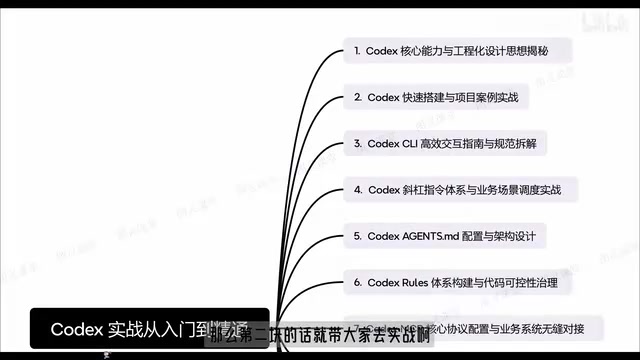
A systematic guide to mastering OpenAI Codex from CLI setup to enterprise-level RAG project deployment.
This guide covers the full OpenAI Codex learning path — from understanding its core engineering philosophy and CLI installation, to mastering slash commands, configuring AGENTS.md, integrating business systems via MCP protocol, leveraging multi-agent collaboration, and deploying a real-world RAG intelligent customer service system.
Why You Should Learn Codex Systematically
OpenAI Codex is a pivotal tool in AI-assisted programming, fundamentally changing the way developers work. From code completion to project-level intelligent collaboration, Codex's capabilities continue to expand. Yet many developers still think of it as just "an AI that writes a few lines of code," failing to unlock its full engineering potential.
OpenAI Codex is a large language model built on the GPT-3 architecture and fine-tuned extensively for code-related tasks. It was originally released in 2021 and powered the early versions of GitHub Copilot. Trained on hundreds of billions of lines of publicly available code, Codex can understand and generate dozens of programming languages including Python, JavaScript, TypeScript, Go, and Ruby. Its core capabilities stem from a deep understanding of code semantics, syntactic structure, and programming patterns — not simple text matching. After 2023, as GPT-4's coding abilities advanced significantly, OpenAI evolved Codex into a more powerful code intelligence agent that supports multi-step task planning, file system operations, and command execution. This marked a critical paradigm shift from "code completion tool" to "autonomous programming agent."
This article systematically covers the complete Codex learning path — from understanding its core capabilities and setting up your environment, to enterprise-level deployment — helping developers build a comprehensive understanding and avoid common pitfalls.
1. Understanding Codex's Core Capabilities and Engineering Philosophy
When learning any tool, start by understanding its design philosophy. Codex is more than a code generator — it embodies a complete engineering design philosophy.
The key to truly mastering Codex lies in understanding how it integrates AI capabilities across the full software engineering lifecycle — from requirements analysis and code implementation to testing and maintenance. Compared to a simple "prompt → output" model, an engineering-oriented approach places greater emphasis on controllability, reusability, and team collaboration.
This means developers need to build the right mental model: Codex is an intelligent collaborator in the development process, not a replacement. Only by clarifying its capability boundaries and collaborative role will the hands-on work that follows be truly productive.
2. Quick Setup: From Installation to Your First Project
Setting up your environment is the first hurdle for beginners. The Codex CLI (command-line interface) is the primary way to interact with Codex, and a proper installation and configuration will ensure a smooth development workflow.
The Codex CLI is a lightweight programming agent open-sourced by OpenAI in 2025. Built on Node.js, it allows you to call OpenAI's model APIs directly from your local terminal. Unlike traditional IDE plugins, the CLI approach gives Codex the ability to directly manipulate the local file system, execute shell commands, and manage code repositories. Its core working mechanism is "sandboxed execution" — Codex runs code in a controlled environment, analyzes the output, and then decides the next step, forming a "Think → Act → Observe" ReAct (Reasoning + Acting) loop. This architecture enables Codex to handle complex tasks requiring multi-step iteration, such as automatically fixing failing tests, refactoring code modules, or integrating third-party APIs.
Once your environment is set up, it's recommended to start practicing with a simple "from zero to one" project. Walking through a complete project development cycle will quickly familiarize you with Codex's working rhythm and interaction logic. The focus at this stage isn't on pursuing complex features, but on establishing a complete operational loop — from project initialization and code generation to running and validation.
Keys to Efficient Interaction with the Codex CLI
Using the Codex CLI efficiently has its own norms and techniques. Following sensible interaction guidelines can significantly boost development productivity. Clear instruction phrasing and proper context management are prerequisites for helping the AI accurately understand your intent.
3. The Slash Command System and Business Scenario Integration
Codex has a built-in slash commands system. These commands encapsulate common development operations into quickly invocable commands, making them a powerful tool for improving development efficiency.
The design of slash commands draws from Unix command-line philosophy — "do one thing and do it well." In AI interaction contexts, slash commands solve the ambiguity problem inherent in natural language instructions: through standardized command formats (such as /fix, /test, /explain, /commit), developers can trigger specific AI behaviors in a precise and predictable way. This design has significant implications in engineering practice: it abstracts common development operations into recordable, reproducible instruction sequences, helping teams establish unified AI collaboration standards. From a broader perspective, the slash command system is a concrete implementation of "standardizing the human-AI collaboration interface" — a critical bridge for integrating AI tools into the R&D process SOP (Standard Operating Procedure).

More importantly, the slash command system needs to be combined with real business scenarios. Using tools in isolation from business context tends to remain superficial; only by combining the command system with specific development needs can it deliver real value. Developers should identify their high-frequency operations based on their business characteristics and form a standardized command usage workflow.
4. AGENTS.md Configuration and Architecture Design
AGENTS.md is the core configuration file for a Codex project — essentially a "project manual" for the AI. A well-crafted AGENTS.md allows Codex to deeply understand the project structure, coding conventions, and business logic.
The design philosophy behind AGENTS.md originates from the software engineering principle of "convention over configuration." It is essentially a structured project context document designed specifically for AI agents, aimed at reducing the "cognitive friction" the model experiences when trying to understand a project. A complete AGENTS.md typically includes: technology stack declarations (languages, framework versions), code style guidelines (naming conventions, comment requirements), directory structure explanations, operation boundaries (e.g., certain core files must not be modified), and a business domain glossary. This concept parallels the Infrastructure as Code (IaC) philosophy in DevOps — making previously implicit team knowledge explicit and documented, so that the AI can operate within team standards. This greatly reduces code review costs and rework risk.
How to Write a Good AGENTS.md
Writing a good AGENTS.md requires careful architectural consideration, including: technology stack description, code style conventions, directory structure overview, and key business rules. A well-configured AGENTS.md can significantly reduce the AI's "comprehension cost," making generated code more aligned with team standards.
Additionally, building a robust Rules system is critical for code controllability governance. In team collaboration scenarios, using rule constraints to ensure AI-generated code meets quality standards is an essential component of enterprise-level applications.
5. MCP Protocol and Business System Integration
MCP (Model Context Protocol) is the core mechanism enabling Codex to achieve deep business integration. Through MCP configuration, Codex can seamlessly connect with existing business systems.
MCP is an open standard protocol proposed and championed by Anthropic in November 2024, designed to solve the "integration fragmentation" problem between AI models and external data sources and tools. Its architecture uses a client-server model: the MCP Server encapsulates specific data sources or services (such as databases, Git repositories, or internal enterprise APIs), while the MCP Client (the AI model side) discovers and calls these services through standardized interfaces. OpenAI Codex's support for MCP means developers can connect internal code repositories, requirements management systems, CI/CD pipelines, and other resources to Codex's context window, enabling the AI to work within a real enterprise data environment. Compared to traditional hardcoded API integrations, MCP provides a "plug-and-play" standardized integration paradigm, significantly lowering the technical barrier for enterprise AI transformation.
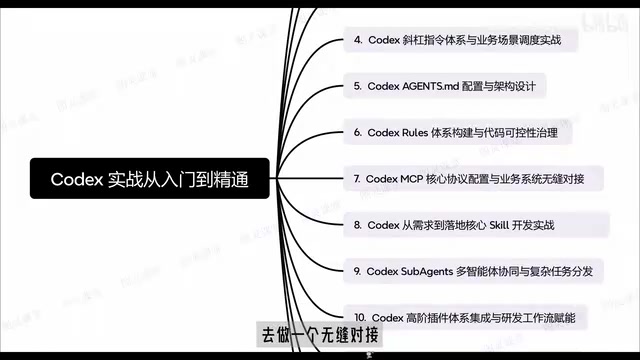
The significance of this capability is that Codex is no longer an isolated code tool — it can connect to internal enterprise data sources, APIs, and services to provide more precise assistance within a real business context. For enterprises looking to modernize existing systems, MCP provides a standardized integration path.
6. Multi-Agent Collaboration and Enterprise Applications
As task complexity increases, a single agent often struggles to handle everything. Codex's SubAgents mechanism supports multi-agent collaboration, handling complex scenarios through task distribution.
In Codex's SubAgents mechanism, an Orchestrator agent is responsible for task decomposition and scheduling — breaking complex tasks into independent subtasks and distributing them to specialized sub-agents for parallel or sequential processing. The advantages of this architecture are threefold: first, it overcomes the length limitations of a single context window, since each sub-agent only needs to handle local context; second, different sub-agents can specialize in specific areas (such as test generation, documentation writing, or security review), improving output quality through specialization; and third, parallel task processing significantly speeds up the handling of large projects. This aligns closely with the microservices architectural philosophy and represents a key technical breakthrough for AI systems handling enterprise-level complex tasks.
This architecture resembles a software team's division of labor: different sub-agents handle their respective subtasks, ultimately collaborating to accomplish complex development goals. For large-scale projects, this capability can significantly improve overall processing efficiency.
Advanced Plugin Development and R&D Workflow Integration
Codex supports advanced plugin integration. Once plugins are incorporated into a project, they can be deeply connected with the R&D workflow. Enterprises can also develop proprietary plugins to achieve customized development capabilities.
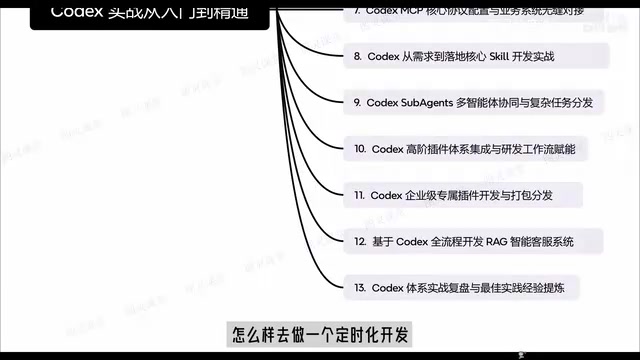
Once a plugin is developed, there are also packaging and distribution considerations — for example, how to make the plugin available for web-based use. Managing the complete plugin lifecycle is an important component of enterprise-level Codex deployment.
7. Hands-On Project: Building a RAG Intelligent Customer Service System
The best way to validate your learning is to build a complete, real-world project. Building a RAG (Retrieval-Augmented Generation) intelligent customer service system from scratch using Codex is one of the most representative practical case studies you can undertake.
RAG (Retrieval-Augmented Generation) is one of the most important engineering patterns in current AI application development, originally proposed by Meta AI Research in 2020. Its core idea is to combine the generative capabilities of large language models with the precise retrieval capabilities of external knowledge bases, addressing the issues of knowledge cutoff dates and hallucinations in LLMs. A standard RAG system architecture consists of three core components: an Indexing Pipeline (which chunks documents and stores their vector embeddings in a vector database), a Retrieval Engine (which performs semantic similarity searches based on user queries), and a Generation Module (which injects retrieved results as context into the prompt to drive the model's response). In intelligent customer service scenarios, RAG enables systems to provide accurate, traceable answers based on a company's private knowledge base (product manuals, FAQs, policy documents) — making it one of the most mature and practically valuable technology paths for enterprise AI deployment today.
Through such a complete project, developers can connect all the capabilities learned previously — environment setup, command usage, configuration management, MCP integration, and multi-agent collaboration — into a complete engineering practice loop.
Conclusion: The Learning Path from Beginner to Expert
The value of systematically learning Codex lies in building a complete capability chain that spans from tool awareness to enterprise-level deployment. By reviewing project practices and extracting best practices, developers can truly transform Codex into a core productivity driver for improving R&D efficiency.
Rather than exploring haphazardly, follow a structured path: Understand the capabilities → Set up the environment → Master interactions → Deep configuration → Enterprise integration → Real-world deployment. This systematic approach will help you avoid common pitfalls and fully unlock the engineering potential of OpenAI Codex.
Key Takeaways
Related articles

WebMCP in Practice: How MakeMyTrip Is Reshaping the Travel Booking Experience
India's largest OTA platform MakeMyTrip uses WebMCP to standardize AI Agent interactions with web apps, replacing fragile DOM scraping with natural language-driven test automation and simplified complex booking scenarios.

Deep Dive into the EYG Programming Language: A New Portable Programming Paradigm Designed for Humans
Deep analysis of the EYG programming language's core design, including algebraic effects, program state persistence, and cross-platform portability, exploring how it addresses modern software fragmentation.

WebMCP in Practice: How MakeMyTrip Is Reshaping the Travel Booking Experience
India's largest OTA platform MakeMyTrip uses WebMCP to standardize AI Agent interaction with web apps, solving DOM scraping fragility, enabling natural language test automation, and simplifying complex international flight bookings.