The Confidence Dilemma in Discrete Diffusion Models: Why Parallel Generation Diverges from the True Distribution

Discrete diffusion's parallel token writing introduces unavoidable distributional bias due to dependency structure that confidence-based strategies cannot overcome.
The paper *Limits of Confidence in Diffusion* mathematically reveals a fundamental limitation of discrete diffusion samplers. By writing multiple token positions in parallel to accelerate inference, these samplers approximate the true joint distribution with a product of marginals — an approximation valid only when positions are conditionally independent. Since real-world pixels, words, and phonemes are naturally dependent, this assumption almost never holds, causing parallel sampling to systematically diverge from the training distribution. Confidence-based position selection — writing the most "certain" positions first — cannot escape this structural constraint: high confidence does not guarantee a correct joint distribution.
The Core Mechanism and Hidden Pitfall of Discrete Diffusion Models
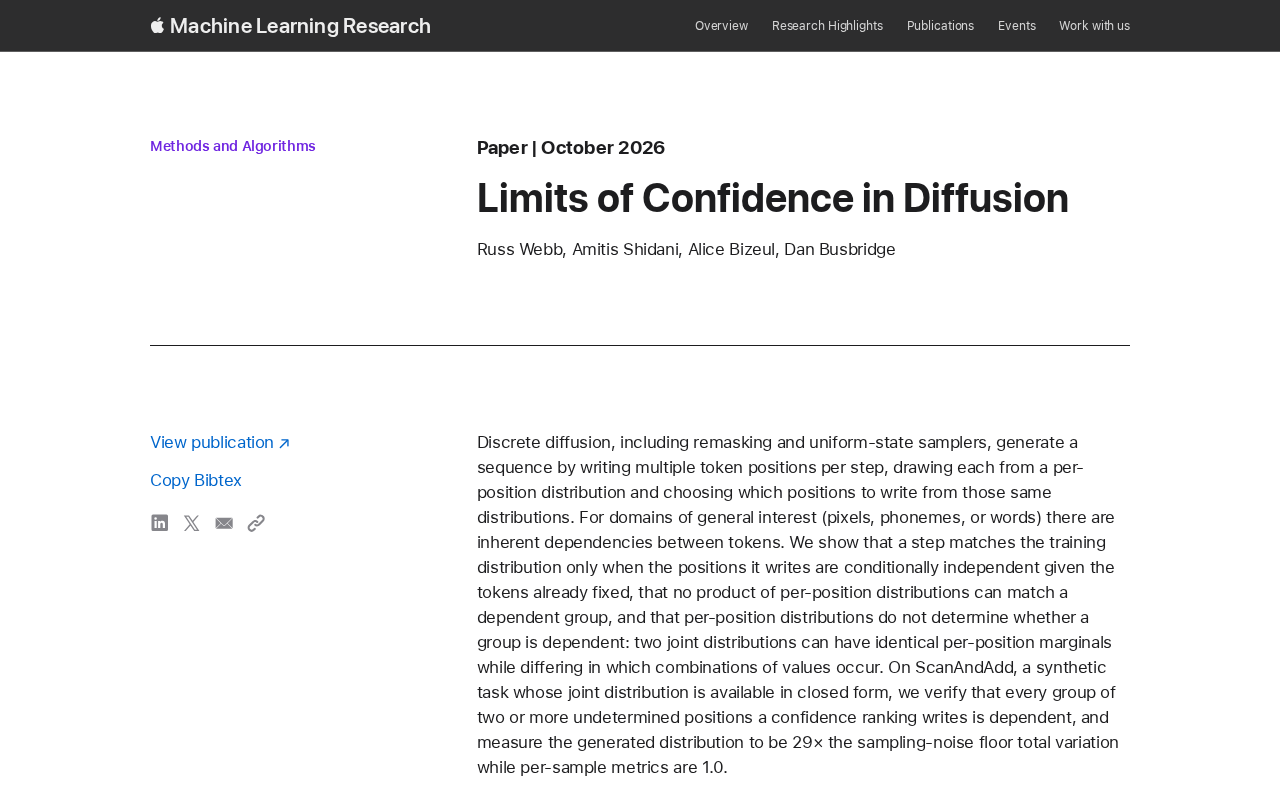
Discrete Diffusion has emerged in recent years as a popular technical approach for generating text, speech, and even images. Unlike autoregressive models that generate tokens one at a time, discrete diffusion samplers — including remasking and uniform-state samplers — write multiple token positions simultaneously in a single step. Each position is sampled independently from its own marginal distribution, which also determines which positions should be written.
This parallel writing design offers significant inference speed advantages, making discrete diffusion a compelling alternative to autoregressive generation. However, a study titled Limits of Confidence in Diffusion points out that this mechanism carries a fundamental mathematical limitation that is difficult to avoid.
Discrete diffusion models operate similarly to continuous diffusion models (such as DDPM commonly used in image generation), but act on discrete token sequences. The forward process progressively replaces original tokens with masks or random tokens until the sequence is fully corrupted; the reverse process trains the model to gradually recover the original content from the corrupted sequence. The remasking sampler uses model predictions at each step to preferentially "confirm" high-confidence positions, then re-masks the remaining ones. The uniform-state sampler allows tokens to randomly jump across the full vocabulary, rather than only switching between mask and real tokens. Both sampler types support writing multiple positions in a single step — the key to their inference speed far surpassing autoregressive models. Representative works include Masked Diffusion Language Models (MDLMs) and subsequent MDLM improvements, as well as generation tasks for structured data such as code and protein sequences.
Conditional Independence: The Hidden Prerequisite for Matching the Training Distribution
The central argument of the research is this: single-step generation in discrete diffusion can truly match the training data distribution only when the positions it writes are mutually independent conditioned on the already-fixed tokens.
In other words, when a sampler writes several positions simultaneously in one step, it is effectively using the product of marginal distributions at each position to approximate the true joint distribution over those positions. Only when there is no conditional dependency between these positions does the product form equal the joint distribution.
The problem is that in the domains we actually care about — pixels, phonemes, or words — tokens naturally exhibit strong dependencies. Adjacent pixels in images are highly correlated; words in language are constrained by grammar and semantics; phonemes in speech are mutually entangled. This means the assumption of "conditional independence" does not hold in the vast majority of practical scenarios.
Product Distributions Cannot Capture Dependency Structure
The paper further proves that any product-form distribution over individual positions cannot match the true distribution of a token combination with dependencies. This is a structural limitation, not an engineering problem that can simply be overcome with more training data or larger models.
When a sampler writes multiple mutually dependent positions at once, the joint distribution it generates is inevitably an approximation where those dependencies have been "forcibly decoupled." The results may appear locally reasonable, but will systematically deviate from the training distribution at the level of the global joint distribution.
From a probability theory perspective, this problem can be quantified using KL divergence. Let the model write position set S in one step, with the true joint distribution being p(x_S | x_{\bar{S}}), while the sampler actually uses the product distribution ∏{i∈S} p(x_i | x{\bar{S}}). When conditional dependencies exist between positions, the KL divergence between the two is strictly greater than zero, and the stronger the dependencies and the more positions written simultaneously, the larger the KL divergence. This bias accumulates across generation steps — the "approximation error" introduced at each step manifests as systematic distortion in the final samples, such as grammatical incoherence in language generation or structural inconsistency in image generation. More critically, this error is independent of model capacity: even with a perfect marginal distribution predictor trained on infinite data, as long as parallel writing involves multiple dependent positions, the product approximation will inevitably diverge from the joint distribution.
The Limits of Confidence
The word "confidence" in the title points to a key design choice in many discrete diffusion samplers — using the confidence of each position's distribution to determine which positions to write first. Intuitively, the more certain the model is about a position (the sharper the distribution), the sooner it should be committed.
However, the research reveals that this confidence-based position selection strategy cannot circumvent the constraint of conditional independence. Even if the model is highly confident about every individual position, as long as the simultaneously written positions have dependencies between them, the product distribution still cannot recover the true joint structure. High confidence does not equal a correct joint distribution — this is precisely where the "limits of confidence" lie.
Implications for Generative Model Design
The significance of this research is not to negate the discrete diffusion approach, but to clarify its capability boundaries. It provides a theoretical basis for understanding the fundamental trade-offs between diffusion-based parallel generation and autoregressive generation.
- Speed vs. fidelity trade-off: Writing more positions in parallel speeds up inference, but also increases the risk of diverging from the true distribution — especially when those positions are mutually dependent.
- The importance of how many positions are written per step: Writing only one position (or conditionally independent positions) per step can theoretically match the distribution exactly; writing more dependent positions leads to greater error accumulation.
- Design space for sampling strategies: Future sampler designs need to more carefully identify which positions are approximately conditionally independent in the current context, so as to strike a balance between speed and correctness.
For practitioners in generative model research and engineering, this means that while pursuing inference acceleration, one must squarely face the distributional bias introduced by parallel sampling — and cannot simply rely on confidence heuristics to guarantee generation quality.
From an engineering standpoint, one viable mitigation direction is adaptive step-size control: during the early stages of sequence decoding (when uncertainty is high and dependencies are strong), write only a small number of positions per step; as more tokens are fixed and the conditional dependencies among remaining positions weaken, gradually increase the number of parallel writes. This aligns with the broader idea of "progressive decoding." Another direction is to introduce structured joint sampling — for example, using Gibbs sampling or MCMC corrections to approximate the true joint distribution — at the cost of increased inference complexity. Researchers are also exploring whether certain data modalities (such as byte-level sequences or certain encoding spaces) have naturally weaker conditional dependencies between tokens, making the distributional bias from parallel sampling practically acceptable. Understanding this theoretical boundary helps make more informed architectural decisions when selecting models.
Conclusion
With clear mathematical arguments, this research reveals a fundamental limitation of discrete diffusion samplers in parallel generation: only conditionally independent positions can be safely written simultaneously, yet real-world data is almost always full of dependencies. It reminds us that gains in generation speed should not come at the cost of faithfulness to the true distribution. Understanding this boundary is a prerequisite for designing the next generation of diffusion samplers.
Related articles

Chain of Thought Isn't Just for AI: How Humans Can Use CoT to Improve Thinking Quality
Chain of Thought isn't just a prompt trick for large models. Starting from a Hacker News discussion, this article analyzes why CoT works for human thinking too, breaks down actionable ways to transfer it, and highlights the key differences between human CoT and machine CoT.
Cloudflare Teams Up with OpenAI: Closi…
Cloudflare Teams Up with OpenAI: Closing the Loop from Vulnerability Discovery to Defense with AI
Cloudflare uses OpenAI Daybreak to investigate security vulnerabilities and generate reviewable remediation plans, while developers use Codex to boost coding efficiency and quality.

Orca Multi-Agent Orchestration in Practice: A Guide to Parallel Collaboration with Claude and Codex
Orca is Stable AI's free open-source agent workbench supporting 34 agents like Claude Code and Codex in parallel. Learn its Git worktree isolation, multi-model orchestration, and mobile management.