The Core Competencies of Engineers in the AI Era: Systems Thinking and Human Judgment

AI doesn't diminish specialization—it shifts engineers toward systems thinking, problem framing, and human-AI coordination.
The article argues that AI is changing how engineering work is divided: engineers shift from executing every technical step to deciding how humans, machines, and expert knowledge collaborate. AI lowers the barrier to cross-domain exploration, not professional judgment, making systems thinking a key competency—engineers must decide what to delegate to AI, what requires human verification, and when experts should decide. AI can give convincing answers on weak assumptions, making human roles in context, values, responsibility, and judgment more important. The article recommends IEEE provide shared expectations through problem-oriented cross-disciplinary communities and actionable human-AI collaboration standards, and introduces the "boundless engineer": boundaries are easier to cross, but defining problems, judging evidence, and taking responsibility remain human.
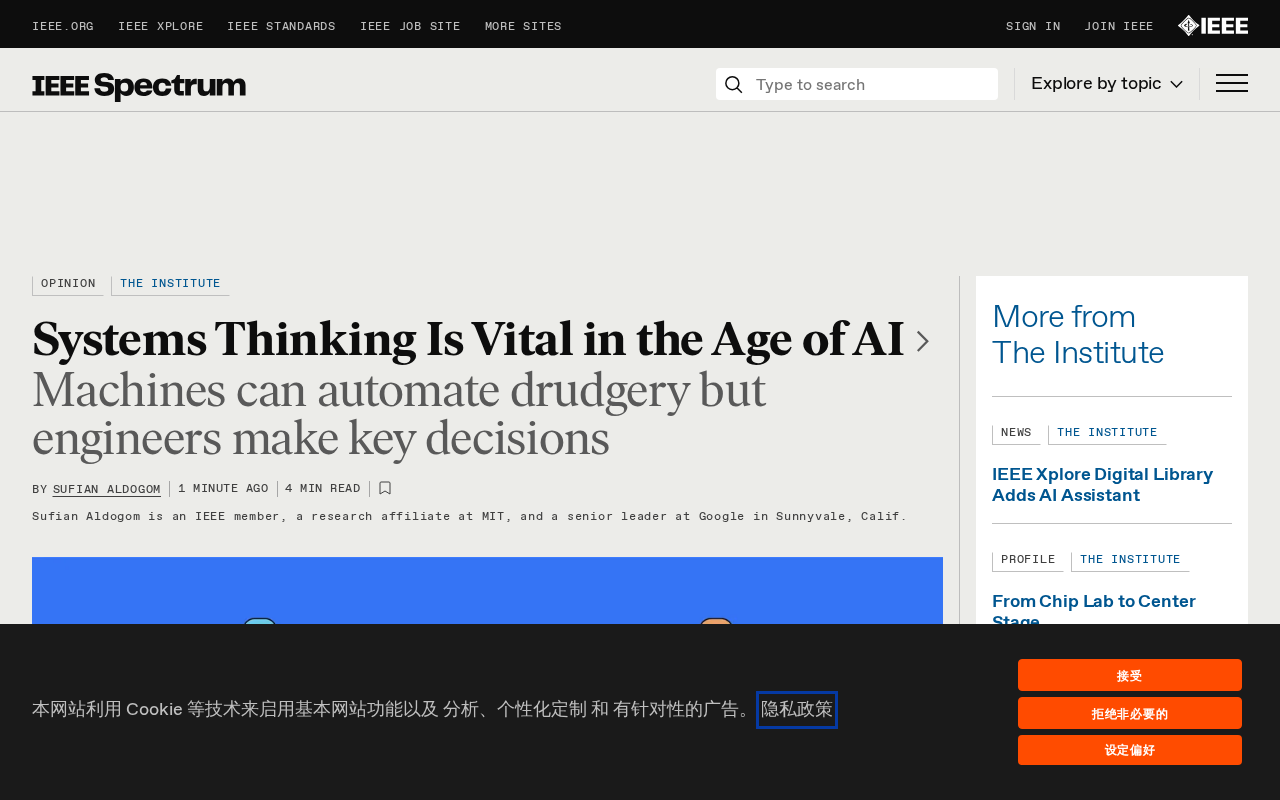
AI is changing how engineering work is divided. An engineer can define a problem, then have AI search relevant research and technical standards, generate design options, test and compare results in simulation, and hand the results to experts who can identify AI's blind spots—such as whether a design can be built safely, whether it makes sense in a specific context, and what impact it will have on users. The decision of whether and how to proceed ultimately remains with humans.
The core argument of this IEEE Spectrum opinion piece is that AI does not diminish the value of specialization; instead, it shifts the engineer's role from "executing every technical step" to "deciding how humans, machines, and expert knowledge collaborate." This means systems thinking becomes a key competency for engineers in the AI era.
The Engineer's Role Is Being Redefined
Traditional engineering is divided into disciplines—electrical, mechanical, civil, software, and so on—and for good reason: each field requires years of accumulated deep knowledge. AI does not replace that depth; it changes how easily engineers can explore problems outside their own specialty.
The article gives a concrete scenario: a software engineer involved in medical device development can use AI to search biomedical research, understand unfamiliar terminology, analyze data, and build early prototypes. But this does not turn the software engineer into a doctor or biomedical expert—it enables them to ask better questions before collaborating with specialists.
This distinction matters. What AI lowers is the barrier to cross-domain exploration, not the barrier to professional judgment. The same applies in energy, transportation, manufacturing, and other fields—a problem may start in software and quickly involve hardware, safety measures, economics, human behavior, and regulation. Engineers don't need to master every domain, but they need to identify what expertise a problem requires and bring the right people and tools together.
Why Systems Thinking Has Become More Important
Systems thinking requires engineers to see the whole picture: understanding how parts affect one another, identifying constraints and failure points, and making trade-offs. AI adds a new dimension to this process—engineers must not only decide how technical components connect, but also which work to delegate to AI, which must be verified by humans, when experts should make the call, and when the problem needs to be redefined.
The article's summary of an engineer's value is worth remembering: an engineer's value lies not in knowing everything, but in knowing how to frame problems, how to ask the right questions, how to validate answers, and when another expert should lead the project.
Another easily overlooked point is the dynamic nature of engineering. Technical challenges rarely stay static: new evidence may change objectives, expose hidden constraints, or prove original assumptions wrong. Effective engineers don't rigidly execute an initial specification; they continuously update the problem definition as their understanding of the system deepens. From this perspective, engineering is not just a body of technical knowledge but a disciplined way of thinking about projects.
Why Human Judgment Is Irreplaceable
The article is quite direct about AI's limitations: AI may give convincing answers on weak assumptions; it may generate code that passes one test but fails another; it may summarize research without understanding which evidence is strongest; and it may optimize a design for the wrong objective.
These limitations make human professional judgment more important, not less. Machines are suited to speed, scale, search, pattern recognition, and data generation; humans are irreplaceable for context, values, responsibility, and judgment. The challenge is drawing the line between the two.
The medical sensor example in the article illustrates what collaboration actually looks like: AI may generate multiple design options and predict performance; engineers test the predictions and eliminate options that violate technical requirements; clinicians judge whether the sensor can be used in practice; patients and practitioners may reveal problems that neither engineers nor developers anticipated. The final solution emerges from the overlay of multiple perspectives. Engineers remain builders and experts, but increasingly they are coordinators of knowledge.
The article mentions that "AI may give convincing answers on weak assumptions," which in AI research is often classified as "hallucination"—the model generates content that seems plausible but is factually incorrect or unsupported. Related is the "alignment" problem: how to make AI systems' objectives consistent with human values and intentions. These concepts explain why AI output needs to be treated with caution: models excel at pattern matching and generation, but they don't truly "understand" the weight of evidence, nor can they be held accountable for wrong optimization objectives. Understanding the limitations of hallucination and alignment helps engineers set appropriate verification checkpoints when designing human-AI collaboration workflows, rather than blindly trusting AI's fluent output.
IEEE's Role: Cross-Disciplinary Communities and Collaboration Standards
The article argues that this broader form of engineering creates important space for IEEE. IEEE's societies already bring together expertise in technology, engineering education, and technical standards, which positions them to help engineers collaborate across specialties without diminishing the value of specialization.
There are two specific recommendations. First, establish more communities around problems that require multi-domain expertise—such as trustworthy clinical AI, resilient infrastructure, energy reliability, scientific discovery, and safe autonomous systems. Engineers can start from their own specialty and collaborate with experts from other IEEE communities as projects require.
Second, develop practical standards for human-AI collaboration. Engineers need clear guidance on: when AI-generated work must be verified, how uncertainty should be documented, when expert decisions are mandatory, and who is responsible when a system uses both human judgment and machine output. The article emphasizes that these questions are becoming part of everyday engineering and should not be answered separately by each company or project manager; professional organizations can provide shared expectations across roles, industries, and technical domains.
The article recommends developing practical standards for human-AI collaboration, which touches on the fundamental role of technical standards in engineering practice. Standards are normative documents formed through multi-stakeholder consensus coordinated by professional organizations, used to unify terminology, processes, testing methods, and responsibility boundaries so that practitioners across companies, industries, and regions can collaborate. The IEEE Standards Association (IEEE-SA) is one of the world's leading standards development organizations, with processes that emphasize openness, consensus, and cross-stakeholder participation. In human-AI collaboration scenarios, standards can specify verification requirements for AI-generated content, methods for documenting uncertainty, and accountability, thereby transforming questions previously decided ad hoc by individual project managers into shared industry expectations.
The "Boundless" Engineer: A Broader Definition of Engineering
The article concludes by returning to the fundamentals of engineering education: AI will not make engineering disciplines less important; it makes the connections between disciplines easier to use. Deep expertise gives engineers the foundation to judge what is reliable, systems thinking helps them understand how the parts of a problem fit together, AI expands their ability to explore, test, and communicate across domains, and human judgment provides direction and responsibility for the work.
Engineers are defined not just by job titles or fixed tasks, but by a trained capability: understanding complex systems, defining and redefining problems, assembling the knowledge and tools needed, validating whether solutions are feasible, and taking responsibility for outcomes. This is what the article calls the "boundless" engineer—professional boundaries are easier to cross, machines may take on more technical work, but the core of engineering remains human: deciding which problems are worth solving, what evidence is good enough, how the parts fit together, and what to do when answers are uncertain.
Related articles

Fifty Years Studying Power: Robert Caro's Writing and Insights on Power
Robert Caro reflects on 50 years studying power: Lyndon Johnson's persuasion and leverage, Robert Moses's transformation from idealist to ruthless builder, the dilemmas of large-scale construction, and his methods of compressing themes and solitary focus in biography writing.

Can a $20,000 Robot Do Your Chores? The Test Results Are Surprising
A YouTube test video shows how a $20,000 robot responds to commands like washing dishes, turning off lights, taking out trash, and feeding the dog. This article analyzes its real capability boundaries, the state of voice interaction technology, and how far household robots are from mainstream adoption.

The Complete Guide to Running AI Models Locally: Inference Engines and Tool Stack Explained
A systematic breakdown of the complete local LLM tool stack: from PyTorch and GGML compute libraries to llama.cpp, vLLM, SGLang inference engines and Ollama, LM Studio wrapper layers, with benchmark data on performance differences and selection logic.