The Cost Reduction Dilemma in AI Verification Systems: How to Read Less Evidence Without Missing What Matters
In AI verification pipelines, the costly bottleneck is reading evidence — and cutting it risks silently losing critical minority signals.
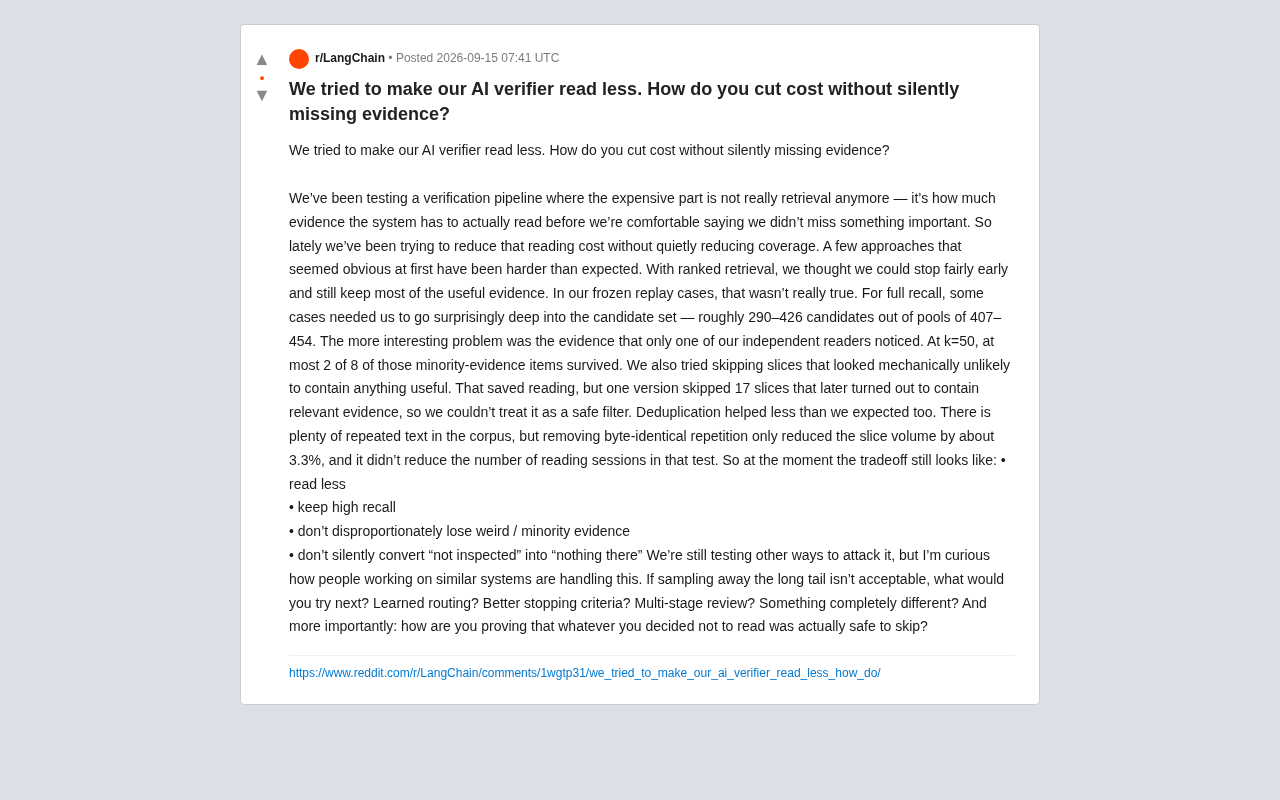
An engineering team building an AI fact-checking pipeline discovered that system costs have shifted from retrieval to evidence reading, and every attempt to reduce reading volume hits the same deep contradiction. Ranked retrieval doesn't make early stopping safe — tests showed some cases required reading 426 of 454 candidates for full recall. Aggressive truncation disproportionately sacrifices minority evidence caught by only a single reader; skipping low-probability slices and deduplication both yielded far less than expected, with deduplication reducing slice volume by just 3.3% and not cutting reading sessions at all. The team frames the core dilemma as an inescapable burden of proof: how to rigorously demonstrate that what you've decided not to read is truly safe to skip.
When building AI verification pipelines, a counterintuitive cost bottleneck has emerged: the truly expensive step is no longer retrieval — it's how much evidence the system must actually read before it can be confident it hasn't missed anything important. An engineer shared on Reddit how their team attempted to cut this "reading cost," exposing several problems that look simple on the surface but prove surprisingly thorny in practice.
This touches on a core tension in RAG (Retrieval-Augmented Generation) and automated fact-checking systems: the less you read, the cheaper it gets — but once coverage quietly drops, the system risks silently converting "not checked" into "nothing here."
Early Stopping: The Illusion of Ranked Retrieval
The team's initial assumption was straightforward: since they were using ranked retrieval, high-value evidence should cluster near the top, so stopping after reading to a certain depth should still preserve most useful evidence.
But in "frozen replay" test scenarios, this assumption didn't hold. Achieving full recall required reading quite far down the candidate list in some cases — roughly 290 to 426 out of 407 to 454 candidates. In other words, to avoid missing evidence, the system had to read through nearly the entire candidate pool, and early stopping saved far less cost than expected.
This finding directly challenges the widely held belief that "a good ranking model lets you stop early." When evidence isn't distributed according to an ideally concentrated long-tail pattern, ranking quality alone cannot guarantee coverage.
Ranked retrieval typically relies on mechanisms like BM25, bi-encoder models, or cross-encoders to surface the most query-relevant documents or chunks at the top. The underlying assumption borrows from information retrieval's "precision-recall curve" intuition: relevant documents should concentrate near the top of the ranking, so reading the top-k results should cover most valuable information. This assumption holds only when relevance follows a pronounced head-heavy distribution. In fact-checking scenarios, however, evidence is often scattered across different sources and formats throughout the corpus. A critical piece of rebuttal evidence might be ranked poorly by the model due to phrasing discrepancies, causing it to sink deep into the candidate list. "Frozen replay" testing reveals this problem precisely because it fixes the retrieved result set, eliminates randomness, and lets researchers count exactly "how far down you need to read" to avoid missing evidence — an offline evaluation method that essentially measures the upper bound of a ranking model's evidence coverage.
Minority Evidence: The First Thing to Be Sacrificed
An even thornier problem involves "minority evidence" — information noticed by only a single independent reader.
With k=50, at most 2 out of 8 such minority evidence items could "survive." This means any aggressive truncation strategy disproportionately loses the "weird," edge-case, but potentially critical evidence.
This is precisely the most dangerous failure mode for automated verification systems: mainstream evidence tends to appear redundantly and gets captured easily, while the piece that actually determines whether a conclusion is correct may be exactly the one clue caught by just a single reader. When a system samples and discards the long tail to cut costs, it's often sacrificing this hard-to-reproduce critical information.
In multi-reader parallel architectures, the system typically distributes the candidate document set across multiple independent readers for parallel processing, then aggregates their findings. "Minority evidence" refers to information flagged as relevant by only one reader while all others missed it. In ensemble learning frameworks, this is called a "low-consensus signal" — its very existence indicates the evidence sits at a semantic boundary, relating to the query in an atypical way that standard relevance models struggle to consistently capture. A k=50 setting means each candidate chunk is processed on average by one of 50 readers, and minority evidence "survives" statistically only if at least one reader covers it. When truncation strategies compress total reading volume, these low-frequency, edge-case hits are the first to disappear from the system's view — and they tend to correspond precisely to the most fragile, error-prone parts of the claims being verified.
Skipping Slices and Deduplication: Optimizations with Limited Returns
The team also tried two more "mechanical" optimization approaches, both with disappointing results.
Skipping low-probability slices: They attempted to skip slices that appeared unlikely to contain useful information based on surface-level features. This did reduce reading volume, but one version skipped 17 slices that were later found to contain relevant evidence. Since the risk of missed detection exists, it cannot be used as a "safe filter."
Deduplication: The corpus contained substantial duplicate text, and intuitively deduplication should significantly reduce workload. But in practice, removing byte-level exact duplicates reduced slice volume by only about 3.3%, and didn't reduce the number of reading sessions at all. The presence of redundant text doesn't equate to reading burden that can be safely skipped.
The Core Trade-off: Four Goals That Can't Be Achieved Simultaneously
Drawing on these experiments, the team distilled the dilemma into a set of mutually conflicting constraints that all need to be satisfied at once:
- Read less (reduce cost)
- Maintain high recall (miss no evidence)
- Don't disproportionately lose strange/minority evidence
- Don't silently convert "not checked" into "nothing here"
The last constraint is the heart of the problem. Any cost-reduction approach can easily look good on metrics, because skipped content is implicitly treated as "empty." The real challenge isn't deciding what to skip — it's proving that what you've decided not to read can actually be safely skipped.
The tension among these four constraints is formally analogous to the CAP theorem in database design — where in distributed systems, consistency, availability, and partition tolerance cannot all be guaranteed simultaneously. In high-recall verification systems, "low cost" and "complete coverage" are in structural conflict, and the constraint about not silently converting "unchecked" to "no content" is particularly insidious: most evaluation metrics (such as accuracy and F1) cannot distinguish between "the system checked and found no relevant evidence" and "the system never checked at all." This causes cost-reduction optimizations to appear lossless at the metrics level while actually introducing systematic blind spots. This kind of "silent coverage degradation" is especially dangerous in high-stakes scenarios like legal document review and medical evidence auditing, where the cost of a missed detection is asymmetric — missing a single critical rebuttal piece of evidence is far more costly than reading dozens of redundant documents.
Possible Directions and Open Questions
The original poster outlined several paths still under exploration and invited community input:
- Learned routing: Training a model to dynamically decide which content warrants deeper reading.
- Better stopping criteria: Moving away from fixed k values toward dynamic judgments based on evidence sufficiency.
- Multi-stage review: Coarse filtering followed by close reading, using a layered structure to control costs.
But regardless of which approach is taken, one critical verification question remains unanswered: how do you actually demonstrate that what was skipped is safe to skip? If sampling and discarding the long tail is unacceptable, what's the next step?
This is a deeply practical challenge for any team building retrieval-based verification, compliance review, legal document checking, or other high-recall systems. It's a reminder that in AI cost optimization, there's a gap between "looks like we saved money" and "we truly didn't miss anything" — a gap that requires rigorous proof to bridge.
Related articles
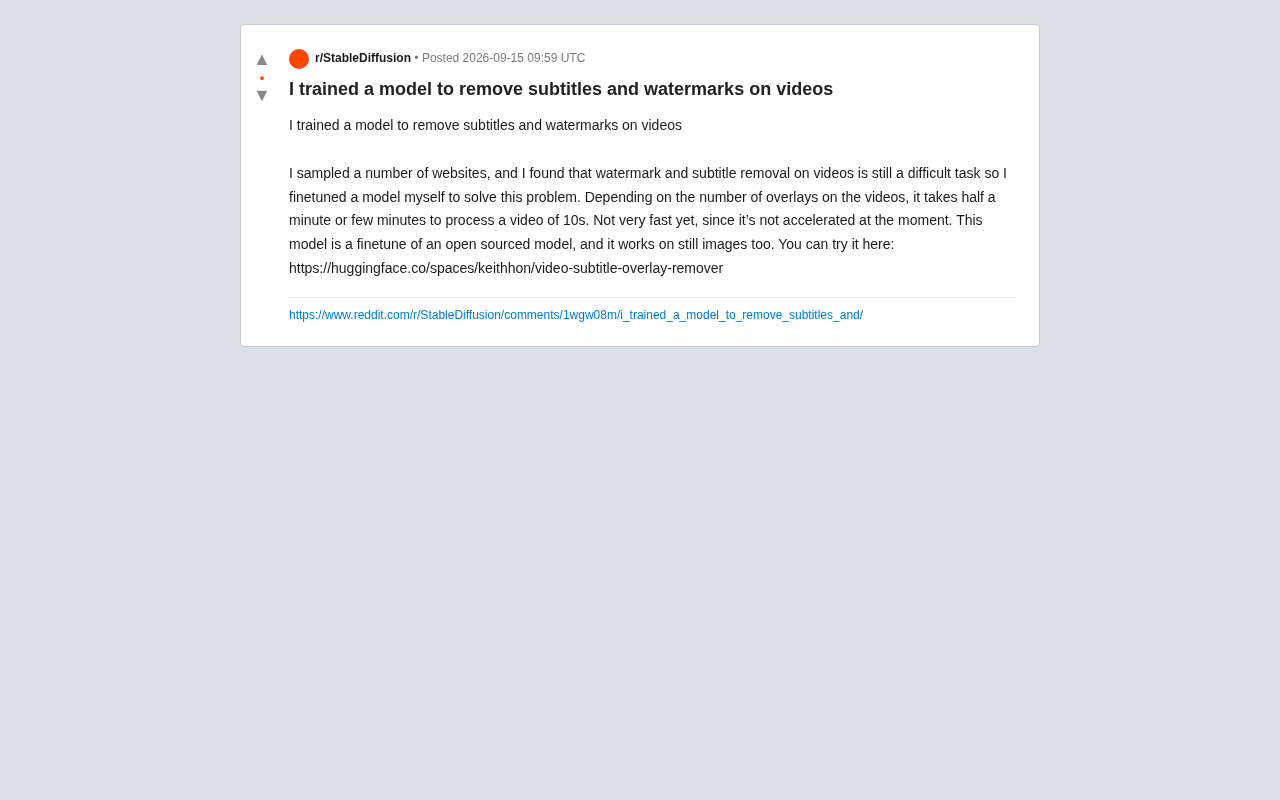
Developer Fine-Tunes AI Model to Remove Video Subtitles and Watermarks
A developer fine-tuned an open-source model to remove subtitles and watermarks from video and images, deploying it on Hugging Face for public use.

Salesforce and Nvidia Launch Koa: How Open-Weight Models Are Disrupting Enterprise AI
Salesforce and Nvidia's Koa reasoning model targets sales, marketing, and customer support using Nvidia's open-weight Nemotron. Here's why this vertical AI strategy should worry general-purpose AI labs.

H3 Acceleration Arena Adds Three New Models: Community Crowdsourced AI Performance Testing
H3 Acceleration Arena adds VDN-H3, TaoMate H3, and LightX2V 1.2. Community votes compare new vs. old models on acceleration performance. Here's what to know.