The Danish Bestseller Mystery: How Can Computational Stylometry Identify the True Author of 'The Dead Laundress'?

Four authorship attribution algorithms consistently point to Nordbo, but segmentation analysis suggests a possible co-author.
A study used four authorship attribution methods—Delta, intertextual distance, Nearest Shrunken Centroids, and naïve Bayes—to systematically analyze the 2017 Danish novel *The Dead Laundress*, consistently identifying Mads Peder Nordbo's writing style as dominant. Segmentation analysis showed that most 5,000-word segments matched Nordbo's style, but a few segments suggested another possible author (such as credited author Sara Omar), indicating the novel may be co-authored. Researchers stress that algorithmic results are not decisive; authorship attribution only reveals stylistic similarity and must be combined with historical context, witness testimony, and other evidence. The study illustrates both the potential and limitations of computational stylometry in literary identification.
Introduction: When Literature Meets Algorithms
In 2017, the Danish novel Dødevaskeren (The Dead Laundress) was published under the name Sara Omar and quickly became a bestseller. However, a Danish peer raised doubts: the novel might have come from another author's hand, with suspicion pointing to Mads Peder Nordbo. This authorship controversy concerns not only literary reputation but also a core question: can we objectively identify a text's author using computational methods?
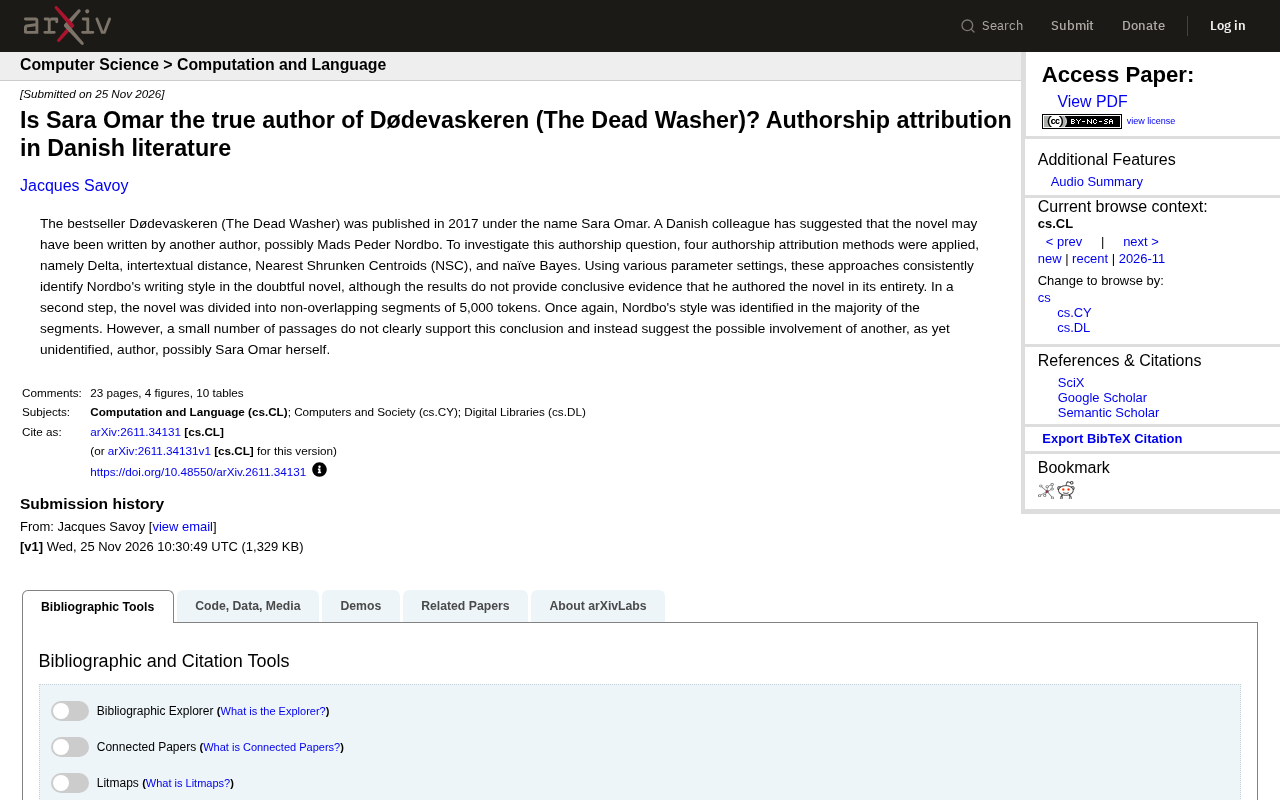
A recent study applied four authorship attribution methods to systematically analyze The Dead Laundress. The results showed that multiple algorithms consistently identified Nordbo's writing style, though the evidence was not conclusive enough to settle the matter definitively. This study demonstrates both the potential and the limitations of computational stylometry in literary identification.
Authorship Attribution Methods: Cross-Validation Across Four Algorithms
The study employed four independent authorship attribution methods: Delta, intertextual distance, Nearest Shrunken Centroids (NSC), and naïve Bayes. These methods are based on different statistical principles, quantifying writing style along dimensions such as word frequency and syntactic features.
By adjusting various parameter settings, all four methods consistently pointed to Nordbo's style in The Dead Laundress. This cross-method consistency strengthens the reliability of the results—a single method might be biased by parameter choices, but when multiple methods reach the same conclusion, it indicates that the signal is genuinely present.
However, the researchers cautiously note that these results do not constitute decisive evidence that Nordbo wrote the entire novel. Authorship attribution analysis can only reveal stylistic similarity; it cannot directly prove copyright ownership.
The Delta method, proposed by John Burrows in 2002, is one of the most classic and widely used authorship attribution techniques in computational stylometry. Its core idea is to select the most frequent function words in a text (such as articles, prepositions, and conjunctions), compute the frequency differences between the target text and candidate authors' works on these words, standardize them via z-scores, and take the mean absolute difference as a distance measure. The smaller the distance, the closer the style. The Delta method is somewhat sensitive to parameters (such as vocabulary size and distance measure), but it is widely adopted for its simplicity and effectiveness.
Intertextual distance, proposed by French scholar Dominique Labbé, is also based on word frequency but uses a specific statistical distance formula (such as a variant of relative entropy) to quantify the difference between two texts. It particularly emphasizes the impact of text length on distance calculation and proposes correction methods.
Nearest Shrunken Centroids (NSC) is a classifier based on centroid shrinkage, originally used for gene expression data analysis and later introduced to authorship attribution. It reduces the risk of overfitting in high-dimensional small-sample settings by shrinking the class (author) word-frequency centroids toward the overall mean.
Naïve Bayes is a probabilistic classifier based on Bayes' theorem with the assumption of conditional independence among features, commonly used in text classification. In authorship attribution, it uses word frequencies to estimate the probability of a given text under each author and selects the author with the highest posterior probability as the decision.
Segmentation Analysis: Revealing Potential Co-Authorship
To investigate further, the study divided the novel into non-overlapping 5,000-token segments and analyzed each one. The results showed that most segments were still attributed to Nordbo's style. This suggests that the main body of the novel may indeed have been written by Nordbo.
However, a few segments did not clearly support this conclusion. These passages instead suggested the possible presence of another, as-yet-unidentified author—perhaps Sara Omar herself. This finding adds a new dimension to the controversy: the novel may be a co-authored work rather than the product of a single author.
The value of segmentation analysis lies in its ability to capture stylistic variation within a text. Traditional whole-text analysis may mask local differences, whereas segmentation methods help detect potential traces of collaboration or editorial intervention.
Segmentation analysis is an important strategy in authorship attribution research, particularly suited to detecting co-authorship, ghostwriting, or editorial intervention. Its basic assumption is that if a text was written by a single author, the stylistic features of each segment should be relatively consistent; if multiple authors are involved, different segments may show systematic stylistic differences. Common segmentation approaches include splitting by fixed word count (e.g., every 5,000 words) or by chapters or paragraphs. After segmentation, authorship attribution analysis is performed independently on each segment, and the distribution of decisions is then examined. Note that the choice of segment length affects statistical power: segments that are too short yield unstable word-frequency estimates, while segments that are too long may mask local variation. Therefore, researchers often test robustness using multiple segment lengths. In addition, segmentation results should be interpreted in conjunction with external information such as narrative structure and chapter divisions, to avoid mistaking topic changes or editorial revisions for author changes.
Limitations and Implications of Computational Stylometry
Although cross-validation across four methods increases credibility, authorship attribution analysis still has inherent limitations. First, the algorithms depend on the quality and representativeness of the training corpus; second, stylistic similarity does not equate to the same author—the same author may also change style due to subject matter, editing, or other factors; finally, phenomena such as imitation, parody, or ghostwriting in literary creation are difficult for algorithms to fully identify.
The significance of this study goes beyond a single case. It demonstrates how computational tools can assist literary research, offering a data-driven perspective on authorship controversies. At the same time, it reminds us that algorithmic results should be treated as one piece of evidence, not the sole verdict. In literary identification, only by combining historical context, witness testimony, and internal textual evidence can we get closer to the truth.
Conclusion: A Dialogue Between Algorithms and the Humanities
The mystery of The Dead Laundress's authorship has not been fully resolved, but computational stylometry has already provided valuable clues. With advances in natural language processing technology, authorship attribution analysis will become more refined and is expected to play a greater role in literature, law, and publishing. For readers and researchers alike, the controversy itself also prompts reflection on the nature of authorship: style is the author's fingerprint, but fingerprints are not necessarily unique.
One-line Summary
Four authorship attribution algorithms consistently point to Nordbo, but segmentation analysis suggests a possible co-author.
Paragraph Summary
A study applied four authorship attribution methods—Delta, intertextual distance, Nearest Shrunken Centroids, and naïve Bayes—to systematically analyze the 2017 Danish novel The Dead Laundress, consistently identifying Mads Peder Nordbo's writing style as dominant. Segmentation analysis showed that most 5,000-word segments matched Nordbo's style, but a few segments suggested the possible presence of another author (such as the credited author Sara Omar), indicating the novel may be a co-authored work. The researchers emphasize that algorithmic results are not decisive evidence; authorship attribution analysis can only reveal stylistic similarity and must be combined with historical context, witness testimony, and other factors for comprehensive judgment. The study demonstrates both the potential and limitations of computational stylometry in literary identification.
Related articles

Prospero: A Lightweight Native AI Coding Tool Built with ImGui
Prospero is a bloat-free native AI coding tool built with ImGui, emphasizing lightweight design, high performance, and low dependencies. This article analyzes its design philosophy, technical choices, and the divergence between platformization and toolization in AI coding tools.

WebRTC Abused: New Variant of Credit Card Skimming Scripts on Shopping Sites
Security researchers found skimming scripts on popular shopping sites using WebRTC data channels to exfiltrate credit card data. This article analyzes the technical原理, differences from traditional Magecart attacks, and defense strategies for e-commerce platforms in third-party script governance and CSP policies.

Single GB10 Card Hits 101 tok/s: Inkling 2 Mini Performance Tested on vLLM
A developer shared on Hacker News running Inkling 2 Mini with vLLM on a single GB10 at 101 tok/s. This article analyzes the technical context, the significance of vLLM with small models on single cards, and caveats for interpreting tok/s metrics.