The Debate Over AI Tool Usage Limits: Calls to Remove the 5-Hour Threshold Win Out

Reddit vote shows AI users prefer weekly usage quotas over disruptive 5-hour rate-limit windows.
A Reddit community poll debated two AI tool rate-limiting approaches: a "5-hour usage window" versus a "weekly quota." Users clearly favored the latter. Short-cycle limits are highly interruptive, repeatedly breaking deep-work flows like coding or writing; weekly quotas return scheduling autonomy to users. The two models reflect different product philosophies — short windows serve platform load balancing, while weekly quotas trust users to self-manage. The vote signals that uninterrupted continuity matters more to users than raw total usage, offering a telling reference point for AI product rate-limit design.
A Community Vote on Usage Limits
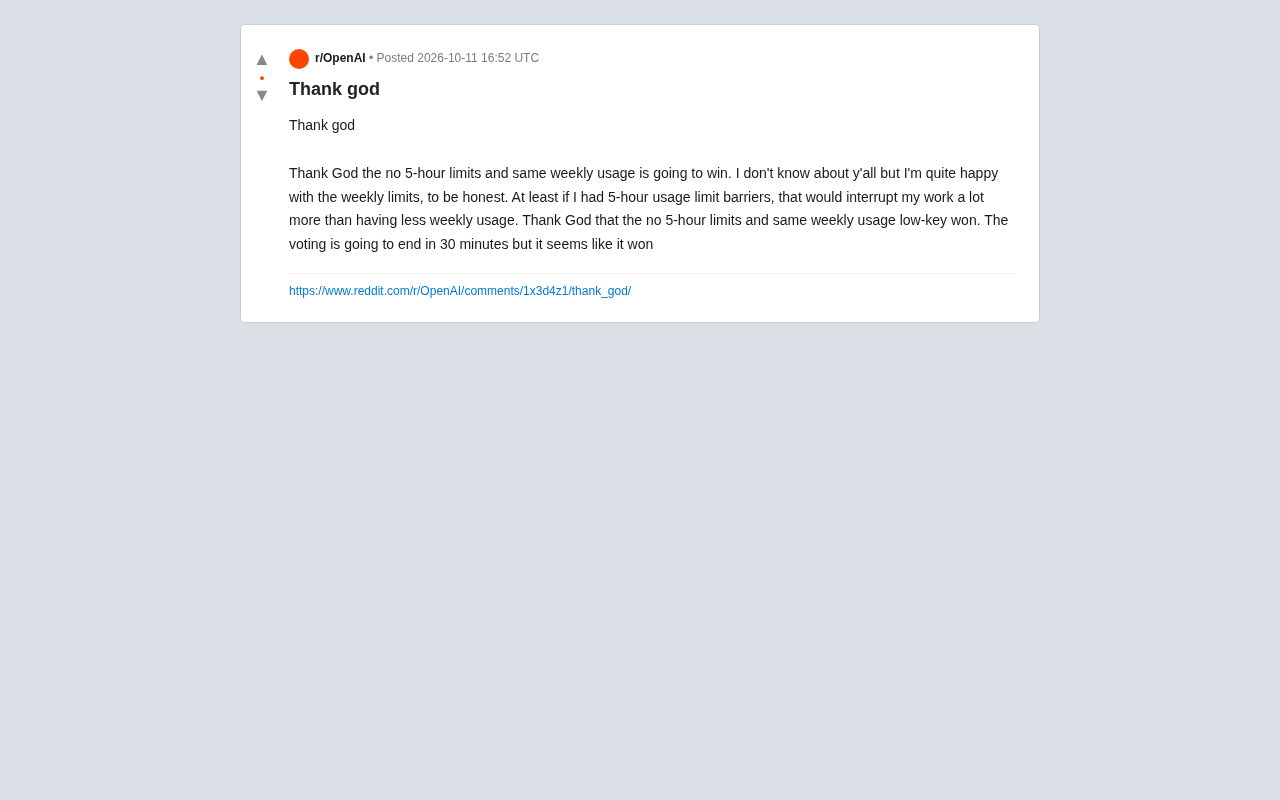
A Reddit poll sparked widespread discussion about AI tool usage limit mechanisms. The core debate centered on two approaches to billing and rate limiting: a short-cycle "5-hour usage window" versus a more flexible "weekly usage quota."
According to the original poster, as the vote neared its end, the option to "remove the 5-hour limit while keeping the weekly quota" appeared to be winning by a clear margin. The user made no bones about their preference: compared to hard short-cycle thresholds, a weekly quota is far less disruptive to actual work.
Why the 5-Hour Limit Frustrates Users
The problem with short-cycle limits is their interruptive nature. The original poster highlighted a key pain point: if a usage cap triggers every 5 hours, workflows get repeatedly broken. For tasks that require prolonged, immersive focus — such as continuous coding, document writing, or complex reasoning — these frequent "cooldown periods" severely disrupt momentum.
In other words, the granularity of a limit determines the user experience. A weekly quota may seem tighter in theory, but it hands control back to the user: you can work intensively on one day, or spread usage across the entire week. That kind of flexibility is exactly what deep-work scenarios need most.
Weekly Quota vs. Short-Cycle Window: A Fundamental Difference
The two rate-limiting models reflect fundamentally different product philosophies.
The Logic Behind Short-Cycle Windows
Designs like the 5-hour window are typically intended to smooth server load and prevent individual users from monopolizing compute resources in a short burst. From a platform operations standpoint, this distributes peak load more evenly — but at the cost of users' workflow continuity.
This approach has well-established precedents in cloud computing and SaaS. Technically known as Rate Limiting or Sliding Window Throttling, common implementations track a user's request volume or compute consumption within a fixed or sliding time window, triggering a cooldown once a threshold is exceeded. For AI services, a "5-hour window" likely corresponds to a cumulative cap on GPU compute usage rather than a simple time count — platforms use this to ensure quality of service (QoS) during high-concurrency periods and prevent a small number of heavy users from crowding out the shared compute pool and slowing response times for other subscribers.
The Logic Behind Weekly Quotas
Weekly quotas are closer to a total-volume management approach. They trust users to set their own pace, without hard cuts on when usage can occur. For power users, this means more predictable planning; for platforms, it requires greater backend elasticity to handle uneven usage distribution.
Judging by this vote, the community spoke clearly — users strongly prefer the latter, prioritizing continuity and autonomy over being forced into fragmented time slots.
What This Vote Signals
Though it's just a brief Reddit thread, it reflects the increasingly sophisticated expectations of AI tool users. Once AI assistants become deeply embedded in daily workflows, users care not just about whether they can use the tool, but whether they can use it smoothly.
Rate-limiting policies may look like technical details, but they directly affect productivity. A poorly designed restriction can make paying users feel penalized rather than served. When platforms factor in users' real working rhythms when crafting usage policies, they tend to earn higher satisfaction and retention.
The victory of the "remove the 5-hour limit" option may become a reference case for AI product rate-limit design: fewer rigid time-based thresholds, more total-volume-based flexible management — that's likely the direction that best fits real-world usage patterns.
The concept of Deep Work was introduced by computer science professor Cal Newport. It refers to cognitively intensive tasks requiring high focus and freedom from interruption — such as writing, programming, and complex analysis. Research shows that after an interruption, people need an average of 23 minutes to fully regain their focus. When AI tools — designed to support deep work — become a source of interruption themselves due to their own rate-limiting mechanisms, they end up working against their stated goal of boosting productivity. This explains why "continuity" emerged as the overwhelming priority in this vote. Users aren't rejecting total-volume constraints; they're rejecting having their work rhythm forcibly fragmented.
Summary
This brief discussion highlights an underappreciated detail in the commercialization of AI tools: the design of usage limits. Short-cycle windows and weekly quotas each involve trade-offs, but the community's choice is clear — for heavy users, an uninterrupted, continuous experience matters more than a theoretically larger total allowance.
Related articles

JobRunner MCP Server: AI Agents Can Now Fix Failed Java Jobs
JobRunner launches an open-source MCP server enabling AI agents to view cluster status, diagnose failures, and recover Java jobs—incident response from any cloud coding environment or existing agent.

MLAI Digital Launches 9 Security Agents: MCP Server Safeguards the Full Lifecycle of Agentic AI
MLAI Digital launches Security MCP Server with nine built-in specialized security agents covering vulnerability discovery, attack simulation, prompt injection detection, API and infrastructure assessment, and accelerated remediation—embedding security validation across the full Agentic AI lifecycle from development to production.

Running Isaac Lab on H100 GPUs: Exploring Better Approaches
Exploring optimization methods for running Isaac Lab on NVIDIA H100 GPUs, including MIG configuration, mixed precision, TensorRT acceleration, and community experience to improve robotics simulation and reinforcement learning efficiency.