The Directionality Crisis of Magnetic Graph Networks: How Reciprocity Erases Directional Information

Magnetic graph networks' direction encoding is structurally erased under strong reciprocity, with Top-k selection forcing directional collapse under sparse observations.
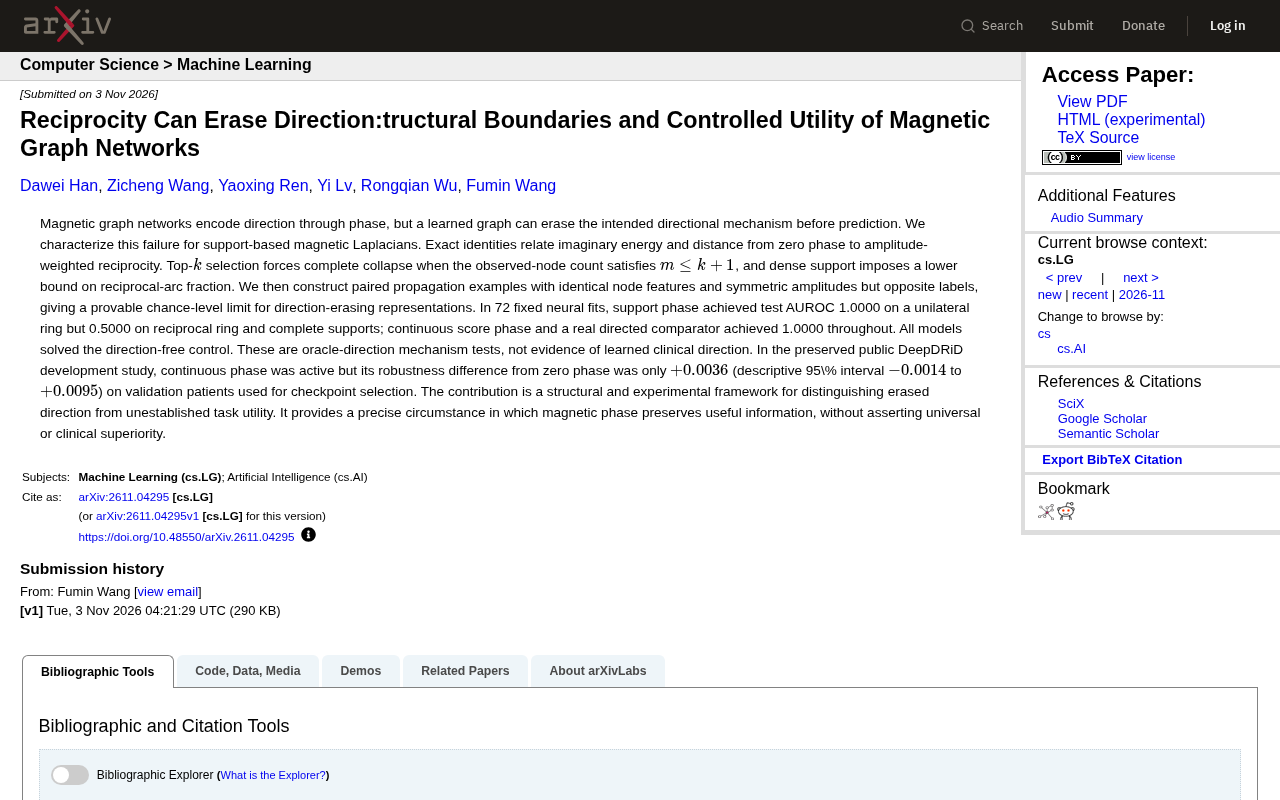
This study reveals a structural flaw in support-based magnetic Laplacians for encoding direction in magnetic graph networks. Exact identities link imaginary-part energy to amplitude-weighted reciprocity, showing that high bidirectional-edge proportions weaken or eliminate directional signals. A key boundary: when observed nodes m ≤ k+1, Top-k selection forces complete directional collapse. Paired propagation experiments provide a provable random-level criterion; 72 neural network fits show support phase AUROC 1.0000 on the unilateral ring but only 0.5000 on the reciprocal ring and full support set, while continuous phase and real directed comparator remain at 1.0000. On DeepDRiD, continuous phase vs. zero phase differs by only +0.0036, not statistically significant. The work emphasizes exact conditions for direction preservation and warns practitioners about reciprocity eroding directional mechanisms.
Introduction: When Directional Information Is "Legitimately" Erased
Graph Neural Networks (GNNs) often rely on Magnetic Graph Networks to encode directional information via phase when processing directed graphs. However, a recent study points out that this seemingly elegant mechanism has a structural flaw: the learned graph structure may erase the intended directionality mechanism before prediction even occurs. The study focuses on support-based magnetic Laplacians and, through exact identities and controlled experiments, reveals a deep tension between reciprocity and the preservation of directional information.
Magnetic Laplacian is a spectral method for handling directed graphs in graph signal processing. It encodes edge direction by introducing a complex phase (typically of the form $e^{i\theta}$) into the adjacency matrix: an edge from node $u$ to $v$ receives a phase $+\theta$, while the reverse edge receives $-\theta$ (or its conjugate). In this way, the directed graph is mapped to a Hermitian matrix whose eigenvalues are all real, allowing Fourier bases and spectral convolutions to be defined just as with the undirected graph Laplacian. In magnetic graph networks, the phase angle $\theta$ is a learnable or preset parameter whose magnitude controls the strength of directional encoding. However, when the graph contains many bidirectional edges, the phase contributions from the two directions cancel each other out, causing the imaginary part of the Hermitian matrix to approach zero and the directional information to vanish.
Support Set in this context refers to the subset of nodes or edges used to construct the magnetic Laplacian. A support-based construction means that only partial observations are used to define the phase structure. While this localized design improves computational efficiency, it also introduces structural constraints: when the support set is limited in size, sparsification operations such as Top-k selection may be forced to include reciprocal edges, thereby destroying directionality already at the phase-encoding stage.
Core Findings: The Mathematical Link Between Reciprocity and Directionality
The study establishes a series of exact identities that relate imaginary-part energy and distance from zero phase to amplitude-weighted reciprocity. Simply put, when the graph contains many bidirectional edges (i.e., reciprocal arcs), the directional signal carried by the magnetic phase is weakened or even completely eliminated.
Complete Collapse Under Top-k Selection
A key structural boundary is: when the number of observed nodes satisfies (m \leq k+1), Top-k selection forcibly causes a complete collapse of directional information. This means that in sparse-observation scenarios, support-based magnetic phase mechanisms may fail entirely. Moreover, dense support sets impose a lower bound on the proportion of reciprocal arcs, further squeezing the space in which directional information can survive.
Top-k selection is a common sparsification strategy: for each node, retain only the $k$ edges with the highest weights (or sort all edges globally by score and take the top $k$). In support-based magnetic Laplacian construction, Top-k selection determines which edges participate in phase encoding. When the number of observed nodes $m \leq k+1$, Top-k forcibly includes a large number of reciprocal edges—because the pool of candidate edges is too small for bidirectional connections to be effectively filtered out. The consequence is that the phase imaginary part is completely canceled, and directional information is lost before prediction. This structural boundary reveals a fundamental contradiction between sparse observation and direction preservation: the sparser the observations, the more likely Top-k is to introduce reciprocity, and the more fragile the directional mechanism.
Paired Propagation Experiments: Provable Random-Level Performance
The researchers constructed paired propagation examples that share identical node features and symmetric amplitudes but have opposite labels. For any representation that erases direction, there is a provable upper bound on classification performance at the random level. This provides a theoretical criterion for identifying direction erasure.
Reciprocity is a concept in graph theory describing the degree of bidirectional connection. If the graph contains both edge $u \to v$ and $v \to u$, the pair is called a reciprocal arc. Reciprocity is usually measured by the reciprocity rate, i.e., the proportion of bidirectional edge pairs among all edges. In magnetic phase encoding, $u \to v$ contributes phase $e^{i\theta}$ and $v \to u$ contributes $e^{-i\theta}$; their sum is $2\cos\theta$, with zero imaginary part. Therefore, the higher the proportion of reciprocal arcs, the weaker the imaginary-part energy of the magnetic Laplacian, and the more severely the directional signal is diluted. The exact identities in this paper precisely link imaginary-part energy to amplitude-weighted reciprocity quantitatively, thereby providing a computable criterion for "when directional information is erased."
AUROC (Area Under the Receiver Operating Characteristic Curve) is a commonly used performance metric in binary classification tasks, ranging from 0.5 (random guessing) to 1.0 (perfect discrimination). This paper uses AUROC to measure whether the model preserves directional information: if the representation erases direction, then positive and negative samples in the paired propagation experiments cannot be distinguished, and AUROC necessarily degrades to 0.5; if directional information is fully preserved, AUROC can reach 1.0. The choice of this metric turns "direction erasure" from a qualitative description into a quantitatively testable conclusion.
Experimental Validation: Boundary Conditions of the Phase Mechanism
In 72 fixed neural network fits, the support phase achieved a test AUROC of 1.0000 on the unilateral ring, but only 0.5000—i.e., random level—on the reciprocal ring and the full support set. By contrast, the continuous score phase and the real directed comparator both achieved 1.0000 in all cases. All models were able to solve simple tasks without directional control.
These results clearly delineate the applicable boundary of the support phase mechanism: it preserves directional information only under specific graph structures and fails completely on graphs with strong reciprocity.
Cautious Validation on a Public Dataset
In a development study on the public DeepDRiD dataset, the continuous phase showed active performance, but its robustness difference relative to zero phase was only +0.0036 (descriptive 95% interval -0.0014 to +0.0095), based on validation patients used for checkpoint selection. This difference is not statistically significant, indicating that the advantage of continuous phase in real tasks is limited.
The researchers emphasize that these are "oracle-direction" mechanism tests, not learned clinical evidence of directionality. Their contribution lies in providing a structural and experimental framework for distinguishing "erased direction" from "task utility that was never established."
DeepDRiD is a public fundus image dataset for Diabetic Retinopathy, containing multi-center fundus photographs and grading labels. This paper uses it as a real-world task scenario to test whether the continuous phase mechanism yields robustness improvements over zero phase (i.e., no directional encoding). It should be emphasized that this experiment is an "oracle-direction" mechanism test: direction labels are given by prior knowledge or external information rather than learned from data. Therefore, the +0.0036 difference only reflects the descriptive performance of continuous phase under known direction conditions and cannot be used to infer that the model can automatically discover clinically meaningful directional structure. This distinction is crucial to avoid overinterpretation.
Significance and Limitations: Exact Conditions for Preserving Directionality
The study precisely characterizes when magnetic phase can preserve useful information, but it does not assert general or clinical superiority. For GNN researchers and practitioners, this work serves as a reminder: when designing directed graph models, one must be wary of reciprocity eroding directional signals and must verify the effectiveness of the directional mechanism through structural analysis or controlled experiments.
Future work could explore more robust phase-encoding schemes or actively control the proportion of reciprocal arcs during graph construction to balance expressive power and preservation of directional information.
One-line Summary
Directional encoding in magnetic graph networks is structurally erased when reciprocity is strong, and Top-k selection forcibly collapses direction under sparse observations.
Paragraph Summary
This study reveals a structural flaw in support-based magnetic Laplacians for encoding directional information in magnetic graph networks. Through exact identities, the authors link imaginary-part energy to amplitude-weighted reciprocity, proving that when the proportion of bidirectional edges is high, the directional signal carried by the magnetic phase is weakened or even completely eliminated. A key boundary is: when the number of observed nodes m ≤ k+1, Top-k selection forcibly causes a complete collapse of directional information. Paired propagation experiments provide a provable random-level criterion; 72 neural network fits show that the support phase reaches AUROC 1.0000 on the unilateral ring but only 0.5000 on the reciprocal ring and full support set, while the continuous phase and real directed comparator consistently remain at 1.0000. On the public DeepDRiD data, the robustness difference between continuous phase and zero phase is only +0.0036 and not statistically significant. The study highlights the exact conditions for preserving directionality and warns practitioners to be wary of reciprocity eroding directional mechanisms.
Related articles

GPT-6.2 Astra and Sol Released: Dual-Model Architecture and Community Buzz
OpenAI releases GPT-6.2 with Astra and Sol models. This article summarizes the official announcement and Hacker News discussion, analyzing the potential impact of the dual-model architecture on developers and offering selection advice.

Gmod TTT Egyptian-Themed Map: Space Capitalism vs. the Pharaoh
Explore the fun of a Gmod TTT Egyptian-themed map: players pick roles like pharaoh, teleport to space via a cube, and engage in a humorous capitalism vs. communism showdown with chaotic prop fighting.

GraphRAG: Beyond Search, Toward Global Knowledge Discovery
GraphRAG is a knowledge-graph-enhanced retrieval technology from Microsoft Research that goes beyond local search in traditional RAG to enable global knowledge discovery. This article introduces its core ideas, generational evolution, and healthcare use cases.