The Eight-Week Peril After Trump's Midterms: Political Violence Expert Warns of Power Transition Risks

A political violence researcher warns the eight weeks after the midterms are the most dangerous transition, listing intersecting domestic and external risks.
The article reviews a YouTube warning from an expert claiming thirty years of studying global political violence and advising successive White Houses: the eight weeks after the U.S. midterms may be the most dangerous power transition in modern American political history, modeled on the January 6 Capitol riot. The expert addresses whether Trump will accept the results, a three-day strike plan against Iran, Putin's strategic pivot on Ukraine, European retaliatory pressure, and escalating emergency powers, predicting cumulative consequences by 2027. The article notes the video relies on assertions and scenarios, lacks verifiable data, and omits specific action advice, so it should be treated as a risk checklist rather than a definitive forecast.
An expert who has studied global political violence for thirty years warned in a YouTube video that the eight weeks following the U.S. midterm elections could become the most dangerous power transition period in modern American political history. His core argument rests on a historical reference point—the January 6 Capitol riot.
The analyst, who describes himself as having advised successive White Houses since 9/11, breaks the current situation down into several intertwined risk threads: whether Trump will accept the election results, the escalation window for military action against Iran, Putin's strategic pivot on Ukraine, and the possibility of Europe being dragged into a cycle of retaliation.

Why Power Transitions Become Risk Multipliers
The expert singles out the "power transition period" because it is when institutional constraints are loosest, the room for miscalculation by all parties is greatest, and the cost of mobilizing violence is lowest. January 6 is cited repeatedly not to retell history but as a reproducible mechanism sample—when one side refuses to acknowledge the results, the transition period shifts from a procedural issue to a security issue.
In his judgment, the midterm results themselves are not the endpoint but a switch that triggers a chain reaction. The first question he raises cuts to the core: Will Trump accept the election results? The video does not give a definitive answer, but the way the question is framed already hints at the analyst's inclination.
The January 6 Capitol riot refers to the violent events of January 6, 2021, when Trump supporters stormed the U.S. Capitol in an attempt to block certification of the 2020 presidential election results, leaving multiple people dead and over a hundred law enforcement officers injured—a rare direct assault on the power transfer process in American history. After the events, the U.S. Congress amended the Electoral Count Act in 2022, tightening the vice president's discretion in the certification process and raising the threshold for objecting to electoral votes. Understanding this background helps grasp the original logic: the expert is not retelling history but treating January 6 as a mechanism that can recur when institutional gaps, disinformation, and group mobilization overlap. The core of the "transition period risk" discussion is therefore whether institutional resilience can withstand a similar shock, not simply predicting a specific event.
Iran, Ukraine, and Europe: The Intersection of Three Conflict Lines
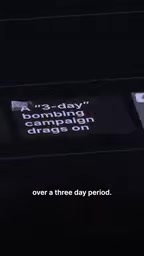
The middle of the video turns to external conflicts. According to the analyst, a three-day strike plan targeting sites inside Iran is already on the table. He emphasizes repeatedly in the video that Trump has repeatedly promised to "escalate after the election," and the election has passed.
On the other side, Putin may be reaching a cognitive turning point: unable to obtain Ukrainian territory from Trump, he pivots to the next plan. The video does not elaborate on the specifics of that plan, leaving only suspense.
More noteworthy is Europe's role. The expert predicts that Europe will come under immense retaliatory pressure; should Europe take retaliatory action, he characterizes it directly as "what World War III looks like." The rhetoric is intense, but the video offers no accompanying military or diplomatic projections.

"Escalate after the election" in the original text points to Trump's hardline commitments on Iran. To understand this thread, one must know the existing framework of U.S.-Iran confrontation: the U.S. withdrew from the Iran nuclear deal (JCPOA) in 2018 and reimposed sanctions; in 2020, U.S. forces killed Qasem Soleimani, commander of the IRGC's Quds Force, and Iran responded with missile strikes on U.S. bases in Iraq. These precedents show that limited military strikes and retaliation cycles already have a well-established script in the region. If a "three-day strike plan" were implemented, the risk would lie not in the initial strike itself but in Iran's asymmetric response through proxy forces, shipping in the Strait of Hormuz, or cyberattacks—spilling the conflict into energy markets and European security issues.
Emergency Powers and the 2027 Setup
On the domestic dimension, the expert lays out an escalating path: Trump will be able to invoke an increasing number of emergency powers, and the cumulative effect of these powers will manifest as a "devastating" situation in 2027. The logic here is institutional—once emergency powers are used routinely, the threshold for returning to normalcy keeps rising.
This judgment is a single-source predictive opinion lacking verifiable indicators. The video also does not specify which emergency power provisions would be invoked.

The U.S. president's emergency powers are not a single power but a scattered set of authorizations embedded in law: mechanisms under the National Emergencies Act to declare a state of emergency and invoke related special authorities, economic and trade restrictions under the International Emergency Economic Powers Act, and provisions involving domestic deployment such as the Insurrection Act. Their key feature is that congressional oversight and judicial review often lag, and states of emergency can be renewed year after year, causing extraordinary measures to become normalized. The original text's statement that "the threshold for returning to normalcy keeps rising" refers precisely to this ratchet effect: each invocation broadens precedent and weakens the political incentive to return to regular procedures. What deserves attention, therefore, are observable indicators such as the frequency of invocation and Congress's willingness to check the executive—not a single dramatic event.
What Ordinary People Can Do: The Distance from Warning to Action
The end of the video turns to audience concerns: What should the public do? Should people stockpile supplies? The expert says "the first point is extremely important," but the source material cuts off here, and the specific advice is not presented.
This leaves an obvious gap—the endpoint of a warning should be actionable advice, yet currently there is only a risk description with no response plan.
How to View This Kind of Warning
The analyst's credentials (thirty years of research, advising successive White Houses) lend credibility to his views, but the video as a whole consists mainly of assertions and predictions, lacking data, documents, or cross-verifiable details. The Iran strike plan, Putin's "next plan," and the specific form of European retaliation are all presented vaguely.
For readers, a more reasonable approach is to treat this content as a checklist of risk scenarios rather than a definitive prediction. The observation points it lists—acceptance of election results, timing of military action against Iran, Europe's willingness to retaliate, frequency of emergency power use—have monitoring value in themselves, even if the strength of the conclusions should be discounted.
The urgency of the video's title, "Prepare for the Next Eight Weeks," is less a factual judgment than a narrative frame. Distinguishing between the two is basic due diligence when consuming this kind of political risk content.
One-line Summary
A political violence researcher warns that the eight weeks after the midterms are the most dangerous transition period, listing a risk checklist where domestic and external conflicts intersect.
Paragraph Summary
The article reviews warnings from an expert—who claims thirty years of studying global political violence and advising successive White Houses—in a YouTube video: the eight weeks after the U.S. midterm elections could be the most dangerous power transition period in modern American political history, with the January 6 Capitol riot as its mechanism sample. The expert's judgments center on whether Trump will accept the election results, a three-day strike plan against Iran, Putin's strategic pivot on Ukraine, Europe under retaliatory pressure, and the escalating use of emergency powers, predicting cumulative consequences by 2027. The article also notes that the video consists mainly of assertions and scenario predictions, lacks verifiable data, and is missing specific action recommendations in the source material, so it should be viewed as a checklist of risk scenarios rather than a definitive forecast.
Related articles
 Tech Frontiers
Coldframe: A Honeypot Disguised as a Supermarket Freezer Controller
Coldframe is a honeypot disguised as Danfoss AK-SM 800A and Dixell XWEB freezer controllers, built as a single Python file that detects CVE-2025-41450 attempts and is identified as real devices on Shodan.
 Tech Frontiers
GRFNet: A Lightweight PyTorch Model Designed for Multichannel Time-Series Classification
GRFNet is a lightweight PyTorch model for multichannel time-series classification, originating from EEG decoding research. With only 3,847 parameters, it is based on the ROCKET architecture, combining random convolution kernels with learnable spatial filters, supports arbitrary input lengths, and will soon be evaluated on the PhysioNet dataset.
 Tech Frontiers
CUDA-Accelerated Rocket League Simulator: A Player-Made Hardcore Experiment
A Reddit post shows a "100% Accurate" Rocket League simulator accelerated with CUDA. We analyze its technical context, CUDA's value in game physics simulation, and the significance and limitations of such community projects.