The Elder Scrolls 6 Officially Titled Sentinel, Confirmed in Bethesda 40th Anniversary Short

Bethesda confirms The Elder Scrolls 6 is officially titled Sentinel in its 40th anniversary video, but reveals no release details.
In a video celebrating the studio's 40th anniversary, Bethesda officially confirmed that The Elder Scrolls 6 is titled The Elder Scrolls VI: Sentinel. It is the first naming since the project's existence was announced eight years ago, but the video included no gameplay, no release window, and no explanation of the subtitle's meaning. Because "Sentinel" is tied in series lore to Redguard culture in Hammerfell, the community immediately produced a wave of speculation—none of it officially grounded. The article argues that the low-key reveal in a commemorative short fits Bethesda's habitual "give a little, keep a lot" marketing rhythm; the naming is more a psychological milestone than a sign of imminent release, making rational expectation management especially important now.
Eight Years of Waiting Finally Answered: The New Game Gets Its Name
In a commemorative video celebrating the studio's 40th anniversary, Bethesda officially confirmed that the sixth main installment in The Elder Scrolls series is titled The Elder Scrolls VI: Sentinel. The video runs under ten minutes, yet it sent a signal that set the player community ablaze — it has been years since the last mainline entry, The Elder Scrolls V: Skyrim, launched, and more than eight years since Bethesda first publicly acknowledged that a sixth game existed.
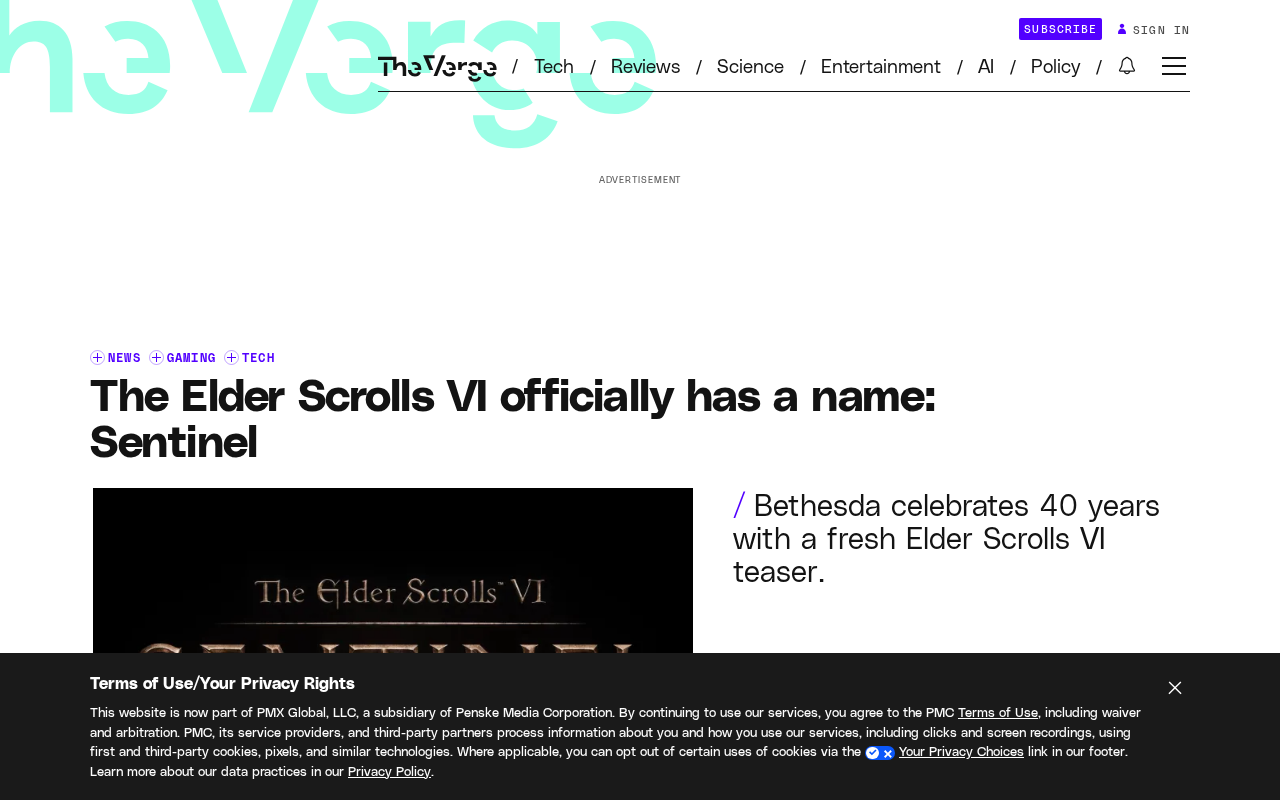
The cadence of information here is notably restrained. Bethesda showed no gameplay footage in the 40th anniversary video, announced no release window, and did not even explain what the subtitle "Sentinel" refers to within the game's world. For a long-anticipated title, this restraint is both typical of Bethesda's marketing style and a sign that the project remains at a stage requiring patience.
What Does "Sentinel" Mean? A Subtitle Open to Interpretation
In The Elder Scrolls universe, "Sentinel" is not an unfamiliar word. It has appeared in the series' lore as both a place name and a political entity, closely tied to the Redguard culture of Hammerfell. So when the subtitle was revealed, the player community immediately produced a wave of speculation: will the new game's story be set more explicitly in Hammerfell? Is "Sentinel" a geographic reference, a faction symbol, or a core plot concept?
To be clear, Bethesda has only confirmed the name this time and has offered no official explanation of the subtitle's meaning. Any inferences about plot direction or map scope are currently reasonable associations based on established series lore, not official information. This article presents only the conversation the name itself generates and does not overextend into unrevealed content.
Hammerfell and the Redguards: In The Elder Scrolls series, Hammerfell is a province in the west of the continent of Tamriel, primarily inhabited by Redguards, whose culture blends Middle Eastern and North African influences. In series lore, one of Hammerfell's capitals is named "Sentinel," an important political and commercial center for the Redguards. The subtitle "Sentinel" thus has a direct geographic link to Hammerfell on its face — which is precisely the main basis for players' speculation that the new game's setting may shift to Hammerfell. However, Bethesda has not confirmed this connection, and the word "Sentinel" also carries the generic English meaning of "a guard or outpost," so whether there is a separate plot-level metaphor cannot currently be determined.
The 40th Anniversary Video: A Low-Key but Special Venue for the Announcement
Choosing a 40th anniversary commemorative video to confirm the new game's title is itself worth pondering. Compared with a standalone game showcase or a major trade show stage, an anniversary short leans more toward brand retrospective and emotional storytelling, with limited information density. By placing The Elder Scrolls 6's name in such a setting, Bethesda satisfied players' desire for "progress" while avoiding excessive marketing commitments for content that is not yet mature.
From a communications standpoint, the approach is quite effective: the short-video format lends itself to easy re-sharing on social platforms, and the name confirmation alone is enough to generate conversation without delivering more substantive content. For a studio known for long polishing cycles, this "give a little, keep a lot" rhythm is consistent with its past marketing habits.
Behind the Eight-Year Cycle: Player Expectations and Development Reality
The most noteworthy fact in the original information is the time span — more than eight years from the first confirmation of the game's existence to the official naming. That number needs no additional explanation; it is enough to illustrate the complexity of developing a large open-world RPG and the resource-allocation pressure Bethesda faces from juggling other projects alongside The Elder Scrolls 6.
For players, the name announcement is a psychological milestone: it turns "a known existing project" into "a work with an identity," but actual hands-on play is still some distance away. Rational expectation management is especially important at this moment — a name is not progress, and a subtitle is not a release date. Until Bethesda provides more concrete development information, treating this announcement as a signal that "the project is still moving forward" may be the more prudent interpretation.
Why large open-world RPGs take so long to develop: Modern AAA open-world RPG development involves dozens of parallel workstreams — large-scale terrain and level design, quest and dialogue systems, animation and physics, cross-platform optimization, and more — with teams often numbering in the hundreds and development cycles routinely running five to seven years. After The Elder Scrolls V: Skyrim, Bethesda also advanced projects including Fallout 4, Fallout 76, and Starfield, distributing resources across multiple titles and further lengthening the wait for The Elder Scrolls 6. In addition, the new engine technology Bethesda introduced with Starfield needs time to settle into subsequent titles, which is another practical factor stretching the cycle.
What to Watch Next
With the name settled, the player community's main concerns come down to three things: where the story takes place, the release time window, and directional changes in gameplay. By Bethesda's usual practice, this information typically emerges gradually only as the official marketing cycle approaches launch. Until then, lore research around "Sentinel" will likely remain a持续 hot topic in community discussion, and whether the official side offers further clarification on later occasions will be the key observation point for gauging the project's rhythm.
Related articles

WorkBuddy in Practice: How Tencent's AI Agent Is Reshaping Office Workflows
An in-depth analysis of Tencent WorkBuddy AI agent: it reads local files, executes multi-step tasks, runs on schedules, and supports remote control—how is it fundamentally different from conversational AI? This article combines practical cases to help you understand its core capabilities and use cases.

Codex App Complete Guide: From Installation to Hands-On Practice — AI Automatically Organizes Files and Builds Reports
Codex App complete guide: install from the app store, configure everyday work mode, and use real coffee shop data to practice file organization, Excel reports, and visual dashboards. Learn Plan Mode and the little pet feature — master Codex's AI automation workflow in one episode.

Getting Started with Langfuse: Building a Financial Analysis Agent and Evaluation Platform
A Langfuse tutorial: explore the core capabilities and boundaries of this open-source AI Engineer platform, and learn how to build an enterprise-grade log tracing, evaluation, and observability platform for a Harness-architecture financial analysis multi-agent system, covering prompt management, token cost analysis, and integration with frameworks like LangChain.