The End of LeetCode Grinding? How AI Coding Tools Are Reshaping Tech Hiring

AI coding tools are eroding LeetCode's dominance as the default filter in tech hiring.
Sparked by the phrase "Sorry we made you grind LeetCode," the tech community is reckoning with algorithm grind culture. For over a decade, LeetCode-style tests dominated big-tech hiring for their scalability, but often measured test-taking over real engineering skill. As AI tools like GitHub Copilot, Claude, and GPT make hand-coding algorithms less relevant, the industry is shifting focus toward judgment, system design, and AI collaboration — though debate over the value of CS fundamentals remains very much alive.
An Overdue Apology That Got the Industry Talking
"Sorry we made you grind LeetCode" — this line, at once tongue-in-cheek and genuinely reflective, recently sparked a wide-ranging discussion in the technical community on Hacker News. It cuts to the heart of the hiring mechanism that has dominated software engineering recruitment for over a decade: the algorithmic grind culture.
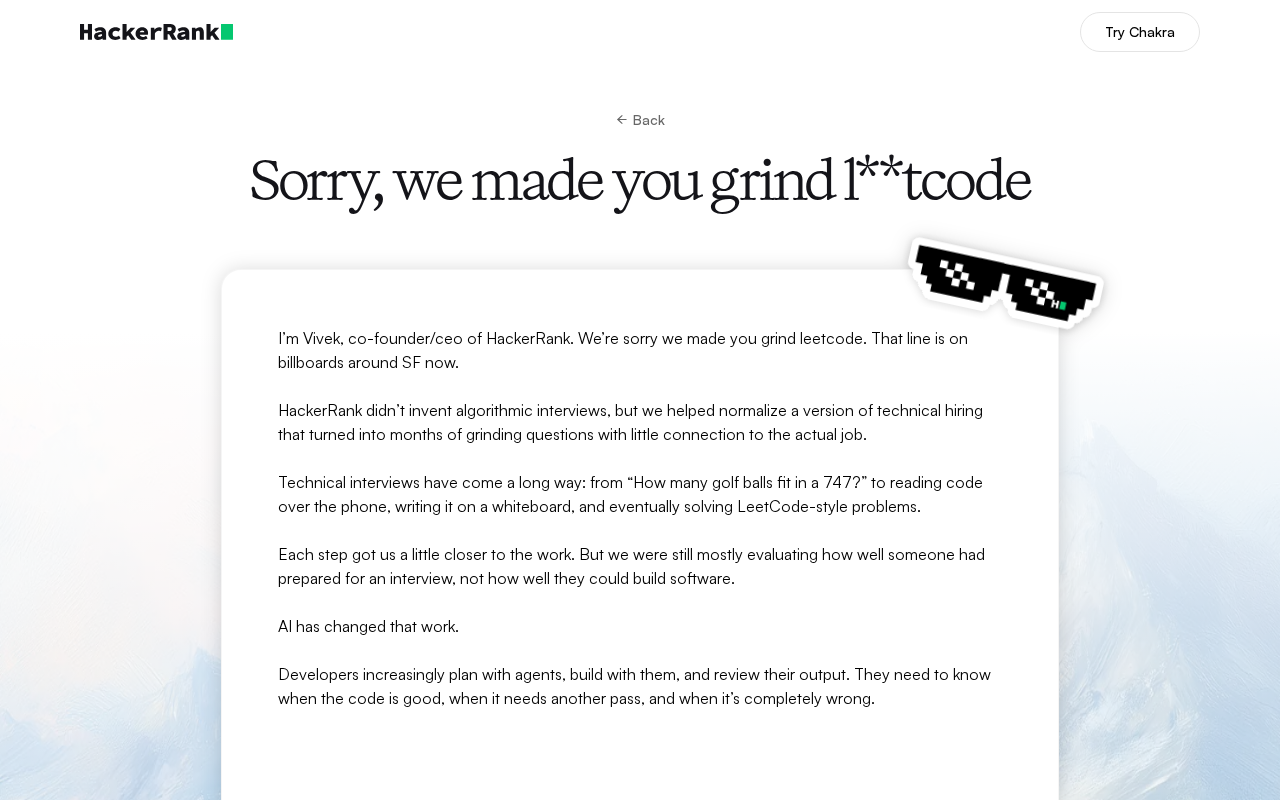
For years, LeetCode was practically a mandatory rite of passage into big tech. Countless job seekers poured hundreds — sometimes thousands — of hours into drilling dynamic programming, binary tree traversals, and graph algorithms, the kind of problems that rarely come up in day-to-day engineering work. Now, with AI coding tools maturing rapidly, this entire evaluation framework is being called into question.
A quick note: this article is based on discussion threads from Hacker News. The source material primarily reflects a shift in community sentiment around this topic, with relatively limited technical detail and hard data.
Why the Grind Culture Took Hold
Algorithmic problems didn't become a hiring staple by accident. When companies face enormous applicant pools and lack the bandwidth for deep individual evaluation, LeetCode-style standardized tests offered a seemingly objective, scalable filtering tool.
The Efficiency of Standardization
For large tech companies drowning in resumes, algorithm problems could quickly weed out candidates with weak fundamentals while testing logical thinking and problem decomposition to some degree. With clear right and wrong answers, they also made it easier to maintain scoring consistency across different interviewers.
This filtering logic didn't emerge in a vacuum. In the mid-2000s, Google was among the first to systematize algorithmic interviewing, and Facebook, Amazon, Microsoft, and others soon followed, gradually cementing an industry-wide paradigm. LeetCode itself launched around 2015, consolidating scattered interview problems into a structured question bank with an online judge, making "prep grinding" highly standardized. In some ways, this system did democratize access — strong problem-solving scores could get a candidate past the resume screen regardless of their school pedigree, offering a kind of skills-based meritocracy. But the side effects were equally significant: it spawned a cottage industry of dedicated prep courses and fostered an ecosystem of leaked problems and memorized solution patterns, gradually distorting a tool originally meant to assess raw thinking ability.
The Signal Distortion Problem
The deeper issue is that the correlation between LeetCode performance and actual engineering ability has always been contested. Someone who can dash off an optimal solution on a whiteboard isn't necessarily skilled at system design, code maintainability, or working within a team. Over time, the exercise devolved into an adversarial game — candidates memorized solution templates while companies kept ratcheting up difficulty, creating an arms-race dynamic of competitive cramming.
How AI Coding Tools Are Changing the Game
What's truly destabilizing this system is the rise of AI coding assistants. When tools like GitHub Copilot, Claude, and GPT can instantly generate algorithmic implementations, the scarcity value of skills like "write a binary search from scratch" has been dramatically eroded.
From "Can You Write It" to "How Do You Use It"
When AI can produce standard algorithm code in seconds, testing whether a developer remembers a classic solution starts to feel beside the point. The center of gravity for an engineer's value is shifting away from "implement a specific algorithm" toward higher-order capabilities: how to frame a problem, how to evaluate the correctness of AI-generated code, how to make architectural trade-offs, and how to integrate components across complex systems.
GitHub Copilot launched as a technical preview in 2021 and went commercial in 2022, becoming the first AI coding assistant adopted at scale. Built on OpenAI's Codex model, it could autocomplete code snippets and even full functions from comments or context alone. Claude (Anthropic), GPT-4 (OpenAI), and tools like Cursor and Codeium soon followed, evolving AI-assisted programming from "code completion" into "conversational development" capable of producing entire functional modules. The core disruption here is this: the classic interview question — "can you write a quicksort or an LRU cache in 45 minutes without any tools" — is no longer a meaningful bottleneck in real-world work. What developers actually need is the ability to clearly articulate requirements to AI, read and verify its output, and identify potential edge cases and performance pitfalls — capabilities that traditional algorithm problems struggle to measure.
A New Direction for Technical Assessment
One of the central ideas emerging from community discussions is that future technical interviews should more closely mirror real working conditions — evaluating a candidate's ability to collaborate with AI to complete a task, exercise judgment in code reviews, and demonstrate holistic system understanding, rather than solving isolated algorithmic puzzles. In short, the evaluation focus is moving from "memorization and manual implementation" to "judgment and engineering maturity."
The Debate Is Far From Settled
It's worth noting that the community isn't uniformly on one side of this. A portion of voices argue that the foundational thinking skills cultivated by algorithm training still matter — understanding time complexity and mastering data structures helps developers assess the quality of AI-generated code and avoid blind dependence on it.
Others caution that fully abandoning assessments of core fundamentals risks overcorrecting. AI tools make mistakes and hallucinate; without solid computer science grounding, developers may struggle to catch those errors. The "retreat" of grind culture is therefore more likely a reweighting of evaluation priorities than a complete disappearance.
At its core, this debate hinges on the distinction between "instrumental knowledge" and "transferable knowledge." Big-O notation, the space-time characteristics of common data structures, the equivalence of recursive and iterative approaches — in the AI era, the value of these concepts isn't "implementing them by hand." It's using them to build a judgment framework: spotting when AI-generated O(n²) code will become a performance bottleneck at scale, or recognizing when a hash table is more appropriate than a sorted tree. The criticism of grind culture is more specifically aimed at the overemphasis on obscure Hard problems and decontextualized whiteboard performances, not a call to abandon algorithmic thinking altogether. The line between those two things is precisely where the industry's current conversation is most unsettled — and most in need of nuance.
What This Means for Job Seekers and Companies
For individual developers, this trend signals a need to rebalance how they invest in skill-building: maintain the necessary algorithmic foundations, but place greater emphasis on system design, engineering practice, and the ability to work effectively with AI tools.
For companies, this is an opportunity to redesign the hiring process. Rather than continuing to screen candidates with algorithmic puzzles disconnected from real work, the better path is to build evaluation frameworks that more accurately reflect what the job actually involves. That line — "sorry we made you grind LeetCode" — is, in some sense, the industry's collective reckoning with how it has measured talent.
The logic of technical hiring is evolving alongside the tools of the trade. LeetCode won't vanish overnight, but its era as the sole gateway into the industry is, in fact, drawing to a close.
Related articles

ChatGPT Space Launches: Team Collaboration and New Pages Features Explained
ChatGPT Space is OpenAI's new team collaboration feature with Pages, real-time collaboration, and Slack/Google Drive sync. We break down its privacy design, multi-platform integration, and the full workflow from conversation to document.

Migrating Apache Spark UDFs to GPU Acceleration with AI Agents
NVIDIA developer blog explains how AI Agents rewrite Apache Spark UDFs for GPU acceleration, covering migration criteria, agent rewriting and verification workflows, plus pitfalls like result consistency and CPU-GPU transfer overhead.

Zed Editor v0.40.4-rc2 Released: Usage Credits Now Available Without Upgrading
Zed editor releases v0.40.4-rc2, allowing users to use usage credits for AI features without upgrading to a paid plan, lowering the trial barrier.