The Exploration Bottleneck at a Million Parallel Environments: How Success Guided Sampling Makes Robot RL Truly Scale

SGS uses adaptive sampling to focus large-scale parallel RL training on the policy's competence frontier, breaking the exploration bottleneck at the million-environment scale.
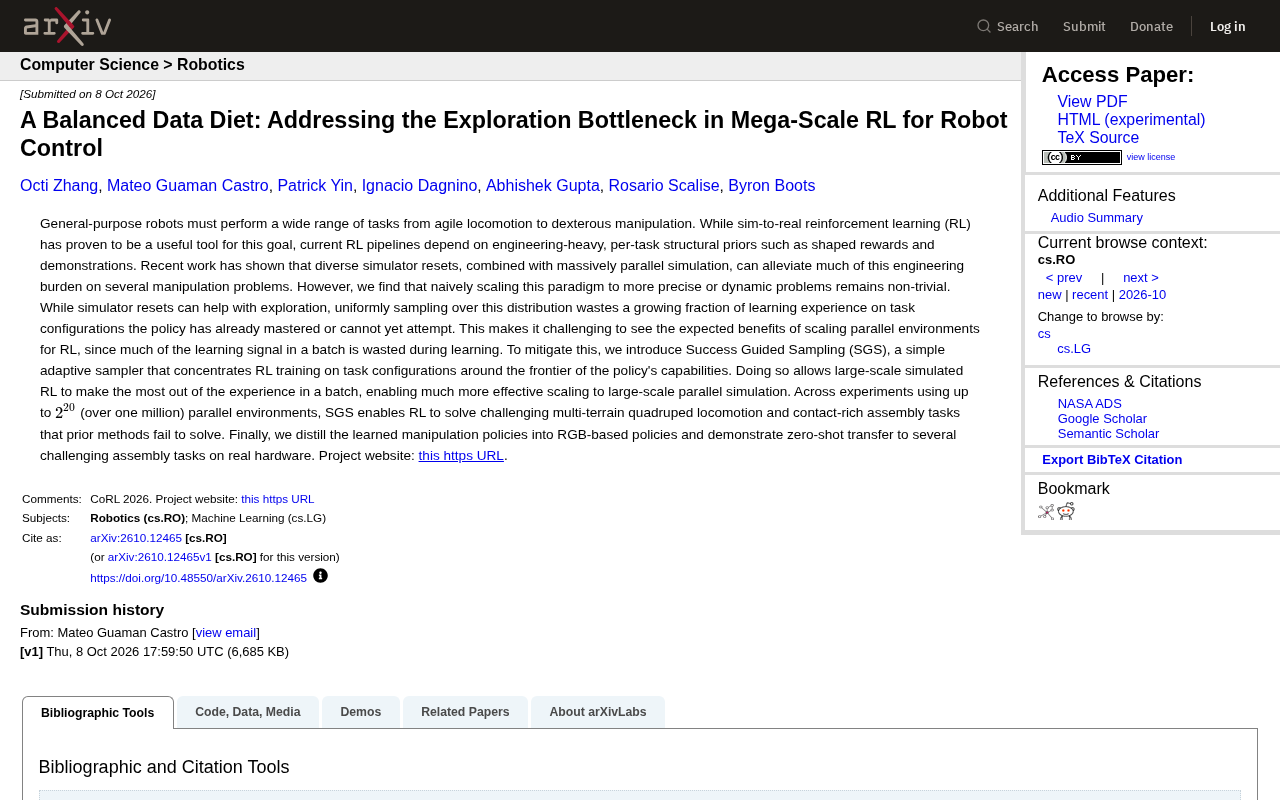
The article discusses a counterintuitive bottleneck in mega-scale robot reinforcement learning: even when parallel environments are scaled to the million level, uniformly sampling the reset distribution causes a large fraction of experiences in each batch to fall on configurations the policy has already mastered or cannot possibly attempt, severely wasting learning signals. The authors propose Success Guided Sampling (SGS), a simple adaptive sampler whose core idea is to concentrate training on task configurations near the policy's competence frontier, thereby improving the utilization of effective learning signals in each batch. Experiments are conducted with up to more than \(2^{20}\) parallel environments, and SGS solves previously intractable tasks such as multi-terrain quadruped locomotion and contact-rich assembly, while distilling manipulation policies into RGB policies for zero-shot real-robot transfer. The article derives a general engineering principle: the larger the parallel scale, the more the sampling strategy itself may determine training efficiency and ultimate success than the number of parallel environments.
In an era where large-scale parallel simulation has become standard practice for robot reinforcement learning, a counterintuitive fact is emerging: scaling the number of parallel environments to the million-level does not automatically deliver proportional returns. When a policy is already "farming score" on easy task configurations—or is fundamentally incapable of handling overly difficult ones—uniform sampling causes an increasingly large fraction of experiences in a batch to become useless learning signals. This is precisely the core bottleneck facing current mega-scale RL for robot control.
Reset Distributions: From Engineering Savior to New Bottleneck
Over the past few years, one clear trend in sim-to-real RL has been to move away from per-task engineering priors—no longer relying on carefully crafted shaped rewards, nor requiring large numbers of demonstrations. In their place came a more "idiot-proof" paradigm: using diverse simulator resets combined with large-scale parallel simulation, letting the policy explore countless initial conditions on its own.
This approach has proven effective on a number of manipulation tasks, reducing engineering burden. But the paper's authors point out an overlooked problem: on more precise or more dynamic tasks, this paradigm cannot be made to work through naive scaling alone.
The reason lies in the reset distribution itself. Simulator resets do help with exploration, but sampling uniformly from this distribution wastes an ever-growing share of learning experiences on two categories of configurations—those the policy has already mastered, and those the policy currently has no chance of attempting. The former provides no gradient; the latter provides noise.
Simulator resets refer to the mechanism by which each parallel environment, at the end of every episode, reinitializes the robot state, target poses, object placement, terrain parameters, friction coefficients, and other variables according to some initial condition distribution. In the classical sim-to-real RL pipeline, engineers typically hand-write reward shaping for each task or collect large numbers of human demonstrations to guide training; the diverse resets approach instead uses a data-driven method to replace these per-task engineering priors, letting the policy discover feasible behaviors on its own across countless random initial conditions. The design of the reset distribution directly determines the state space covered by training data: too narrow a distribution leads to overfitting, while too broad a one dilutes effective learning signals. The key point this paper makes is precisely that—even if the reset distribution itself is sufficiently diverse, how to sample from it remains an independent and long-overlooked variable.
Why a Million Environments Doesn't Necessarily Equal a Million in Returns
In parallel simulation, each batch theoretically contains a massive number of experiences. But if most of these experiences fall into the "uninformative" region, then the expected returns from scaling parallel environments are heavily diluted.
The authors put it bluntly: this makes it hard to see the anticipated benefits of scaling parallel environments, because a large fraction of the learning signal in each batch is wasted during training.
This constitutes a structural cause of the exploration bottleneck: it's not that compute is insufficient, but that compute is being allocated to the policy's "comfort zone" and "blind spots" rather than to its competence frontier.
Success Guided Sampling: Pressing Training onto the Competence Frontier
To address this problem, the authors propose Success Guided Sampling (SGS), a simple adaptive sampler. Its core idea can be summarized in one sentence: concentrate RL training on task configurations near the policy's competence frontier.
SGS does not change the underlying RL algorithm, nor does it introduce complex structural priors. Instead, it adjusts how the reset distribution is used—biasing sampling toward configurations where the policy "has a chance of succeeding but has not yet stably mastered." This allows large-scale simulation RL to more fully exploit the experiences in a batch, making scaling to large-scale parallel simulation genuinely efficient.
The paper's experimental scale is quite aggressive: it uses up to (2^{20}) (over one million) parallel environments. At this magnitude, SGS enables RL to solve challenging tasks that previous methods could not crack, including multi-terrain quadruped locomotion and contact-rich assembly.
Competence frontier is a concept borrowed from the curriculum learning and autonomous task generation literature (such as Goal GAN, ALP-GMM, etc.). It refers to the task difficulty range where the policy's current success rate is neither close to 0 nor close to 1. Configurations with success rates near 0 provide noisy gradients, from which the policy cannot obtain a reliable direction for improvement; configurations with success rates near 1 have gradients approaching zero, so continued training merely repeats already-mastered behaviors. The "edge" region between the two—typically corresponding to success rates roughly between 20% and 80%—is the source of samples that provide the greatest information gain. SGS turns this intuition into a lightweight adaptive sampler that continuously estimates the current success rate of each configuration during training and reweights the reset distribution accordingly, concentrating the limited batch budget on the regions with the most learning value.
From Simulation to Real Hardware: Zero-Shot Transfer of RGB Policies
The final step of the paper is to distill the learned manipulation policies into RGB-based policies and complete zero-shot transfer on real hardware for several challenging assembly tasks.
The significance of this step lies in closing the loop: SGS addresses the sample efficiency and exploration efficiency problems in simulation, while distillation plus zero-shot transfer verifies whether this efficiency improvement can translate into usable policies in the real world. For a sim-to-real pipeline, this is more convincing than mere simulation benchmark numbers.
Policy distillation typically refers to using a student policy to imitate the behavior of one or more teacher policies. In the sim-to-real context, the teacher is often a policy that used privileged information during training, such as directly reading object poses, contact forces, terrain height maps, and other states available only in simulation; the student policy receives only observations obtainable from real sensors, such as RGB images. The goal of distillation is for the student policy to reproduce the teacher's behavioral decisions despite limited observations. Zero-shot transfer then refers to deploying the student policy directly to real hardware to perform tasks after training is complete in simulation, without any real-world fine-tuning or domain randomization retraining. This path is very sensitive to visual and dynamic differences between simulation and reality, so whether it succeeds is often regarded as an important indicator of the maturity of a sim-to-real pipeline.
Implications for Robot RL Engineering Practice
The lessons of SGS are not limited to any single task. It points to a more general engineering principle: once parallel scale rises to a certain level, the sampling strategy itself becomes a more critical variable than the parallel scale.
For teams building large-scale RL pipelines, this means that before increasing parallel environments, it is worth first examining how well the reset distribution matches the policy's competence. A simple adaptive sampler may determine whether training converges to solve the task more than additional GPU hours ever could.
Project website: https://sgs-rl.github.io/
Related articles

Chain of Thought Isn't Just for AI: How Humans Can Use CoT to Improve Thinking Quality
Chain of Thought isn't just a prompt trick for large models. Starting from a Hacker News discussion, this article analyzes why CoT works for human thinking too, breaks down actionable ways to transfer it, and highlights the key differences between human CoT and machine CoT.
Cloudflare Teams Up with OpenAI: Closi…
Cloudflare Teams Up with OpenAI: Closing the Loop from Vulnerability Discovery to Defense with AI
Cloudflare uses OpenAI Daybreak to investigate security vulnerabilities and generate reviewable remediation plans, while developers use Codex to boost coding efficiency and quality.

Orca Multi-Agent Orchestration in Practice: A Guide to Parallel Collaboration with Claude and Codex
Orca is Stable AI's free open-source agent workbench supporting 34 agents like Claude Code and Codex in parallel. Learn its Git worktree isolation, multi-model orchestration, and mobile management.