The 'Fake Resolution' Trap in Voice AI Customer Service: Call Completed ≠ Problem Solved

Voice AI should be measured by whether problems disappear, not whether calls complete.
This article addresses a widely overlooked blind spot in voice AI evaluation: treating 'call completed' as a proxy for 'problem resolved.' Polite, smooth conversations score well on quality models, but if a customer calls back about the same issue, the first call clearly didn't close the loop. The piece introduces repeat contact linking as a core calibration signal for true resolution rates, emphasizes that lookback windows must be tailored to task type, and argues that evaluation systems must extend beyond the call itself to track whether promised follow-up actions were actually executed.
A Blind Spot Nobody's Talking About
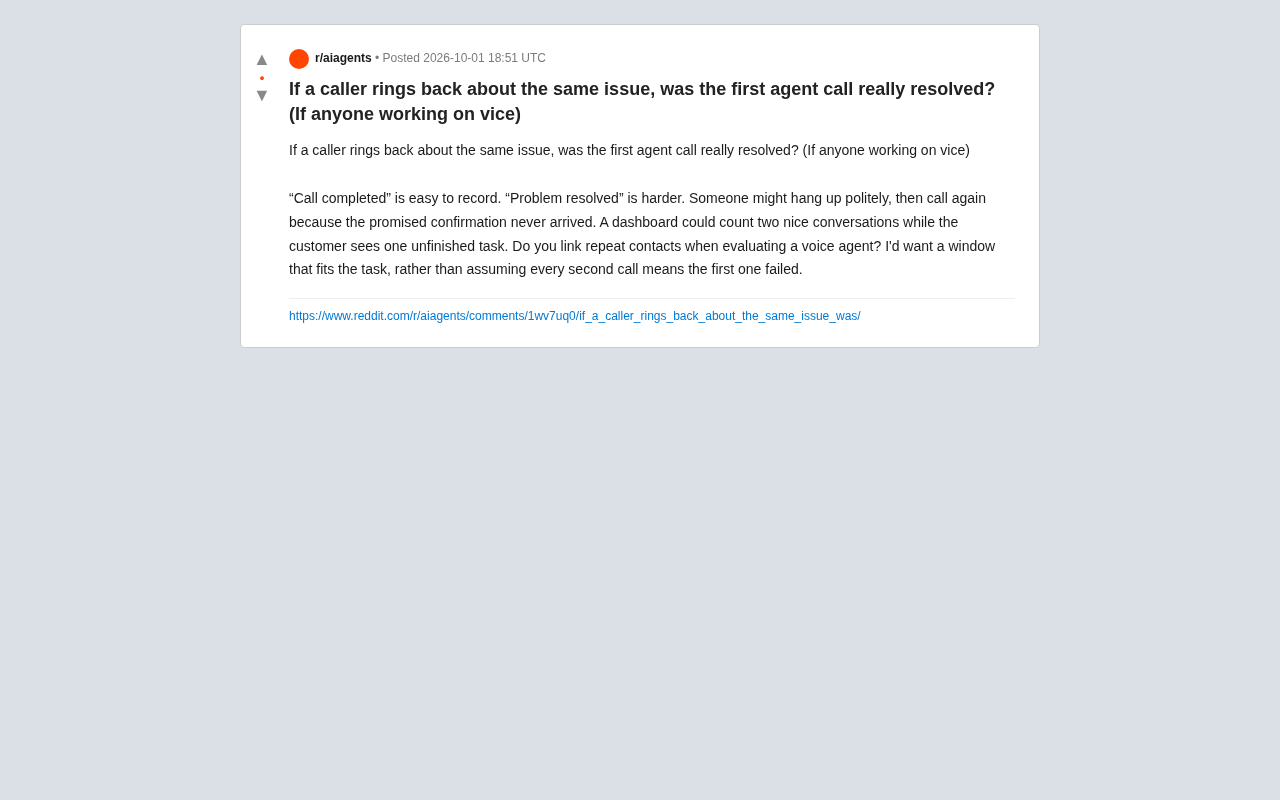
In evaluating the effectiveness of voice AI customer service (voice agents), there's a metric that looks simple but is dangerously easy to misread: whether a call actually resolved the customer's issue. A Reddit user asked a question that cuts right to the heart of it — if a customer calls back about the same problem, did that first call really count as "resolved"?
This matters because it exposes a widespread measurement misalignment in customer service evaluation. Logging "Call completed" is easy — the system just needs to detect a hang-up and check a box. But determining "Problem resolved" is far harder, because it requires judging whether the customer's actual need was genuinely met — and that often only becomes clear after the call ends.
Politely Hanging Up Isn't the Same as Being Satisfied
The original poster offered a telling scenario: a customer might politely end the call, then call back shortly after because "the promised confirmation message never arrived." In that case, the dashboard might log "two pleasant conversations" while the customer experienced "one unfinished task."
This gap between data and reality is exactly where voice AI evaluation becomes dangerous. A polite, smooth conversational tone is easy to score highly on sentiment analysis or dialogue quality models — but it can completely mask the fact that the underlying task was never closed out. A system that appears "friendly" on the surface may actually be generating a steady stream of repeat contacts.
Why "Completed" Is Easier to Record Than "Resolved"
From an engineering perspective, this bias has clear roots:
- Call completion is a well-defined technical event: hang-ups, timeouts, and transfers can all be precisely captured by the system.
- Problem resolution is a fuzzy business outcome: it depends on whether promises were kept, whether follow-up actions were taken, and whether customer expectations were actually met.
When evaluation frameworks lean too heavily on easy-to-collect technical metrics, they systematically overestimate how well a voice AI is actually performing.
Using Repeat Contacts to Calibrate True Resolution Rate
The original poster's core recommendation: when evaluating voice AI, you should link repeat contacts. In other words, if the same customer calls back about the same issue within a short period, that's a strong signal the first call didn't actually resolve anything.
This aligns closely with a metric the customer service industry has relied on for decades: First Contact Resolution (FCR). Factoring repeat contacts into your evaluation cuts through the surface appearance of "dialogue quality" and gets at the real question — was the task actually closed?
Not Every Callback Means the First Call Failed
Importantly, the poster didn't simply equate "called back" with "first call failed." He specifically emphasized: "I'd want a window that fits the task, rather than assuming every second call means the first one failed."
That's a measured and mature judgment. Here's why:
- Natural resolution timelines vary enormously across task types. A simple lookup might close in minutes, while a request involving a refund, shipping update, or third-party confirmation could take days.
- If you apply a single, short time window to flag all callbacks as "repeats," you'll incorrectly penalize calls that are genuinely new issues or normal follow-ups.
The right approach is to set task-matched lookback windows for different issue types. For example, a password reset might only need a 24-hour window, while a billing dispute might warrant 7 days or more.
First Contact Resolution (FCR) is a core metric that traditional call centers have used for decades, defined as the percentage of customer issues fully resolved on the first interaction without requiring a follow-up contact. Industry benchmarks suggest top-performing human agent centers typically achieve FCR rates of 70–85%; falling below 65% is often treated as a signal of systemic process failure. FCR can be measured two ways: "agent-side judgment," where the agent subjectively marks whether the issue was resolved at the end of the call; or "customer-side judgment," verified through callback rates or post-call SMS surveys. The latter is widely considered more accurate, since the former suffers from obvious self-reporting bias. The challenge of applying FCR to voice AI evaluation is that AI systems lack the subjective judgment of a human agent — they must rely entirely on behavioral signals (like repeat calls) to infer resolution outcomes. This makes the design of the lookback time window a critical variable in the entire evaluation framework.
What This Means for Voice AI Evaluation
This discussion is brief, but it offers several practical takeaways for teams deploying voice AI customer service:
First, be wary of "conversational friendliness" as a proxy for resolution. Polite tone and smooth interaction should not be treated as stand-ins for task completion. Emotional quality and task completion must be measured independently.
Second, treat repeat contacts as a first-class evaluation signal. Linking multiple contacts from the same customer about the same issue is one of the most direct ways to test whether a voice AI is actually resolving problems.
Third, make time windows task-specific. A one-size-fits-all window will simultaneously over- and under-count failures. Setting dynamic windows based on the natural resolution cycle of each task type produces far more accurate resolution rates.
Fourth, track the fulfillment chain for promises made. Many "fake resolution" cases stem from commitments made during the call — sending a confirmation email, processing a request — that were never actually carried out. Evaluation systems need to extend beyond the call itself and track whether those promised actions were completed.
Conclusion
As voice AI customer service rapidly expands, accurately measuring real-world effectiveness is becoming a critical challenge. "Call completed" is a tempting but dangerous metric — easy to collect, great-looking on dashboards, yet potentially wildly disconnected from the customer's actual experience. This discussion from practitioners in the field is a useful reminder: what's really worth measuring is never whether a conversation happened, but whether the problem went away. Incorporating repeat contacts into evaluation and setting task-appropriate time windows is how we bring the rigor back to voice AI performance assessment.
Background Context
In voice AI deployments, "unfulfilled promises" represent a distinct category of systemic failure. Follow-up actions triggered during a call — sending a confirmation email, submitting a ticket, notifying a third party — typically depend on API integrations with backend systems. When those integrations experience async delays, permission constraints, or silent failures, the conversation log will show "promise issued" while the actual action never completed — with no alert raised. This problem exists in human agent environments too, but it's far harder to detect in AI systems, because an AI won't notice when an operation fails and proactively escalate the way a human agent might. For evaluation systems to track the promise fulfillment chain, they need an independent task execution log that lives outside the conversation layer, with execution status linked back to the original call record — creating an end-to-end traceable audit trail.
Related articles

Chain of Thought Isn't Just for AI: How Humans Can Use CoT to Improve Thinking Quality
Chain of Thought isn't just a prompt trick for large models. Starting from a Hacker News discussion, this article analyzes why CoT works for human thinking too, breaks down actionable ways to transfer it, and highlights the key differences between human CoT and machine CoT.
Cloudflare Teams Up with OpenAI: Closi…
Cloudflare Teams Up with OpenAI: Closing the Loop from Vulnerability Discovery to Defense with AI
Cloudflare uses OpenAI Daybreak to investigate security vulnerabilities and generate reviewable remediation plans, while developers use Codex to boost coding efficiency and quality.

Orca Multi-Agent Orchestration in Practice: A Guide to Parallel Collaboration with Claude and Codex
Orca is Stable AI's free open-source agent workbench supporting 34 agents like Claude Code and Codex in parallel. Learn its Git worktree isolation, multi-model orchestration, and mobile management.