The Five-Layer Architecture of the AI Industry Chain Explained: A Complete Breakdown from Application to Energy

A breakdown of the AI industry's five-layer architecture from applications to energy.
Using Jensen Huang's five-layer cake metaphor as a framework, this article focuses on the application and model layers of the AI industry. The application layer covers products like ChatGPT, with key concepts including Tokens (measurement units), APIs (interfaces), Agents (AI that can execute tasks), and multimodal technology, with the B2B market as the main commercialization battleground. The model layer is AI's brain, with extremely high training costs governed by Scaling Laws, though DeepSeek has proven that high performance at low cost is possible. AI also faces hallucination issues rooted in its probabilistic prediction nature.
Jensen Huang once compared the AI industry to a five-layer cake — the ChatGPT, Doubao, and DeepSeek products we interact with daily are merely the little strawberry on top. Beneath that strawberry, the model layer, infrastructure layer, chip layer, and energy layer are all working silently to hold everything up. Understanding these five layers will not only help you see the full picture of the AI industry but also help you find your own opportunities in this technological revolution.
Application Layer: The AI World Closest to Us
The application layer is what ordinary people interact with every day, including products like ChatGPT, Claude, Doubao, and DeepSeekAd. But AI applications go far beyond chatbots — they span multiple dimensions including software, hardware, and AIGC (AI Generated Content).
From a business model perspective, AI applications fall into two major directions: 2C (consumer-facing) and 2B (enterprise-facing). An often-overlooked fact is that the companies truly sustaining AI businesses aren't free users like us — they're enterprise clients. Enterprises have far greater willingness and ability to pay for AI than individual users, which is why the B2B market has always been the primary battleground for AI commercialization.
Token & API: The Units of Measurement in the AI World
Token is the "taxi meter" of the AI world. Whether it's text, images, or video, everything is ultimately converted into a unified Token unit to measure usage. Two AI products with the same 100,000 users could have wildly different Token consumption levels, which directly determines their commercial value and influence. Token is to AI what DAU is to social products and GMV is to e-commerce platforms.
On a technical level, a Token is the basic unit of natural language processing. Large language models don't process characters or words directly — instead, they split text into finer-grained language fragments through a process called "Tokenization." In English, one Token corresponds to roughly 0.75 words; in Chinese, due to the unique nature of Chinese characters, a single character typically corresponds to 1-2 Tokens. GPT-4's context window is 128K Tokens, meaning it can "remember" approximately 100,000 Chinese characters in a single session. Tokens aren't just a unit of measurement — they're a core indicator of model capability boundaries. The larger the context window, the stronger the model's ability to handle long documents and extended conversations, and the higher its commercial value.
API is the "interface" of the software world. Just as phones and computers need physical ports to transfer data, software systems also need standardized interfaces to communicate with each other — that interface is the API.
Agent, Multimodality & Vertical Scenarios
If earlier AI only "had a mouth" — able to chat, write copy, and look up information — then Agent is AI that has "grown hands and feet." It can organize your files, download images, book flights, and actually complete specific tasks on your behalf.
Agent implementation relies on the coordination of several key technical components. First is "Tool Use" (also called Function Calling) — the model's ability to recognize when it needs to invoke external tools (such as search engines, code executors, or file systems) and generate structured invocation instructions. Second is "planning capability" — an Agent needs to decompose complex tasks into multiple sub-steps and dynamically adjust its plan based on intermediate results, typically implemented through the ReAct (Reasoning + Acting) framework. Third is "memory management" — an Agent needs to maintain task state across multiple interaction rounds, distinguishing between short-term working memory and long-term knowledge storage. Currently, the most representative Agent frameworks include OpenAI's GPT-4o with tools, Anthropic's Claude Computer Use (which can directly control computer interfaces), and open-source projects like AutoGPT and LangChain. Agent maturity is widely regarded as the key milestone for AI's evolution from "tool" to "colleague."
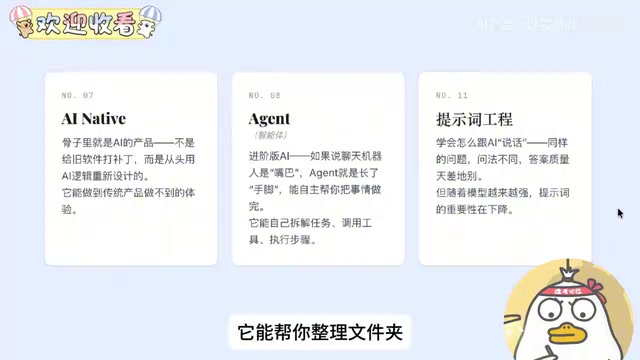
Multimodality refers to AI's ability to simultaneously process multiple forms of information — text, images, audio, video — like a "general practitioner." Vertical scenarios, on the other hand, represent deep AI applications in specific domains such as finance and education.
Additionally, Prompt Engineering is becoming an important skill. Whoever can describe their requirements more clearly — providing background information, specific requirements, and clear objectives — will get better output from AI.
Model Layer: The Brain of AI
Models are where AI's core intelligence resides. Currently, the world's most advanced models come from OpenAI (GPT series), Anthropic (Claude series), and Google (Gemini series). In China, the leading representatives include ByteDance's Doubao underlying model, Alibaba's Qwen model, and DeepSeek.
Training and Inference of Large Models
Large models, also called foundation models, typically have parameter counts in the tens of billions or more. More parameters mean a larger model, and generally stronger capabilities. Think of it as a "bare-bones shell" in the AI world — on top of which you can do fine-tuning, build smaller models, and create applications.
Models aren't "manufactured" — they're trained. It's like teaching a puppy to recognize cats: showing it 10 pictures might not work, but after 10,000 images, it can identify them accurately. This training process is extremely expensive, requiring massive amounts of chips, electricity, and top-tier scientists.
The cost structure of large model training reveals the inherently high barriers to entry in the AI industry. Take GPT-4 as an example: industry estimates put its training cost at over $100 million, involving tens of thousands of A100 GPUs, months of continuous computation, and petabyte-scale training data. Behind this lies a key principle — the "Scaling Law": when model parameter count, training data volume, and compute scale grow in specific proportions, model performance improves predictably. This law was discovered by OpenAI researchers in 2020 and became the theoretical foundation for the entire large model arms race. However, the emergence of DeepSeek challenged this logic — through Mixture of Experts (MoE) architecture and reinforcement learning optimization, it achieved near-top-tier performance while drastically reducing training costs, proving that "brute-force compute" isn't the only path forward.
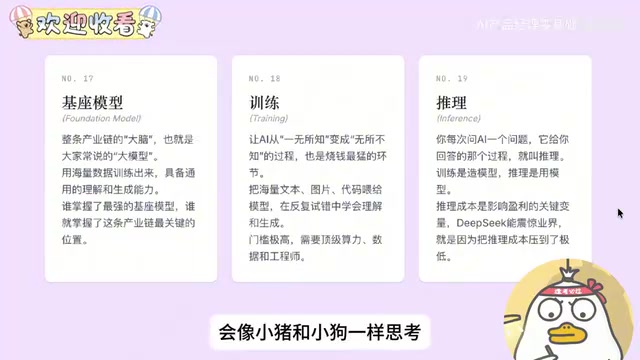
Inference is the process of a model "thinking." The reason DeepSeek caused such a sensation is precisely because it achieved extremely strong inference capabilities while keeping inference costs remarkably low. Fine-tuning involves "precision refinement" on top of a large model, making the model more specialized in specific domains at lower cost.
Hallucination Problems and Data Annotation
AI's hallucination problem deserves attention. Because AI works by "predicting the next most likely word," it's essentially performing probability calculations, which means it sometimes generates content that looks very real but is completely wrong.
AI hallucinations have deep technical roots. Large language models are fundamentally probability prediction systems based on the Transformer architecture — they learn the co-occurrence relationships between words in massive text corpora to predict "given a context, what is the most likely next word?" This mechanism makes models extremely good at generating fluent, coherent text, but it also means they don't truly "understand"
Related articles
Deep Dive into AI Agent Skill Design: …
Deep Dive into AI Agent Skill Design: Engineering Practices from Anthropic and Perplexity
A deep dive into Skill design philosophy from Anthropic's Claude Code team and Perplexity's Agent team, covering the Tax Test, Gotchas Flywheel, progressive disclosure, and Eval-First practices for building high-quality AI Agent skill systems.
Deep Dive into OpenAI's Official GPT-5…
Deep Dive into OpenAI's Official GPT-5.6 Prompting Guide: The Shift from Manual to Automatic
A deep dive into OpenAI's official GPT-5.6 Sol prompting guide: conciseness-first, outcome-oriented design, autonomy boundaries, tool routing, and reasoning intensity tuning.
 Deep Dives
Deep Dive into How OpenClaw (Open-Source Crayfish) AI Agent Works
Deep analysis of OpenClaw AI Agent internals: System Prompt, tool calling, SubAgents, Skill system, memory, and Context Engineering explained.