The Five Stages of AI Agent Architecture Evolution: The Real Path from Model Calls to Production Runtime

AI Agent architecture evolves through five stages, from simple model calls to production runtime systems.
This article breaks down the five evolution stages of AI Agent architecture: model calls, tool calls, workflows, Agent loops, and production runtime. It clarifies the responsibility boundaries between Prompts, Workflows, and Agents, emphasizing that more layers don't mean better systems. Key principles include separating task facts from chat history, designing idempotent tools, and reserving Agent loops only for paths that are hard to enumerate but verifiable.
From Model Calls to Production Runtime: The Real Evolution Path of Agent Architecture
Many people still think of AI Agents as "a model wrapped with a bunch of tools," but from an engineering perspective, this understanding is far from sufficient to support a stable, production-grade system. The evolution of Agent architecture has actually gone through five distinct stages, where each layer adds not flashy capabilities, but a new set of responsibilities—and new failure modes that come with them.
There's a key concept to clarify upfront: These five layers are not a ranking system—more layers don't mean a better system. Use whichever layer the task requires, and build it solidly. Blindly stacking layers only introduces unnecessary complexity and risk.
What Is the Core Responsibility of an AI Agent?
Before breaking down the five-layer architecture, let's clarify the essence of an Agent. A true AI Agent needs to preserve progress toward a goal, select from permitted actions, update its judgment after receiving real execution results, and clearly know: when to continue, when to stop, and when to hand off to a human.
This involves three sets of core elements:
- Goals and State: The goal defines what outcome the task should achieve; state records what has been completed and what facts have been gathered. Note that state here refers to task facts, not chat history. Chat history can contribute to building model context, but it should never serve as the task database, nor should it be the sole basis for resuming execution. Task facts should be structured, serializable data—for example, "3 candidate solutions found" or "user confirmed budget cap of $5,000"—rather than a lengthy conversation log.
- Actions and Feedback: The model cannot act freely—it can only choose from system-permitted actions, which are actually executed by the runtime, with structured results returned. Each execution result must feed back into the task state to inform the next decision. No matter how long a prompt is, it cannot replace this feedback loop. This "perceive-decide-act-feedback" cycle essentially borrows from the Agent-Environment interaction paradigm in classical control theory and reinforcement learning, but adds real-world considerations like permissions, format constraints, and error handling in engineering implementations.
- Stop Conditions: Task completion, confirmed failure, budget exhaustion, consecutive lack of progress, or encountering an action requiring approval—all require exiting the current loop. These conditions must be defined at design time, not patched in after problems occur.
Breaking Down the Five Stages of Agent Architecture
Layer 1: Model Calls — One-Shot Generation
The most basic form: input instructions and context, and the model returns a single result. This stage primarily deals with whether instructions are clear, whether output structure is stable, how to select models, and how to evaluate results. Common issues include inaccurate content, unstable formatting, or incomplete context. But fundamentally, it's still one-shot generation—there's no concept of task state.
From a system design perspective, this layer corresponds to the classic "request-response" pattern. The model acts as a stateless function: given input, produce output. All "intelligence" is compressed into a single forward inference pass. This means it's inherently unsuitable for tasks requiring multi-step reasoning, intermediate verification, or external data retrieval—but for single-turn tasks like text rewriting, classification, or summarization, this layer is sufficient.
Layer 2: Tool Calls — Extending the Model's Capability Boundary
The model begins connecting to databases, external services, or business APIs, significantly expanding its capability boundary. The system now needs to define input/output structures, identity permissions, timeout mechanisms, and error semantics.
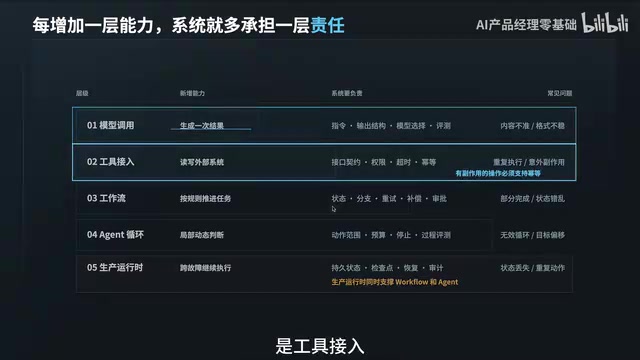
One engineering detail worth emphasizing: Whenever a tool might write data or trigger an action, idempotency must be considered. Otherwise, a single network retry could turn into two real executions, causing irreversible side effects. This is a hidden risk buried in many beginner Agent systems.
Idempotency is a core concept in distributed systems design, meaning that executing the same operation once or multiple times produces exactly the same effect. In Agent systems, network jitter, timeout retries, and process restarts are extremely common. If a tool call (such as a charge, notification, or order creation) isn't idempotent, retries will cause duplicate execution. Common idempotency implementations include: assigning a unique idempotency key to each call and having the server check whether that key has already been processed before executing; or designing operations as "set to a value" rather than "increment by a value." In production-grade Agents, this isn't just a tool-level issue—it also involves how the runtime records "which actions have been successfully completed" so that already-executed steps can be skipped during checkpoint recovery.
Additionally, tool calls introduce a new trust boundary: Are the call parameters generated by the model valid? Could they constitute an injection attack? The system needs to add a parameter validation layer between model output and actual execution—a security requirement that pure prompt engineering cannot cover.
Layer 3: Workflow — Managing Multi-Step Tasks
When a task has clearly defined multiple steps, the system must begin managing state, branching, retries, compensation, cancellation, or approvals. Here's the golden rule for distinguishing Workflow from Agent:
A process can contain multiple model nodes, but as long as the next step is still determined by code or rules, it's a Workflow, not an Agent.
The biggest benefit of this determinism: processes are much easier to test, replay, and audit.
Workflow engines (such as Temporal, Apache Airflow, Prefect, AWS Step Functions) are essentially engineering implementations of finite state machines or directed acyclic graphs (DAGs). They break tasks into discrete steps, each with clear input/output contracts, retry strategies, and compensation logic. Key capabilities include: persisting execution state (enabling recovery from the last checkpoint even if the process crashes), supporting human approval nodes, and providing visual execution history for auditing. Compared to traditional cron scripts or queue consumers, the core advantage of Workflow engines is "execution as record"—the system inherently knows which step it's on, why it stopped here, and what to do next. This determinism is the fundamental difference from Agent loops.
In practice, a large number of systems marketed as "AI Agents" are essentially Workflows containing model nodes. This isn't pejorative—quite the opposite. For the vast majority of business scenarios, deterministic processes plus localized model capabilities form the most robust combination.
Layer 4: Agent Loop — Introducing Dynamic Decision-Making
Only when paths are difficult to enumerate in advance and each step's result can be further verified is it appropriate to introduce an Agent loop. The model decides the next action based on the current state and latest feedback.

But Agent loops also introduce new risks: ineffective loops, goal drift, cost overruns, and cascading error amplification. Therefore, action scope, budget, and stop conditions must be designed together—none can be omitted.
Goal Drift is one of the most insidious risks in Agent loops. Since large language models reason based on the context window, as loop iterations increase, the early goal description gets gradually diluted in the attention mechanism by subsequent information, and the model may start pursuing sub-tasks unrelated to the original goal. Cost overruns are more straightforward: each loop iteration consumes tokens, and without budget limits, an Agent stuck in an ineffective loop can burn through tens of dollars in API costs within minutes. Common safeguards in the industry include: setting a maximum loop count, checking for "new information gain" each round, setting token or monetary caps for the entire task, and introducing a "progress detector"—if the state hasn't materially changed for N consecutive rounds, force an exit and escalate to humans.
From an architectural pattern perspective, an Agent loop is essentially a while loop with a model-based decision maker. Its pseudocode structure is typically: while not done: observe → think → act → update_state → check_stop_conditions. Behind this simple structure lies enormous engineering complexity, because the output of the "think" step is nondeterministic, which transforms the system's behavior space from finite to near-infinite.
Layer 5: Production Runtime — Ensuring Stable Delivery
This layer handles state persistence, checkpoints, timeout recovery, cancellation, auditing, observability, and a range of other capabilities. The runtime can host both Workflows and Agents.
An important clarification: Supporting checkpoint recovery only means a task can continue after a failure or wait—it doesn't mean the model has become smarter. Resumable execution is a runtime capability needed by both Workflows and Agents, not an exclusive feature of Agents.
Resumable Execution relies on checkpointing mechanisms, whose core idea is to serialize and persist the intermediate state of task execution to external storage (such as a database or object storage), so that after a process crash, machine restart, or even cross-machine migration, the task can continue from the most recent checkpoint rather than starting over. This concept originates from transaction logs (WAL, Write-Ahead Logging) in operating systems and databases, and is widely adopted in Workflow engines. For Agent systems, checkpoints need to record not just "which step was reached" but also task facts (collected data, list of completed actions), current goal state, and remaining budget. Notably, the model's context window contents are typically not part of the checkpoint—they can be reconstructed from task facts upon recovery, which is why the article emphasizes that "task facts" and "chat history" must be kept separate.
Additionally, production runtimes need comprehensive observability support: the duration of each step, token consumption, tool call results, and model decision rationale should all be recorded in a structured format for post-hoc analysis and continuous optimization.
Responsibility Boundaries of Prompt, Workflow, and Agent
These three manage entirely different scopes and cannot substitute for each other:
- Prompt governs how a single model node operates;
- Workflow governs how an entire task progresses from start to finish;
- Agent only handles the small number of dynamic decisions within a workflow that can't be hardcoded in advance.
In other words, even as model judgment capabilities grow stronger, task state, permission boundaries, failure recovery, and result verification won't automatically disappear—the system still needs to be explicitly responsible for them.
To determine whether a particular step truly needs an Agent, ask two questions: First, can the path be clearly defined in advance? If yes, use code. Second, if the path is hard to enumerate, can the result be objectively verified? Only when the path is hard to enumerate AND the result is verifiable should you consider letting the model make the judgment.
"Verifiable" is a frequently overlooked condition here. If the model makes a decision but the system cannot judge whether that decision is correct (e.g., "write the user a comforting email"), then even with an Agent loop, the system cannot automatically determine when to stop or whether to retry. Verifiability is a prerequisite for Agent autonomy.
Separation of Concerns in Production-Grade Agent Design
A truly production-grade Agent is far from simply wrapping tools around a model. It needs to clearly separate task orchestration, state persistence, model decision-making, permission checking, tool execution, result verification, and operational governance, giving each component a clear boundary of responsibility.
First is the runtime, responsible for advancing steps, controlling timeouts and cancellations, and writing task facts to persistent state and checkpoints. Model context can be reconstructed before each call, but task facts must not vanish when a single call ends.
The critical division of labor: The model is responsible for proposing action strategies; the system is responsible for deciding whether those actions can be executed. The model suggesting a rollback, sending a message, or modifying a configuration does not mean it has been granted those permissions. Identity, tools, parameter ranges, budget, and human approvals should all be evaluated outside the model.
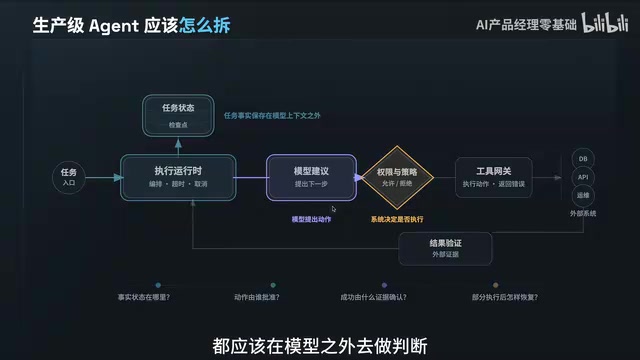
Only after the policy check passes does the tool gateway execute the actual intent, returning results in a unified structure.
This separation of concerns design philosophy is directly aligned with "Separation of Concerns" in microservices architecture and the "Principle of Least Privilege" in security. The model is essentially an "advisor," not an "executor." This design ensures that even if the model hallucinates or falls victim to a prompt injection attack, the system-level policy check can still prevent dangerous operations from actually executing.
A common misconception also needs clarification here: MCP (Model Context Protocol) addresses how models or Agents connect to tools and exchange call information, but it doesn't grant permissions, nor does it automatically handle timeouts or errors. MCP is an open protocol proposed by Anthropic in late 2024, aimed at standardizing the connection between large language models and external tools and data sources. It defines unified formats for tool descriptions, call requests, and result returns, similar to what the OpenAPI specification does for APIs. The core problem it solves is "interoperability"—enabling different models and tool providers to integrate through a unified protocol, reducing integration costs. But whether a task actually succeeds still needs to be verified through tests, database state, monitoring metrics, and other external evidence—you can't just trust the model's own account.
Four Key Questions for Assessing Agent Architecture Maturity
To evaluate whether an Agent architecture is mature, ask four questions directly:
- Where is the factual state stored?
- Who approves actions?
- What evidence confirms success?
- How does execution recover after failure?
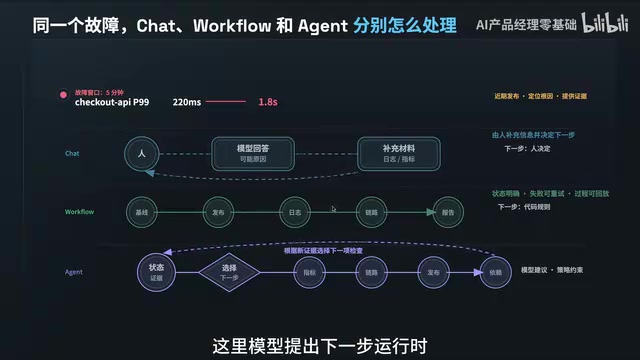
If any of these questions can't be clearly answered, the system will struggle to fully go live. Here's a real-world example: A production service's checkout API P99 latency jumped from 220 milliseconds to 1.8 seconds, with a recent deployment. The goal is to identify the cause and provide verifiable evidence.
P99 latency means that 99% of all requests have response times below this value—only 1% are slower. Compared to averages or medians, P99 better reflects the experience of tail-end requests and is a key indicator of production service health. When P99 spikes from 220ms to 1.8s, it means a significant number of users are experiencing noticeable lag. In observability systems, three pillars are typically used to diagnose such issues: Metrics (like latency distributions, error rates), Logs (recording specific events), and Traces (reconstructing all services and durations a single request passes through).
If you simply paste logs into a model and ask it to list possible causes—that's just assisted analysis. Having a chat interface doesn't mean the backend uses Agent architecture. The proper approach is: the system sequentially retrieves baselines, checks recent deployments, collects logs and traces, and generates reports, with each step advanced by code based on state, and the ability to know where to retry upon failure. Only when fault branches are too numerous for a runbook to cover should local diagnostic choices be handed to the model—the model selects the next check from registered tools like metrics, traces, deployments, and dependencies, with results feeding back into the task state. Meanwhile, the system must enforce clear boundaries: only read-only tools are exposed, maximum call counts are limited, and two consecutive rounds without new evidence triggers human escalation.
This example clearly demonstrates the hybrid use of Workflow and Agent: most of the diagnostic process is deterministic (get baseline → compare deployments → check logs), and model judgment is only introduced when fault branches are too numerous to enumerate. This is the classic "deterministic outer layer + dynamic inner core" pattern.
Four Directions for Agent Architecture Evolution
Looking ahead, Agent architecture has four clear trends, all centered on the model handling local judgments while the system handles execution, verification, and recovery:
- Hybrid control will become increasingly common: Deterministic outer processes are driven by code, with models only handling local judgments that are hard to enumerate. This pattern is sometimes called a "human-machine collaborative semi-autonomous system." It acknowledges the current boundaries of model capabilities while maximizing the model's strengths in pattern recognition and natural language understanding.
- State will be externalized from conversation context: Long-running tasks need checkpoints, event-driven pause/resume, and cancellation capabilities—they can't depend on a single process staying online. This trend is highly consistent with the "stateless compute + external state storage" design philosophy in cloud-native architecture, also enabling Agent systems to better scale horizontally and handle failures.
- Evaluation will expand from final answers to execution processes: Beyond whether the result is correct, checks should cover whether tool selection was appropriate, whether constraints were followed, whether there were repeated ineffective actions, and whether costs spiraled out of control. This means Agent evaluation frameworks need to expand from traditional "input-output pairs" to "Trajectory Evaluation," focusing on the rationality of decision paths rather than just final outputs.
- Multi-Agent should not be the default choice: Splitting into multiple Agents is only beneficial when role permissions truly need isolation, tasks can be effectively parallelized, or different contexts would interfere with each other. Otherwise, it only adds latency, cost, and new failure points. Additional challenges facing multi-Agent systems include: inter-Agent communication protocol design, global state consistency maintenance, deadlock detection and prevention, and a dramatic decrease in overall behavioral predictability.
Decision Sequence for Agent Architecture Selection
The final selection sequence is also clear: If the path is well-defined, prefer Workflow; if the path is hard to enumerate but results are verifiable, then consider Agent; if actions are irreversible or high-risk, retain human approval; if the task needs to survive failures, introduce a resumable runtime. Give deterministic processes to code, give hard-to-enumerate but verifiable local judgments to the model, and always keep execution authorization, acceptance, and recovery under system control.
This decision sequence fundamentally follows the "simplicity principle" in engineering design: given that requirements are met, choose the solution with the lowest complexity. Each additional layer of capability simultaneously introduces new failure modes and maintenance costs. A problem that only needs a Workflow but gets implemented as an Agent loop not only introduces nondeterminism but also makes debugging and monitoring difficult. Conversely, a scenario that truly requires dynamic decision-making but gets hardcoded as a Workflow becomes unmaintainable due to branch explosion. Choosing the right level of abstraction is the most critical judgment in Agent system architecture design.
Key Takeaways
Related articles
Anthropic CEO Warns: AI Agent Swarms Could 'Take Over the Internet' Within Six Months
Anthropic CEO Dario Amodei predicts AI agent swarms could 'take over the Internet' within 6–12 months. We break down what this really means and why frontier lab forecasts deserve careful scrutiny.
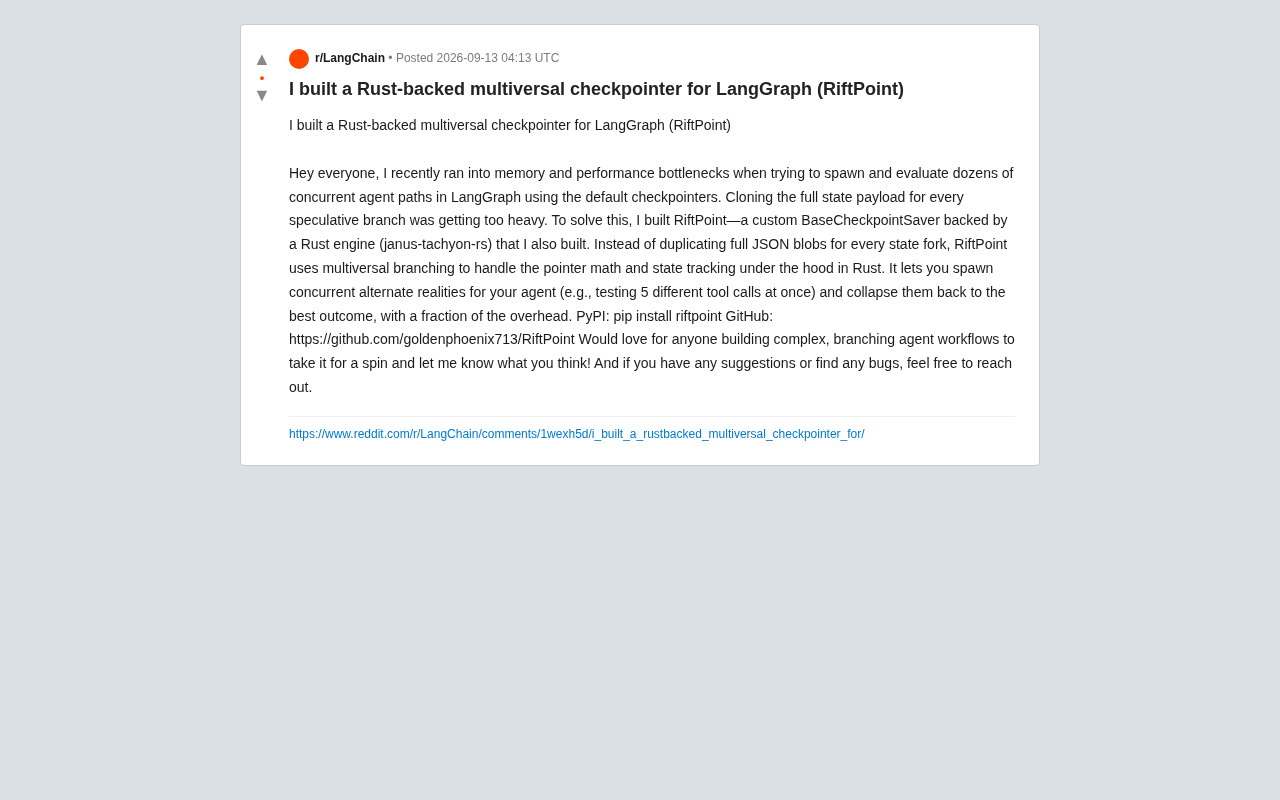
RiftPoint: A Rust-Powered Multiverse Checkpointing Solution for LangGraph
RiftPoint is an open-source LangGraph checkpointer backed by a Rust engine that uses multiversal branching to avoid full state copies, cutting memory and performance costs for concurrent agent paths.

Spotit: Turn Every Mac App into a Real-Time Interactive Tutorial
Spotit is an AI-powered interactive tutorial tool for Mac. Press a shortcut, ask in plain language, and it highlights exactly where to click next — guiding you through any Mac app as you learn by doing.