RiftPoint: A Rust-Powered Multiverse Checkpointing Solution for LangGraph
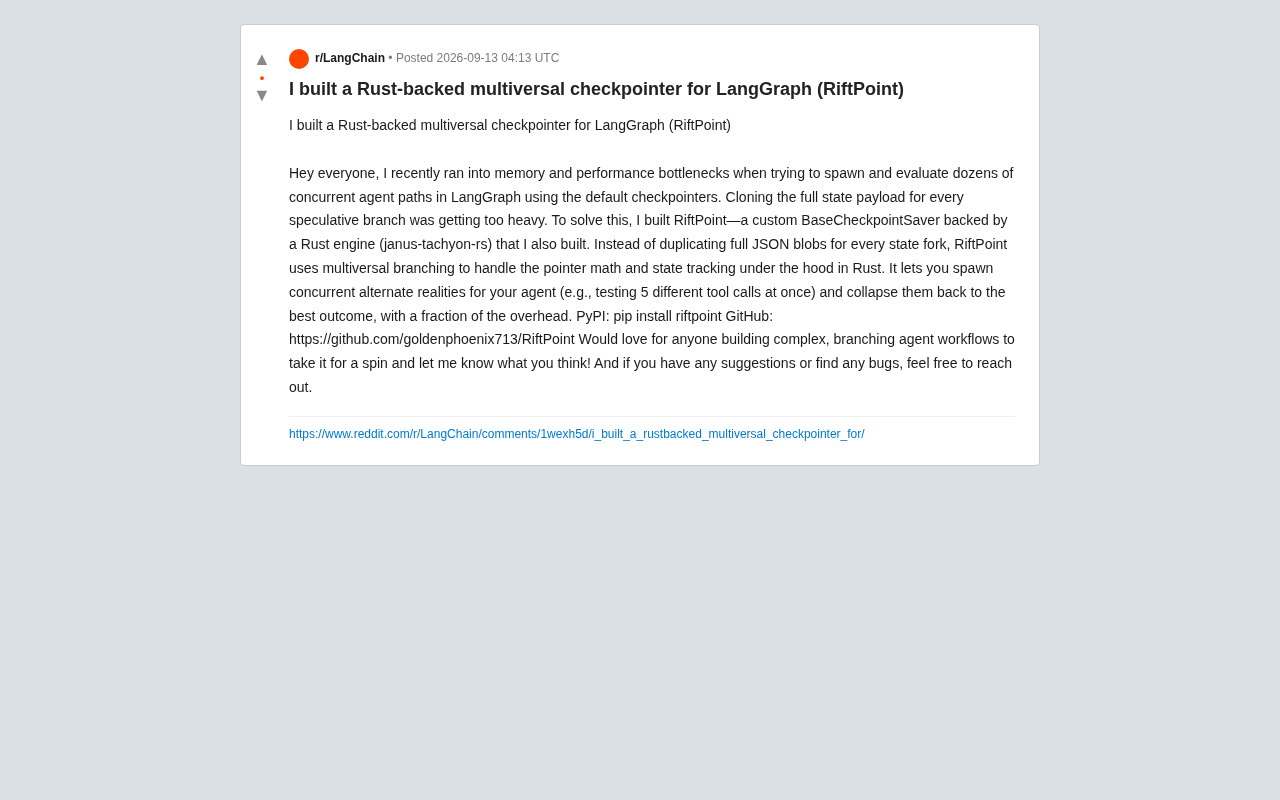
RiftPoint uses a Rust engine for lightweight state branching, solving LangGraph's memory explosion in concurrent agent paths.
RiftPoint is an open-source custom LangGraph checkpointer backed by the Rust engine janus-tachyon-rs. It targets a core pain point: LangGraph's default checkpoint mechanism fully clones the entire state JSON for every concurrent branch, causing memory and performance to balloon as parallel paths multiply. RiftPoint's "multiversal branching" strategy pushes pointer arithmetic and state delta tracking to the Rust layer, letting concurrent paths share unchanged base state and only record their individual diffs. The project is available on PyPI via `pip install riftpoint` and is worth evaluating for developers building large-scale parallel agent workflows.
When building complex agent workflows, performance and memory overhead are perennial pain points. A developer recently shared an open-source project on Reddit called RiftPoint — a LangGraph checkpointer backed by a Rust engine, designed specifically to tackle the memory and performance bottlenecks that arise when evaluating concurrent agent paths.
Where the Problem Comes From
In LangGraph, the checkpoint mechanism records an agent's state during execution, enabling rollback, recovery, or parallel exploration of multiple decision branches. However, the default checkpoint implementation has a notable weakness: every time the system needs to fork a new state for a speculative branch, it clones the entire state payload.
As the developer describes it, when he tried to simultaneously generate and evaluate dozens of concurrent agent paths in LangGraph, the approach of "fully copying the JSON blob for each branch" quickly became an enormous memory and performance burden. The more branches, the more redundant data copies — with overhead growing linearly or even steeper. For scenarios that require large-scale parallel exploration, this is nearly unacceptable.
How RiftPoint Solves It
RiftPoint is a custom BaseCheckpointSaver powered under the hood by the author's own Rust engine, janus-tachyon-rs. Its core innovation is replacing brute-force full-state copying with what it calls "multiversal branching."
Instead of copying the complete JSON data block on every state fork, RiftPoint pushes pointer arithmetic and state tracking down to the Rust layer. This means that when you need to spin up multiple "parallel realities," the system only needs to manage lightweight pointers and delta information rather than full duplicate states.
The direct benefit of this design: you can generate multiple concurrent "alternate realities" for an agent simultaneously — for example, testing 5 different tool calls at once — and then "collapse" them back to the best-performing result, all at a fraction of the overhead of the traditional approach.
Why Rust
Delegating the core state management logic to Rust is the key technical decision in this project. Rust's advantages in system-level performance, memory safety, and zero-cost abstractions are a natural fit for the high-frequency state operations that checkpointing demands. Compared to repeatedly serializing and copying large JSON structures in Python, handling low-level pointers and state tracking in Rust significantly reduces GC pressure and memory usage.
For agentic workflows that involve branching and speculative execution, the pattern of "explore multiple paths, then pick the best" is becoming increasingly common — whether that's parallelizing multiple tools, multiple prompt variants, or Monte Carlo-style path search. The efficiency of the underlying state management directly determines the concurrency scale the system can support.
Getting Started
The project is open-source and published to PyPI. Installation is straightforward:
pip install riftpoint
The source code is hosted on GitHub (goldenphoenix713/RiftPoint). The author welcomes developers building complex branching agent workflows to give it a try, and is actively seeking community feedback on improvements and bug reports.
A Few Observations
As an early-stage open-source project from an individual developer, RiftPoint's value is best understood as a focused response to a genuine pain point: as agents increasingly rely on large-scale parallel exploration, the cost of state copying is becoming an engineering bottleneck. Using a Rust engine to take over pointer management and state tracking — organized around the "multiverse" metaphor for branch management — is a pragmatic and clever angle of attack.
That said, as a new project, its stability, ecosystem compatibility, and behavior under real production workloads still need more validation. For LangGraph users who are already struggling with default checkpointer performance, this is at least a compelling alternative worth keeping an eye on. If you're curious, it's worth spinning up yourself to see whether it alleviates the concurrent branching headaches in your own work.
Related articles
Anthropic CEO Warns: AI Agent Swarms Could 'Take Over the Internet' Within Six Months
Anthropic CEO Dario Amodei predicts AI agent swarms could 'take over the Internet' within 6–12 months. We break down what this really means and why frontier lab forecasts deserve careful scrutiny.

Spotit: Turn Every Mac App into a Real-Time Interactive Tutorial
Spotit is an AI-powered interactive tutorial tool for Mac. Press a shortcut, ask in plain language, and it highlights exactly where to click next — guiding you through any Mac app as you learn by doing.
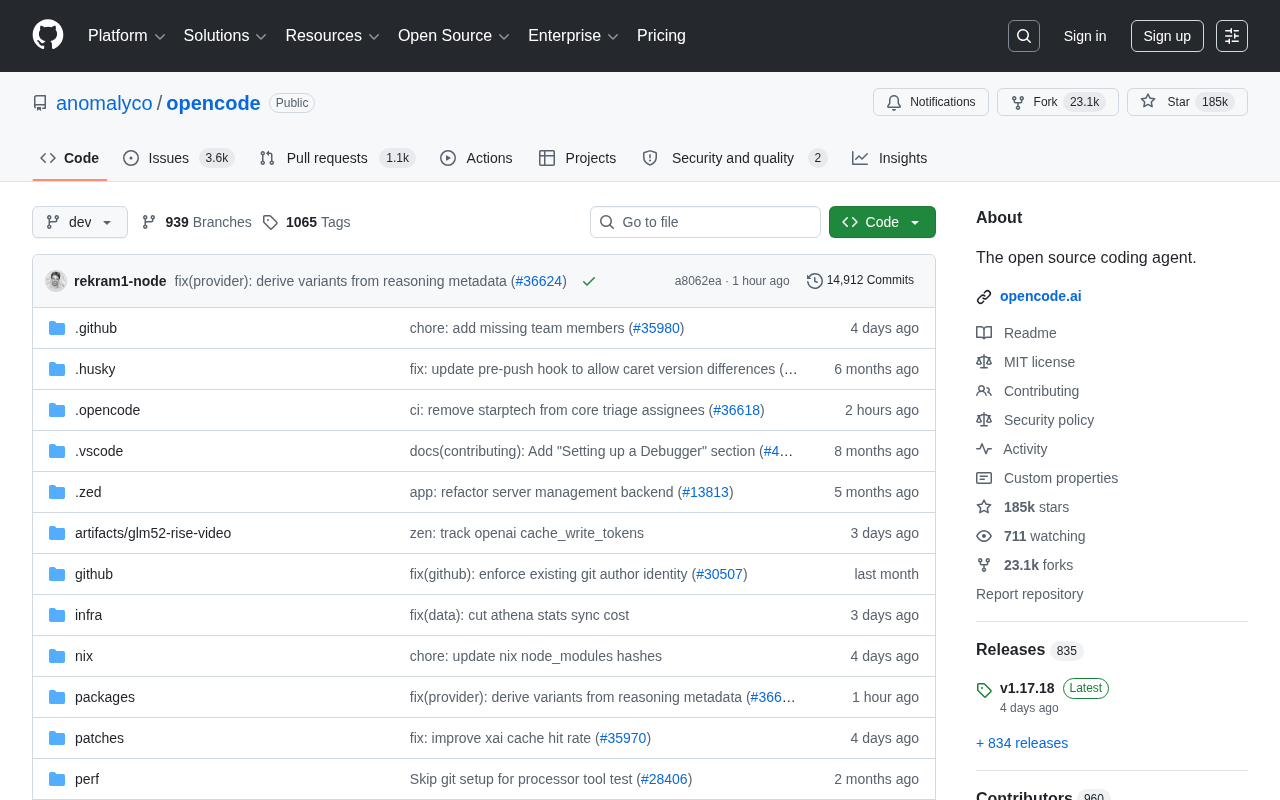
OpenCode: The Open-Source Coding Agent That Hit 150K GitHub Stars
OpenCode is an open-source TypeScript coding agent with 150K+ GitHub stars. Learn about its features, advantages, and use cases for AI-powered development.