The Flood of AI Tool Advertorials: A Practical Guide to Spotting Undisclosed Paid Promotions

A practical guide to spotting undisclosed paid promotions disguised as genuine AI tool recommendations.
As the AI startup boom intensifies, covert paid promotions disguised as organic user recommendations have become rampant across social media. This article examines why undisclosed AI tool advertorials are proliferating, explains the legal and ethical importance of disclosure, and provides practical signals to identify suspicious content — from too-perfect narratives and overuse of pedigree labels to missing disclosures and suspicious account behavior. It also discusses what platforms, creators, and users can do to restore trust in the content ecosystem.
A Tweet That Sparked a Conversation
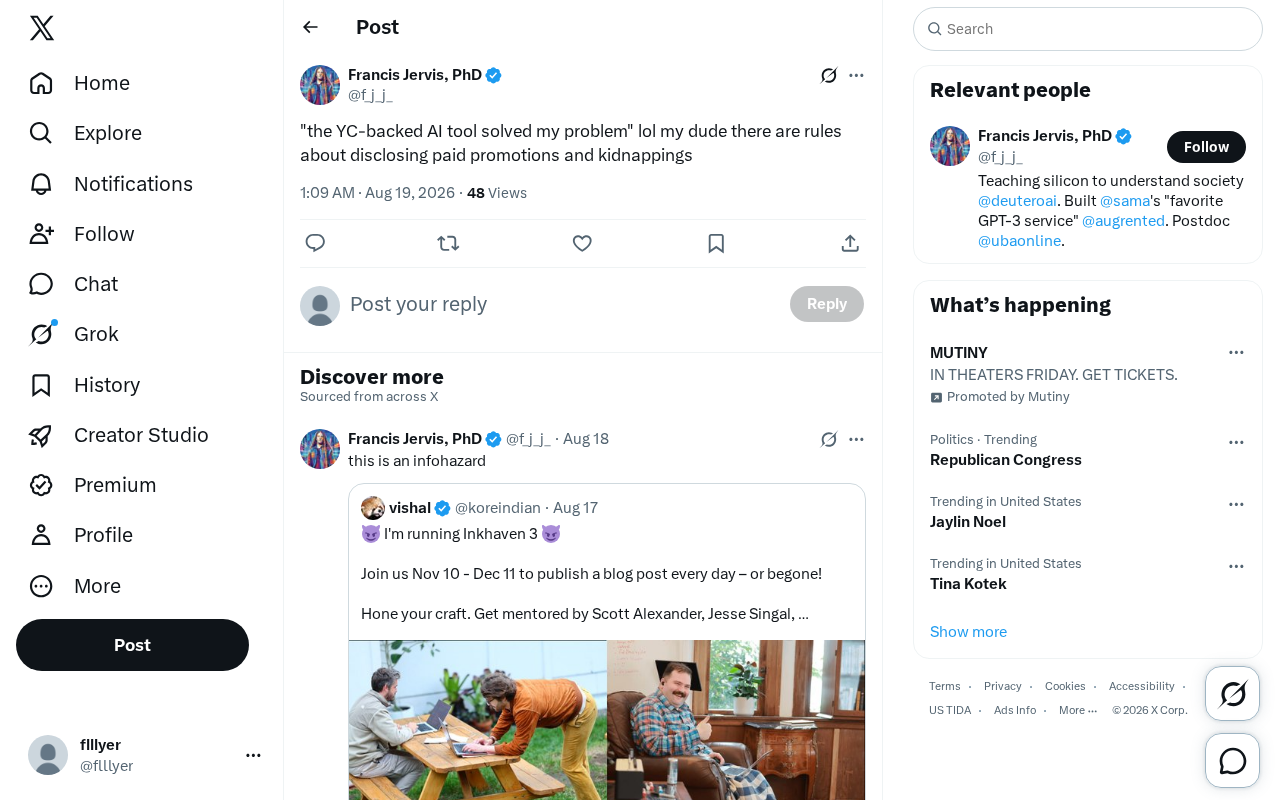
Recently, a tweet on Twitter ignited a widespread discussion about marketing ethics in the AI industry. The slightly sardonic tweet read: "'This YC-backed AI tool solved my problem' — bro there are rules about disclosing paid promotions (and kidnapping)."
While humorous in tone, the tweet struck a nerve about an increasingly serious problem in the AI industry: a flood of seemingly genuine "user recommendations" that are actually undisclosed paid promotions or marketing content from interested parties. When every new tool comes tagged with labels like "YC-backed" or "transformed my workflow," the line between authentic user experiences and commercial advertorials is becoming dangerously blurred.
The Current State of AI Marketing Chaos
Why Covert Promotions Are So Prevalent
Amid the AI startup boom, early-stage companies face fierce competition for user acquisition. Since ChatGPT ignited the generative AI craze in late 2022, the number of AI startups has exploded, with global venture capital investment in AI exceeding $50 billion in 2023. In such a crowded competitive landscape, customer acquisition costs (CAC) through traditional SaaS channels like Google Ads and SEO have been steadily climbing, with some verticals seeing per-customer costs surpass several hundred dollars. This has pushed many startups toward so-called "Product-Led Growth" (PLG) and "community marketing" strategies, manufacturing "organic word-of-mouth" on platforms like Twitter/X, Reddit, Hacker News, and Product Hunt to reduce acquisition costs.
Compared to traditional advertising, recommendations from "real users" or "indie developers" are obviously more persuasive. And so we see:
- Social media suddenly flooded with "I just discovered an amazing tool" recommendation posts
- Tech bloggers "casually" mentioning a tool in their articles without disclosing partnerships
- Anonymous or burner accounts publishing seemingly objective product reviews
These pieces of content share a common trait: they deliberately create an impression of spontaneity and objectivity while concealing the commercial motives behind them. In marketing, this strategy of simulating organic public sentiment through fabricated grassroots support is known as "Astroturfing" — a term derived from the "AstroTurf" artificial turf brand, used to mock these "manufactured grassroots movements." With the proliferation of large language models, the barrier to generating convincing recommendation copy has dropped dramatically. Batch-registering accounts, aging them for a few weeks, and then publishing a coordinated burst of seemingly independent product reviews has become a mature gray-market operation.
Labels like "YC-backed" (incubated by Y Combinator) are themselves an abuse of trust endorsement — they attempt to use a prestigious incubator's reputation as a guarantee of product quality, when in reality, incubation background and whether a product actually solves your problem are two entirely different things. Y Combinator is one of the world's most influential startup incubators, founded in 2005, having incubated well-known companies like Airbnb, Dropbox, Stripe, and Reddit. Due to its extremely high selection standards and stellar investment track record, "YC-backed" has become a trust signal in startup circles. However, the number of companies accepted per batch has expanded from a few dozen in the early days to hundreds today — acceptance alone doesn't guarantee product quality, let alone market validation. Directly grafting an incubator's brand halo onto specific product recommendations is essentially a logical fallacy known as the "Halo Effect."
Why Disclosing Paid Promotions Matters
In many countries and regions, disclosing paid promotions is not just a moral obligation — it's a legal requirement. In the United States, for example, the Federal Trade Commission (FTC) clearly mandates that any endorsement content involving a "material connection" must be transparently disclosed. The FTC is the federal agency responsible for consumer protection and anti-unfair competition enforcement. Its Endorsement Guides were originally published in 1980 and underwent a major update in 2023, specifically addressing new forms of marketing behavior in the social media era.
The updated guidelines explicitly require that: disclosures must be "clear and conspicuous" and cannot be buried at the end of lengthy text or hidden in collapsed content; fake reviews and purchasing followers are explicitly listed as violations; and brands can be held jointly liable for their endorsers' violations. Companies that violate FTC guidelines can face fines exceeding $50,000 per violation. In the EU, similar regulations are embodied in the Unfair Commercial Practices Directive and consumer protection laws of individual member states.
Relationships that require disclosure include:
- Direct monetary compensation
- Free products or services
- Equity stakes, commissions, or other financial interests
Undisclosed paid promotions don't just mislead consumers — they erode the trust foundation of the entire content ecosystem over time. When users begin to doubt all recommendation content, genuinely excellent products actually become harder to discover. This is what economists call "Gresham's Law" — bad money drives out good — manifesting in the content ecosystem.
How to Spot Covert AI Tool Advertorials
As readers and potential users, developing the ability to identify advertorials is crucial. Here are several warning signs to watch for:
Signal 1: Narratives Too Perfect to Be True
Real-world tool usage typically involves learning curves, limitations, and tradeoffs. If a "user experience" post contains nothing but praise with no mention of drawbacks or barriers to entry, it's likely not a genuine experience but rather carefully crafted marketing copy. Real users usually mention details like "it took some time to get started," "certain features aren't quite polished yet," or "it's not ideal for certain use cases." Content lacking this kind of balance often signals commercial intent.
Signal 2: Overemphasis on Pedigree Labels Over Product Details
Repeatedly emphasizing labels like "YC-backed," "founded by ex-FAANG employees," or "raised tens of millions in funding" while remaining vague about the product's actual capabilities is a red flag. When a tool truly solves a problem, the author will specifically describe "how it solved what problem" rather than relying on halo effects. For example, a genuine AI writing tool recommendation would say something like "it's better than ChatGPT for long-form structuring because it supports outline editing and section drag-and-drop," rather than simply stating "this YC-backed AI writing tool completely transformed my creative workflow."
Signal 3: Missing Disclosure Statements
The most straightforward criterion: does the content clearly label itself as "ad," "sponsored," "partnership," or similar? Compliant content creators proactively disclose their interests. The absence of such disclosure is itself a red flag. It's worth noting that more subtle relationships should also be considered within the scope of required disclosure — for example, if the recommender is an early investor, advisory board member, or has a personal relationship with the founder. These "material connections" equally affect the objectivity of recommendation content.
Signal 4: Suspicious Account Behavior Patterns
Newly registered accounts, sudden bursts of recommendations for similar products, and abnormal engagement metrics (lots of likes but few comments) may all point to organized marketing campaigns rather than organic sharing. Additionally, watch for these patterns: multiple accounts using highly similar language structures and keywords; recommendation posts published in a highly concentrated time window (usually coinciding with product launches or funding announcements); and accounts whose historical content has no connection to the recommended domain (for example, an account that normally only posts about food suddenly recommending a code generation tool). These patterns often indicate organized Astroturfing campaigns.
What Kind of Trust Mechanisms Does the Industry Need?
Platforms Must Take Regulatory Responsibility
Social media and content platforms need to establish stricter disclosure mechanisms. Currently, major social platforms have rolled out various forms of paid content labeling: Instagram and Facebook's "Paid Partnership" tags, YouTube's "includes paid promotion" declaration, TikTok's branded content toggle, and so on. However, Twitter/X has relatively weak mechanisms in this regard — the platform itself doesn't provide mandatory paid promotion labeling tools and relies primarily on users to self-disclose. This makes Twitter/X a hotbed for covert AI tool promotion — and it happens to be one of the most active platforms for AI entrepreneurs and the tech community.
Even on platforms with labeling mechanisms, enforcement has been far from ideal. Research indicates that a significant amount of brand partnership content fails to comply with platform labeling requirements. Platforms should strengthen their algorithmic detection and proactive labeling of covert promotions, and take measures like throttling or banning repeat offenders, rather than letting low-quality marketing content proliferate to capture ad revenue.
Self-Discipline and Transparency from Content Creators
For tech content creators, transparency is the cornerstone of long-term credibility. Clearly disclosing partnerships is not just a legal requirement — it's a basic form of respect for your audience. A single instance of concealment might yield short-term gains, but the trust lost when exposed is nearly impossible to rebuild.
The industry already has some best practices worth adopting: labeling interests at the beginning rather than the end of content; using consistent, clear disclosure language (such as "this article is brand-sponsored content" rather than the vague "thanks to XX brand for their support"); and proactively disclosing even when receiving free trial access. Some leading tech bloggers have even published complete interest disclosure pages listing all current and historical partnerships — a practice that effectively strengthens audience trust.
Users Need to Cultivate Critical Thinking
Ultimately, the most reliable line of defense is the reader's own critical thinking. When encountering any AI tool recommendation, it's worth asking a few questions:
- Does the recommender have a financial relationship with the product?
- Are the described features backed by specific, verifiable evidence?
- Are there independent, multi-source reviews to corroborate the claims?
Additionally, some practical verification methods can help: cross-reference product reviews across multiple independent platforms; check whether the recommender's historical content shows a consistent track record of product usage; and visit the product's actual user communities (such as GitHub Issues or Discord groups) to see real user feedback and complaints. Compared to carefully orchestrated marketing content, bug reports and feature requests in user communities often paint a far more accurate picture of a product's actual state.
Conclusion: Staying Clear-Headed in the AI Hype
This seemingly humorous tweet actually raises a serious industry issue. In an era where AI tools are emerging endlessly and marketing tactics are growing ever more sophisticated, the boundary between authentic and fake must be safeguarded through institutional constraints, industry self-regulation, and user vigilance working together.
"This YC-backed AI tool solved my problem" — the next time you see a statement like this, perhaps we should all pause and ask: is this a genuine recommendation, or yet another undisclosed paid promotion? Maintaining that clarity of thought is the key to not being misled in the flood of information.
History tells us that every technology hype cycle brings with it marketing chaos — from the pop-up ads and black-hat SEO of the early internet era, to the influencer marketing controversies of the social media age, to the covert promotions plaguing the AI tools space today. Technology evolves, marketing tactics evolve, but the fundamental principle of protecting consumers' right to know has never changed. In this age of ubiquitous AI, information literacy is itself a core competitive advantage.
Related articles

Kimi K3.1 Hands-On Test: Open-Source Model Nears Opus, Video Generation Steals the Show
Kimi K3.1 completed motion graphics, 3D rendering, mini-games, and video generation in a live test. Analysis of its 2.8T MoE architecture, gap vs Opus/GPT, and hidden video generation.

Sam Altman: Why Life's Biggest Advice Should Still Come from Humans
OpenAI CEO Sam Altman on the limits of AI advice: AI can talk you out of an impulsive email, but life's biggest advice should still come from humans.

"Black October": Did AI Uncover 3% of All Critical Vulnerabilities Ever?
A Reddit post claims 3% of all critical software vulnerabilities ever were found in the past month, dubbed 'Black October.' We break down the statistical issues, how AI-assisted code auditing accelerates discovery, and how developers should respond.