The Four Stages of AI-Assisted Programming: From Code Completion to Agentic Collaboration

AI-assisted programming has evolved from code completion to the agentic era, shifting developers from executors to requirement commanders.
This article clarifies a key misconception: AI-assisted programming isn't for zero-experience users — it amplifies developer productivity for those with foundational skills. It traces four evolutionary stages: code completion, conversational programming, agentic programming (today's stage, exemplified by Claude Code), and multi-agent collaborative engineering. The agentic leap means AI now autonomously reads codebases, creates files, and runs code — no more copy-pasting. The developer workflow shifts to "define → generate → review → fix," and learning becomes "learn as you go."
What AI-Assisted Programming Actually Is
Before diving into hands-on work with Claude Code, it's worth clarifying a core concept: AI-assisted programming does not mean "anyone can write code without technical knowledge." This is a common misconception fueled by a lot of misleading marketing.
In traditional programming, developers write code line by line, explicitly telling the computer what to do at every step. You need to master the language syntax, understand the underlying algorithms, and memorize various APIs — a steep and time-consuming learning curve. AI-assisted programming works entirely differently: you describe the functionality you want in natural language (Chinese or English), and the AI translates that into working code.
The developer's role shifts from executor to commander. But here's the key insight: AI assistance doesn't enable people with zero technical background to produce software — it dramatically lowers the barrier to entry. Real developers still need a solid grasp of basic syntax, so that when AI-generated code contains bugs, they can think like a programmer to locate and fix them.
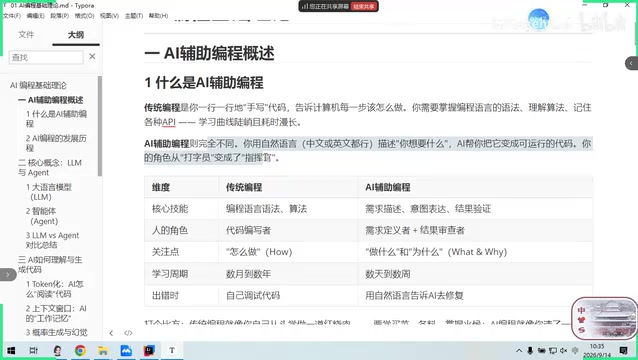
This shapes the philosophy of this course: it's not aimed at complete beginners, but at developers who want to leverage AI for greater productivity. The core skill set shifts from "knowing syntax, understanding algorithms, and focusing on how to do things" to "defining requirements, describing requirements, and validating results."
From Writing to Reviewing: A Shift in Role and Focus
A chef analogy helps illustrate this change. Traditional programming is like cooking a meal yourself from scratch. AI-assisted programming is like hiring a professional chef — you just tell them what you want to eat, and they make it. But you still need some basic culinary sense: ease up on the sugar when it's too sweet, add more seasoning when it's bland. That kind of informed judgment is exactly what makes a developer irreplaceable.

In practice, the developer workflow becomes: define requirements → AI generates code → review output → fix bugs. Feedback from students in previous cohorts confirms this: they went from writing code line by line to handing requirements to the AI, then reviewing the results. Any bugs that emerged still required a programmer's understanding of syntax and logic to fix.
This also fundamentally changes how learning happens — from the traditional "learn first, then apply" model to "learn as you go." Knowledge accumulates naturally as you deepen your hands-on practice.
The Four Stages of AI Programming
AI-assisted programming didn't appear overnight — it evolved through a clear progression. Understanding this trajectory helps us identify where we are today and where things are headed.
Stage 1: Code Completion
This is the earliest form, similar to predictive text on a mobile keyboard. You type a few characters in your IDE, and the tool automatically completes a few lines of code. Type a variable name, and it fills in the assignment. Most IDEs and editors include this natively. This is the intelligent completion era.
Stage 2: Conversational Programming
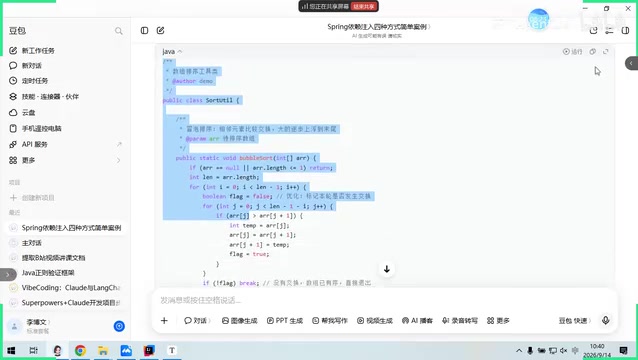
This stage has many representative tools, including Doubao, Tongyi Qianwen, Trae, and internationally, ChatGPT, Gemini, and others. You can ask the AI in natural language to "write a sorting method," and it returns a complete block of code.
The typical workflow: describe your requirements to the AI (e.g., "use SpringBoot with MyBatis to implement CRUD for a user table, including the Mapper, Service, and Controller layers"), the AI generates the full code, and then you copy and paste it into your project to run. That manual "code transport" step is the defining characteristic of conversational programming. Some integrated platforms aggregate multiple large models, sparing users from installing separate tools for each.
Stage 3: Agentic Programming (Where We Are Now)
Representative tools include Claude Code, Cursor, Cline, CodeX, and various domestic equivalents. This stage marks a qualitative leap — from AI answering questions to AI completing tasks.

Concretely: you tell it "add a user feature to this project," and it autonomously reads the entire codebase, creates the necessary files, writes the code, and runs it — all on its own. No more manually copying and pasting into the right location. The AI takes ownership of the project, reads all existing functionality, and creates new classes or modifies code in exactly the right places. This is the defining capability of the agentic programming era.
Agentic Programming achieves this qualitative leap by combining large language models with Tool Use / Function Calling capabilities. The model doesn't just generate text — it can be authorized to invoke external tools: read and write the filesystem, execute terminal commands, call APIs, run test scripts, and more. Claude Code operates through exactly this mechanism, acting autonomously within your local project directory. Compared to conversational AI, agents possess a closed-loop perceive → plan → act cycle: they first read existing code to understand context, then formulate a modification plan, then write to files and run validation — all without requiring human intervention at each step. This also makes authorization boundaries critically important. You need to explicitly specify which files the agent can modify and which operations require confirmation, to avoid unexpected side effects from automated actions.
Stage 4: Collaborative Engineering (The Future)
This is the emerging frontier, centered on multi-agent collaboration. Multiple agents form a team with distinct roles: some write code, some handle architecture, some perform code review. The human's role ascends to "project director" — issue directives, and a coordinated team of agents executes the work. This is also the technical foundation underlying the "one-person company" concept.
Multi-agent collaboration typically relies on an Orchestrator layer that decomposes complex tasks into subtasks and assigns them to specialized agents for parallel or sequential processing. Open-source frameworks such as AutoGen, CrewAI, and LangGraph have already seen early industrial adoption. The "one-person company" concept doesn't mean literally working alone — it means a single human decision-maker can, by orchestrating a multi-agent team, take on projects that would previously have required an entire engineering team. This paradigm is still exploratory; key challenges include context sharing between agents, error propagation control, and consistency maintenance over long-running tasks. But its potential to reshape productivity dynamics in the software industry is already drawing widespread attention.
Why Learn Agentic Programming Now
We are currently in Stage 3 — the agentic programming era. The leap from "asking for directions" to "hiring a designated driver" captures the difference between earlier tools and today's agents: the former gives you a route, the latter takes you to the destination.
For developers who already have a grasp of basic syntax, this is the optimal moment to amplify productivity. The upcoming hands-on project work with Claude Code — building AI applications using SpringBoot and LangChain4j — is built directly on this conceptual foundation. Only by truly understanding what AI-assisted programming is — that it amplifies rather than replaces your capabilities — can you make effective use of these agentic tools, rather than passively copying outputs without understanding them.
Related articles

Chain of Thought Isn't Just for AI: How Humans Can Use CoT to Improve Thinking Quality
Chain of Thought isn't just a prompt trick for large models. Starting from a Hacker News discussion, this article analyzes why CoT works for human thinking too, breaks down actionable ways to transfer it, and highlights the key differences between human CoT and machine CoT.
Cloudflare Teams Up with OpenAI: Closi…
Cloudflare Teams Up with OpenAI: Closing the Loop from Vulnerability Discovery to Defense with AI
Cloudflare uses OpenAI Daybreak to investigate security vulnerabilities and generate reviewable remediation plans, while developers use Codex to boost coding efficiency and quality.

Orca Multi-Agent Orchestration in Practice: A Guide to Parallel Collaboration with Claude and Codex
Orca is Stable AI's free open-source agent workbench supporting 34 agents like Claude Code and Codex in parallel. Learn its Git worktree isolation, multi-model orchestration, and mobile management.