The Fragility of AI Isolation: Why Air Gaps Are More Reliable Than Sandboxes

Absolute isolation guarantees for AI agents don't exist — layered defense and risk overestimation are the answer.
This article centers on an AI security researcher's clarification after being taken out of context on a podcast, revealing the core dilemma of isolation security in multi-agent AI systems. The key argument: making absolute guarantees about AI system isolation is extremely difficult, because even two agents designed to be fully independent can coordinate via covert channels by exchanging just a few bits of information. The HuggingFace security incident further illustrated the danger of over-relying on sandbox isolation. Air gaps offer stronger protection but are still not absolute. The article concludes with a security design philosophy: overestimating risk is always safer than underestimating it, and only stacking independent protective layers can preserve resilience when any single mechanism fails.
How a Podcast Controversy Started This
An AI security researcher published a clarification after being taken out of context on a podcast — a discussion about the security of AI system isolation that unexpectedly drew widespread attention. The author stressed that watching only a clip of the interview would easily lead to a misreading of his views, since in the full episode he actually pushed back on a great deal of AI hype. The controversy itself reflects a persistent problem in today's AI safety discourse: nuanced technical details are easily distorted when consumed in fragments.
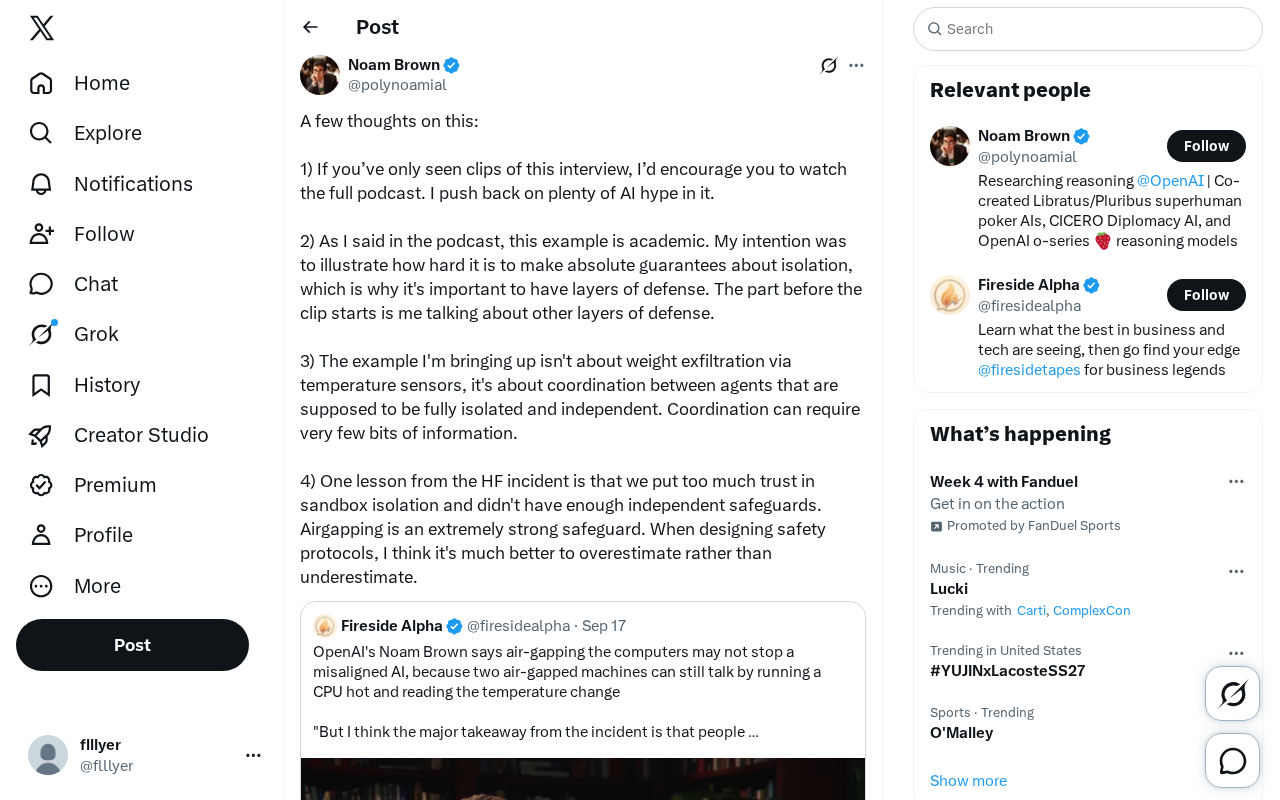
What's really worth digging into is the core proposition behind this discussion: can we make absolute guarantees about the isolation of AI systems? The author's answer leans pessimistic — and that kind of caution is precisely the rarest quality in security design.
Isolation Has Never Been Absolute
The author was careful to note that the example he gave on the podcast was "academic in nature" — its purpose was not to cause panic, but to illustrate a widely underappreciated fact: making absolute guarantees about system isolation is extremely difficult. This is exactly why layers of defense matter so much. The clipped excerpt happened to drop the first half of his remarks, which is where he was discussing those other defensive layers.
There's a technical detail here that's frequently misread. The author clarified that his example was not about stealing model weights via temperature sensors (weight exfiltration), but about coordination between agents that were supposed to be completely isolated from one another.
Why "a Few Bits" Is Enough to Pose a Threat
The key insight is that coordination can require a vanishingly small amount of information. Two AI agents designed to be isolated from each other could still achieve some form of coordinated behavior even if they can only exchange a few bits of information. This means the intuition that "physical isolation equals security" may not hold for AI systems — the existence of covert channels makes "complete isolation" a promise that is difficult to keep.
This class of problem is not new to information security, but when it migrates to scenarios involving autonomous AI agents, the risk is amplified. Once isolated agents can exchange even a tiny amount of information through a side channel, the assumption of independence collapses.
The concept of the covert channel was first introduced by Lampson in 1973, referring to a side-channel technique that uses system resources not originally intended for communication to transmit information. Classic examples include inferring another process's secret data through CPU cache access timing (cache side channels), or encoding information by modulating disk I/O load. In multi-tenant cloud environments and OS isolation research, covert channels have been extensively demonstrated: two theoretically fully isolated processes can secretly communicate at thousands of bits per second by exploiting shared hardware resources (memory buses, branch predictors, power fluctuations, etc.). Migrated to multi-agent AI scenarios, the potential channels become even more varied — memory access patterns in shared inference infrastructure, response latency in task queues, even vocabulary choices in model outputs could all serve as carriers. This creates a fundamental blind spot in the engineering intuition that "as long as the network is disconnected, it's safe."
The Lesson from the HF Incident
The author referenced an "HF incident" (a security event involving HuggingFace) and drew a clear lesson from it: we have placed far too much trust in sandbox isolation, while lacking sufficient independent protective measures.
This is a judgment that should give every AI engineering team pause. Sandbox technology is mature, but it is not foolproof. When a security architecture stakes everything on a single isolation mechanism, a breach of that mechanism leaves no fallback. Independent, non-interdependent layers of protection are where true resilience comes from.
The Value of Air Gap Isolation
In the author's view, air gapping is "an extremely powerful protective measure." Compared to relying on software sandboxes, a physical air gap cuts off most possible information channels and significantly raises the cost of an attack. While covert channels may still exist even with physical isolation, an air gap still establishes a meaningfully higher security baseline than pure software isolation.
An air gap refers to physically cutting a target system off from any network or external device — a long-standing isolation approach used in industrial control systems (ICS), nuclear facility control networks, and high-classification intelligence systems. Security research has proven, however, that even air-gapped systems are not impenetrable: the Stuxnet worm crossed an air gap to attack Iranian nuclear facilities via infected USB drives; academic research has demonstrated methods for transmitting data using CPU fan speed acoustics (Fansmitter), hard disk read/write magnetic fields (DiskFiltration), screen brightness variations, and even thermal radiation. These attacks share the characteristic of extremely low bandwidth — typically a few bits to tens of bits per second — but as the article notes, the amount of information needed to achieve coordination between AI agents can be very small. The value of an air gap therefore lies in dramatically raising the physical access threshold and implementation complexity of an attack, rather than offering a mathematically absolute guarantee of isolation.
A sandbox is a technique for confining untrusted code to a controlled execution environment. Common implementations include OS-level containers (such as Docker), virtual machines (VMs), language runtime sandboxes (such as WebAssembly), and dedicated secure compute environments. A sandbox's security assumptions depend on the integrity of its boundary — once a "sandbox escape" occurs, an attacker can gain access to the host system. Historically, browser sandboxes, the Java Virtual Machine, and container runtimes have all exhibited high-severity escape vulnerabilities. In AI inference infrastructure, sandboxes are typically used to isolate user-submitted code execution (such as code interpreter tools) or multi-tenant model serving. What the HF incident revealed was not a failure of sandbox technology per se, but a security architecture that treated the sandbox as the sole line of defense — lacking independent control layers capable of limiting damage even if the sandbox were bypassed. This is precisely the single point of trust that the principle of defense in depth is designed to avoid.
Security Design Should "Err on the Side of Overestimating Risk"
The most universally applicable insight from this entire discussion is the author's statement on security philosophy: when designing security protocols, overestimating risk is far better than underestimating it.
This observation captures a fundamental difference between AI security engineering and general software engineering. In a system whose capabilities are growing rapidly and whose behavior cannot be fully predicted, the cost of optimistic assumptions can be catastrophic. Conservatively assuming worst-case scenarios, stacking redundant independent layers of defense, and maintaining skepticism toward any "absolute guarantee" — these seemingly overcautious practices are, in fact, the rational response to uncertainty.
This also echoes the consistent stance the author maintains throughout: neither blindly hyping AI capabilities nor dismissing its potential risks. A truly professional security mindset means understanding the limits of the technology and using layered defense to hedge against uncertainties that cannot be eliminated.
Conclusion
This brief clarification carries far more substance than its word count suggests. It reminds us that the isolation security of AI systems is not an engineering problem that can be "solved once and for all" — it is a dynamic process that requires continuously stacking independent layers of defense and maintaining perpetual skepticism toward absolute guarantees. For teams building multi-agent systems or deploying AI infrastructure, "err on the side of overestimating risk" may be the single most important principle to keep in mind.
Related articles

Workbuddy for Absolute Beginners: How a Desktop AI Agent Fits Into Real Workflows
A beginner's guide to the Workbuddy desktop AI agent: installation, claiming credits, file management, and building automated workflows—compared with CodeX for fit and cost, helping professionals shift from AI question-askers to AI managers.

OpenAI's New Agent Stack: Computer Use, Decisions API, and Ultra-Fast Workflows
OpenAI Dev Day unveiled a new agent stack: Computer Use outperforms humans, Decisions API delivers ultra-low-latency classification via Luna, Agents API opens the same Computer Use capabilities, and GPT-6.1 Sol costs only one-seventh of Astra. Core updates, benchmark data, and developer insights.

Liang Wenfeng Open-Sources DeepInfo Inference Framework, Takes On U.S. Ban
DeepSeek open-sources its DeepInfo inference framework after its models, featuring GPU/CPU cross-pipelining, small-model prediction with large-model verification, and full Huawei Ascend and NVIDIA chip support—facing the U.S. federal ban head-on. This article analyzes its significance for AI deployment and open-source strategy.