The Freud-Jung Split: Inside the Love and Hate of Psychoanalysis's Founding Father

How Freud and Jung went from mentor and heir to bitter enemies — and why it mattered.
Drawing on historian Andrew Scull's conversation with Lex Fridman, this article traces the founding of psychoanalysis from Freud's neurological training and collaboration with Breuer, through the pivotal Anna O case, to the theoretical and personal clash that drove Freud and Jung apart in 1913. Theory, temperament, and competition over patients all played a role in one of psychology's most consequential falling-outs.
In the history of psychology, Sigmund Freud and Carl Jung were once the closest of mentor and protégé — and yet they ultimately parted ways in an irrevocable break. In a podcast conversation with Lex Fridman, historian Andrew Scull reconstructed in detail the intellectual origins, clashing personalities, and competing interests that shaped this relationship. This was more than a private falling-out between two men; it reflected the turbulence and ambition of psychoanalysis as a discipline in its earliest days.
The Origins of Psychoanalysis: From Charcot to Breuer
Freud is widely regarded as the father of psychoanalysis. One of his central ideas was that humans possess an "unconscious" dimension of the mind — the true source of much of our behavior — and that psychoanalysis is the method for probing this inner world through the tool of "talk."
Freud himself was trained as a neurologist. He traveled to Paris to study under Jean-Martin Charcot, the most celebrated neurologist of the late 19th century, and earned Charcot's favor by translating his works into German. Scull notes this was a "clever career move" at the time. Back in Vienna, however, Freud's colleagues held Charcot in low regard, and they were equally dismissive of Freud and his theories — leaving him in a difficult position in academic circles early on.
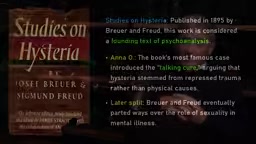
It was Freud's close friend and more established colleague, Josef Breuer, who gave psychoanalysis its real foothold. Breuer ran a large private practice and referred patients to Freud. The two collaborated on the problem of "hysteria" and co-authored Studies in Hysteria.
"Anna O": The Founding Case of Psychoanalysis
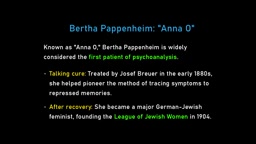
The foundational case of psychoanalysis was a woman known by the pseudonym "Anna O" — her true identity was Bertha von Pappenheim, a fact that was kept hidden for many years. Scull explains that pseudonyms were used partly to protect patient privacy, and partly because these cases exposed deeply intimate aspects of patients' inner lives.
Anna O was actually Breuer's patient, not Freud's. She had spent a long period caring for her ailing father, and after his death she developed an array of physical symptoms and fell into depression. Breuer and Freud argued that her suffering stemmed from repressed memories and trauma.
This idea became the cornerstone of psychoanalysis — memories that lurk in a kind of half-life within the unconscious resurface in distorted form as psychological symptoms and destructive patterns of behavior.
The real-life story of Bertha von Pappenheim took a striking turn: she went on to become a prominent German feminist and social activist, founding a Jewish women's organization and campaigning against human trafficking and for children's rights — a far cry from her image as a passive, hysteria-stricken patient. Breuer once described her case as the origin of the "talking cure," yet he later grew uneasy about the treatment. According to accounts, Anna O developed an intense transference onto Breuer, which deeply unsettled his wife, and Breuer eventually terminated the treatment. The concept of "transference" — in which a patient projects emotions from past significant relationships onto the therapist — later became one of the central mechanisms of psychoanalytic theory. Freud believed that working through transference was precisely where healing took place.
Repression, Resistance, and Childhood Trauma
As the theory developed, Freud initially believed that the underlying experiences were real — for instance, that patients had suffered sexual abuse in childhood, could not face it, and had buried it, yet could not suppress it entirely, so it leaked out in painful forms.
From this emerged the concept of "resistance": these memories could not easily be recalled, and patients instinctively fought against their surfacing. Only through long and painful work could they be excavated. Once these contents were brought from the unconscious into consciousness, patients could relate to them differently — their personality shifted, and their symptoms eased.

Childhood experience was central to this framework. Scull notes that even today's biological psychiatrists would broadly agree with this point: once we dissolve the opposition between mind and body and acknowledge how closely they are linked, the traumas, socialization experiences, and losses of childhood do leave deep imprints on the psyche — with effects that can be lasting and powerful.
"A Great Hater": The Break Between Freud and Jung
At the 1909 Clark Conference, Freud attended alongside two of his closest disciples, with Jung being "crowned" as the heir apparent, expected to carry on Freud's legacy. But the alliance was short-lived: by 1913, the two had completely parted ways.
Jung was Swiss, working at Zurich's leading psychiatric hospital. He was drawn to psychoanalysis and to Freud, and for the first few years the two formed a visibly close alliance. Interestingly, it was Jung who persuaded Freud to visit the United States.
Freud's view of America was scathing. He reportedly quipped that the country should be renamed "Dollaria," accusing Americans of caring only about money; he found American women too aggressive and domineering, the food appalling, and claimed he had been "poisoned" by American cuisine.
Scull uses the words of one of Freud's close friends to describe him: "a great hater." Falling out with Freud was no small matter — you were effectively excommunicated. This happened to Adler, and even more dramatically to Jung. One telling detail: the wealthiest patients ultimately ended up with Jung rather than Freud. Scull suggests that this competition over resources and prestige very likely deepened the rift between them.
The theoretical roots of their split are equally important. Jung grew increasingly dissatisfied with Freud's interpretation of "libido" as almost exclusively a sexual drive, expanding the concept instead into a broader notion of "psychic energy." More fundamentally, Jung developed his theory of the "collective unconscious" — the idea that human beings share a set of primordial images, or archetypes, that transcend cultures and eras — a framework that differed sharply from Freud's emphasis on individually repressed experiences. Jung's deep interest in mythology, religion, and mysticism also alarmed Freud, who feared that psychoanalysis would lose its scientific credibility and slide into "the swamp of mysticism." Jung's 1912 publication of Symbols of Transformation is widely seen as the spark that triggered their open break.
Conclusion: A Relationship That Shaped the History of Psychology
The relationship between Freud and Jung — from intimate alliance to bitter estrangement — was shaped by both the inevitable logic of theoretical divergence and the contingencies of personal temperament and real-world competition. Freud's character as "a great hater" meant that anyone who broke with him paid a steep price; and Jung's independent thinking and growing influence made it impossible for him to remain the "crown prince" indefinitely. Understanding this history helps us see how, in psychoanalysis's earliest years, theory, human nature, and power became deeply intertwined.
Related articles
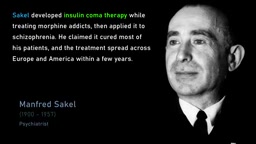
Behind 'A Beautiful Mind': Insulin Shock Therapy and the Dark History of Psychiatric Treatment
Medical historian Andrew Scull revisits the dark history of 20th-century psychiatry: how insulin shock therapy caused harm under the guise of miracle cures, with John Nash — the real man behind A Beautiful Mind — among its victims.

The Bloody Origins of Electroshock Therapy: A Century of Controversy, from the Slaughterhouse to the Psychiatric Ward
Medical historian Andrew Scull reveals ECT's bloody origins in a Roman slaughterhouse, tracing its evolution from punishment tool to evidence-based therapy — and the deeper crisis of scientific credibility it reflects.

Gender Disparities in the History of Psychiatric Treatment: Why Women Became the Primary Test Subjects
Medical historian Andrew Scull reveals on the Lex Fridman podcast that 60–70% of ECT and lobotomy patients were women. An analysis of diagnostic gender bias and psychiatric institutions as social control.