The Full AI Development Lifecycle: An Engineering Guide from PoC to Production

AI success in production depends not on better models, but on a structured process that surfaces problems early.
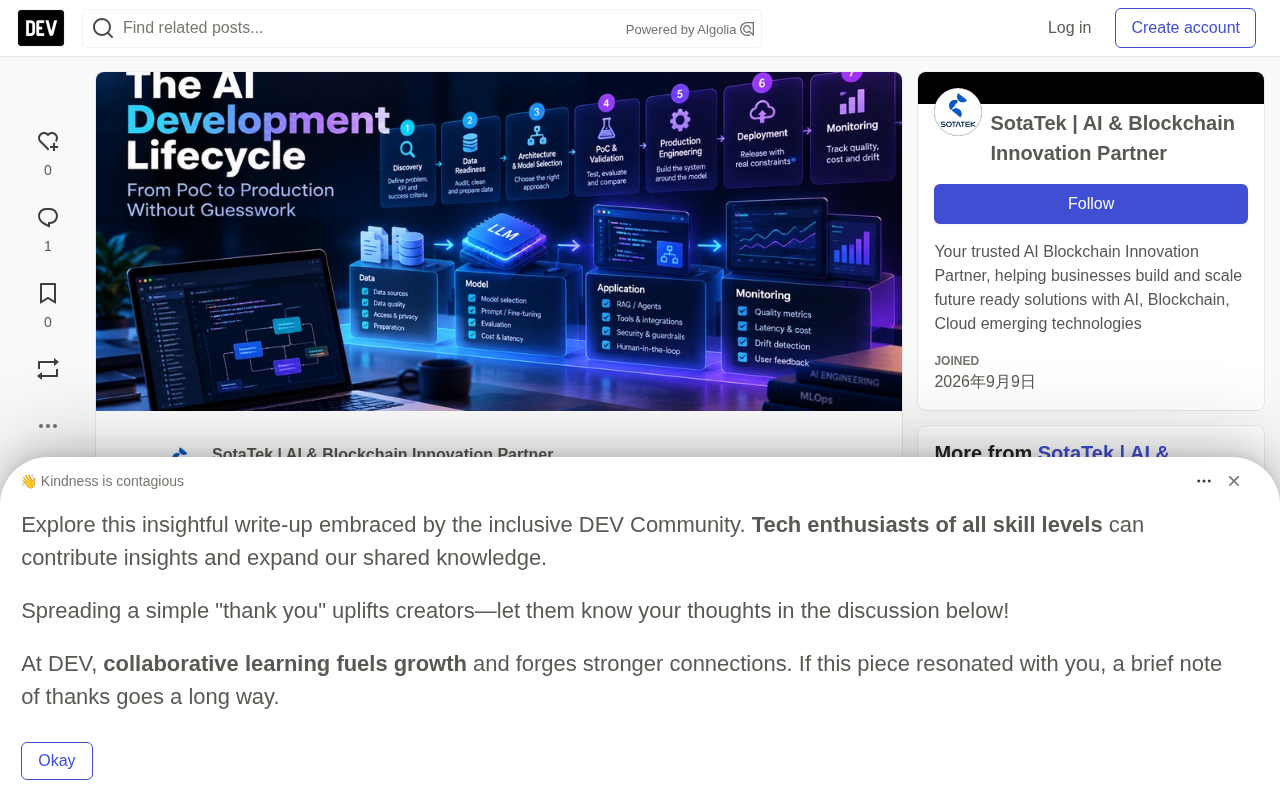
This article presents a comprehensive engineering approach for taking AI from prototype to reliable production system. The core argument is that most AI projects fail not because of model limitations, but because of missing processes for catching data defects, integration risks, and cost overruns early. The author argues for starting with measurable business problems and explicit kill criteria, auditing data before choosing an architecture, defaulting to the simplest design that meets requirements, and treating PoC, production engineering, deployment, and monitoring as distinct phases with Go/No-Go gates that make decisions explicit while course-correction is still affordable.
Getting an AI model to work in a demo environment isn't the hard part. The hard part is keeping it running reliably under the combined pressure of real data, existing business systems, production traffic, security constraints, and a quantifiable budget. These are two fundamentally different engineering problems.
A prototype might look impressive while hiding issues that only surface later: insufficient data coverage, unstable outputs, slow integration, unpredictable inference costs, or evaluation metrics that fail to reflect actual business value. The core insight from the SotaTek team is direct — the solution is usually not to find a better model, but to establish a development process that forces problems to surface before they become expensive production incidents.
Start with a Measurable Problem, Not a Model
Before selecting a large language model, training a classifier, or building an agent, clearly define what problem the system needs to solve. Three things must be established upfront: KPIs (which outcome needs to improve), a baseline (how the current process performs), and acceptance thresholds (what results justify moving forward).
Take an internal document assistant as an example. Initial targets might include: answer quality no lower than 85% on a defined evaluation set, P95 response latency under 3 seconds, per-request cost within budget, and unsupported assertions below an agreed threshold. It's worth emphasizing that these numbers are illustrative, not universal benchmarks — the right thresholds depend on the use case and the consequences of failure.
More critically, define a kill criterion. If a prototype cannot outperform the existing workflow within agreed cost and quality constraints, the team should have the authority to stop or pivot. This prevents a technically interesting experiment from becoming a product that receives indefinite funding.
Audit Your Data Before Choosing an Architecture
Data readiness can completely change the technical direction. A dataset may exist yet be unusable due to incompleteness, inconsistency, inaccessibility, poor labeling, or privacy restrictions.
Before implementation, you need answers to a series of questions: Where does the data come from? Who owns it and who can access it? How frequently does it change? Does it require labeling, cleaning, or deduplication? Can it be used legally and safely for this purpose? How is quality measured?
That last question is especially important, because data quality isn't just a one-time preparation task — it continuously affects evaluation, production reliability, and ongoing maintenance. Two common examples: a computer vision system trained on inconsistently labeled data may learn the wrong visual patterns; a RAG system with stale documentation will return answers that are technically relevant but factually outdated. The engineering bottom line is this — don't lock in any model or architecture before fully understanding data constraints and their implications.
RAG (Retrieval-Augmented Generation) is an architectural pattern that combines information retrieval with generative language models. The core flow works like this: upon receiving a user query, the system first retrieves relevant passages from an external knowledge base (such as a document store or database), then passes those passages as context to the language model, which generates an answer grounded in the retrieved content. RAG's main value is enabling models to access information beyond their training cutoff date, or an organization's private internal documents, without retraining the model itself. Its limitation is that answer quality depends heavily on retrieval quality — if the knowledge base contains stale documents, uses poor chunking strategies, or has incomplete vector index coverage, outputs will be unreliable even with a capable generation model. This is precisely why the article emphasizes monitoring retrieval quality and answer quality separately.
Choose the Simplest Architecture That Meets the Requirements
Not every AI use case needs agents, fine-tuning, or a complex orchestration layer. A clear needs-to-solution mapping: use traditional machine learning for classification or prediction; use a foundation model API for text generation or summarization; use RAG when answers need to be grounded in private or frequently updated documents; consider fine-tuning only for specialized behaviors that prompt engineering cannot achieve; use computer vision for image and video detection; and only reach for agent architectures when multi-step workflows require tool use.
All candidate approaches should be evaluated against the same set of constraints: accuracy and fault tolerance, latency and throughput, per-task cost, data privacy and deployment requirements, integration complexity, operational overhead, and vendor dependency.
A more complex architecture is not automatically a better one. An agent that makes multiple model calls and invokes multiple tools may technically accomplish the task, but a deterministic workflow might achieve the same result with lower latency, lower cost, and more predictable behavior. Decisions should be based on measured requirements, not architectural novelty.
Treat the PoC as an Experiment, Not a Demo
A proof of concept should answer one specific question: does this approach work on representative data under realistic conditions? Build the smallest viable prototype, but define the evaluation process before you start tuning the system.
For an LLM application, an evaluation dataset might include: representative user inputs, expected answers or scoring rubrics, relevant source documents, known failure cases, and situations where the system should refuse to answer or ask for clarification. A simplified evaluation framework runs each case through the system, scores it with a grader, and records the score, latency, and cost.
The key discipline is consistency — you need to apply the same evaluation criteria when comparing different prompts, models, retrieval strategies, or architectures. The metrics you track shouldn't be limited to answer quality; they should also include task success rate, retrieval quality, hallucination or unsupported assertion rate, latency including P95, cost per successful task, and edge case failure rate.
One critical rule: evaluation data must be kept separate from the data used to tune prompts or train models — otherwise, results will overstate the system's ability to generalize. A successful PoC only earns the right to proceed to production engineering. It does not prove the system is ready to ship.
A grader (scorer) is a key component of LLM evaluation pipelines — typically itself a language model or rules engine — responsible for scoring how well a system's output matches an expected answer. Common implementations include using a powerful model like GPT-4 as a "judge" for open-ended outputs (LLM-as-judge), automated comparison based on keyword matching or semantic similarity, and hybrid review with human annotation. The choice of grader directly affects the reliability of evaluation conclusions — a lenient grader will overestimate system capability, while an overly strict one may incorrectly reject a usable system. Therefore, when establishing grader criteria during the PoC phase, sample the grader's own consistency first to ensure its judgments align with how the business defines a "correct answer."
Treat Production Engineering as a Distinct Phase
A working prototype typically proves only that the core capability is feasible — it rarely proves that the complete application is reliable. Production engineering fills in the entire system surrounding the model: client, API gateway, authentication and authorization, application logic, AI orchestration, model inference and retrieval tools, enterprise systems, output validation, and all the way to logging, metrics, and tracing.
Before release, several core concerns must be addressed. Integration: can the system reliably interact with existing APIs, databases, CRMs, ERPs, or internal services? Security: are permissions enforced at the application layer rather than left to the model — could retrieved documents or tool calls expose data the current user shouldn't have access to? Reliability: what happens when the model provider times out, the retrieval service is unavailable, or an upstream API returns an error? Idempotency: if a tool call times out after a transaction succeeds, will a retry accidentally create a duplicate operation?
For tools that modify state, use idempotency keys or equivalent safeguards where appropriate, and validate tool inputs and enforce authorization at the application layer. One line captures the logic: the model can propose an action, but the application must decide whether that action is permitted.
Deploy for Real Constraints and Monitor Continuously
Deployment architecture should follow the workload and operating environment. Public cloud, private cloud, on-premises, edge, and hybrid deployments each involve different tradeoffs across latency, data residency, connectivity, scalability, and maintenance. Consider an example: an AI inspection system operating inside a factory with no network connectivity cannot rely on remote inference APIs during normal operation — this constraint affects model selection, hardware requirements, update mechanisms, and monitoring design from day one.
A production release should also include: staged rollouts where feasible, health and readiness checks, security and load testing, versioning for models and configuration, a rollback process, and human review paths for high-risk decisions. A responding endpoint does not mean deployment is complete.
After launch, AI systems degrade even when the application code hasn't changed: documents go stale, user behavior shifts, input distributions drift, model providers update their services, and traffic patterns affect latency and cost. Monitoring should cover multiple layers — model (output quality, refusal behavior, task success), retrieval (recall, relevance, stale documents), application (errors, timeouts, tool failures), performance (P50/P95 latency, throughput), economics (cost per request and per successful task), data (distribution drift, missing fields), and user experience (feedback, abandonment rate, correction rate).
For systems using RAG, retrieval quality and answer quality should be monitored separately: a poor answer may stem from bad retrieval rather than weak generation. The goal of monitoring is to help pinpoint the source of degradation, not merely report that something went wrong. Every metric needs an owner, an acceptable range, and a response plan.
Distribution drift refers to the phenomenon where the real inputs a model receives in production systematically diverge over time from the data used during training or evaluation. Common types include: data drift (changes in the statistical distribution of input features, such as shifts in how users phrase questions), concept drift (changes in the relationship between inputs and expected outputs, such as business rule updates that make previously correct answers wrong), and silent errors introduced by upstream data pipeline changes. The danger of drift for AI systems is that it typically doesn't trigger obvious system errors — the model continues returning results, but output quality has quietly declined. This is why monitoring service availability and response latency alone is insufficient. You also need to continuously establish statistical baselines for input distributions and output quality, with alert thresholds that enable early intervention before degradation becomes severe.
Manage Risk with Go/No-Go Gates
The lifecycle only becomes truly useful when each phase produces evidence that informs the next decision. This maps cleanly to a gate structure: the discovery phase produces KPIs, baselines, and acceptance criteria, answering "is this problem worth solving?"; the data readiness phase produces a data audit and access plan, answering "can the data support this use case?"; the architecture phase produces an evaluation plan and risk assessment, answering "does the design fit the constraints?"; the PoC phase produces evaluation set results, answering "does it beat the baseline?"; the production engineering phase produces integration, security, and load test results, answering "is the system releasable?"; the deployment phase produces a rollback plan and operational checklist, answering "can this be operated safely?"; and the monitoring phase produces quality, latency, cost, and drift metrics, answering "is the system still performing as required?"
The point of these gates isn't to generate more meetings or paperwork — it's to make technical and business decisions explicit while changing course is still relatively inexpensive.
The Real Deliverable Is a Reliable System
The AI development lifecycle is not just a sequence of modeling tasks. It's a method for managing uncertainty across data, architecture, evaluation, integration, security, deployment, and ongoing operations. A useful mental model:
Production-grade AI = Model + Data + Application + Integration + Evaluation + Security + Operations
Leaving out any layer risks turning a promising prototype into a system that's expensive to maintain, difficult to trust, or impossible to scale reliably. The ultimate goal isn't to get an AI model running — it's to build a system that continues delivering measurable value long after it goes live.
Related articles

Chain of Thought Isn't Just for AI: How Humans Can Use CoT to Improve Thinking Quality
Chain of Thought isn't just a prompt trick for large models. Starting from a Hacker News discussion, this article analyzes why CoT works for human thinking too, breaks down actionable ways to transfer it, and highlights the key differences between human CoT and machine CoT.
Cloudflare Teams Up with OpenAI: Closi…
Cloudflare Teams Up with OpenAI: Closing the Loop from Vulnerability Discovery to Defense with AI
Cloudflare uses OpenAI Daybreak to investigate security vulnerabilities and generate reviewable remediation plans, while developers use Codex to boost coding efficiency and quality.

Orca Multi-Agent Orchestration in Practice: A Guide to Parallel Collaboration with Claude and Codex
Orca is Stable AI's free open-source agent workbench supporting 34 agents like Claude Code and Codex in parallel. Learn its Git worktree isolation, multi-model orchestration, and mobile management.