The Future of CSS: How Interop and New Features Are Reshaping Front-End Development

Interop coordination accelerates CSS evolution, while container queries, :has(), cascade layers, and native nesting reshape front-end development.
Based on Josh W. Comeau's "The Future of CSS" and Hacker News discussion, the article outlines CSS's structural transformation. Its core point: the Interop project shifts browser vendors from fragmented efforts to jointly set priorities, moving up the availability window for new features and shaking the "wait two years" default mindset. Container queries enable container-based responsive components; :has(), :is(), and :where() boost selector expressiveness; cascade layers fine-tune priority; native nesting reduces reliance on Sass. Community views mix optimism and caution, and the article advises following Interop's annual list, piloting new features in component libraries, and basing compatibility strategy on real user data.
Introduction
Front-end developers have never stopped complaining about CSS: poor browser compatibility, slow adoption of new features, and high debugging costs. But things are changing. In his article "The Future of CSS," Josh W. Comeau reviews the latest progress of the Interop project and outlines the structural transformation CSS is undergoing. The article earned 370 points and 143 comments on Hacker News, showing that it struck a real chord with many developers.
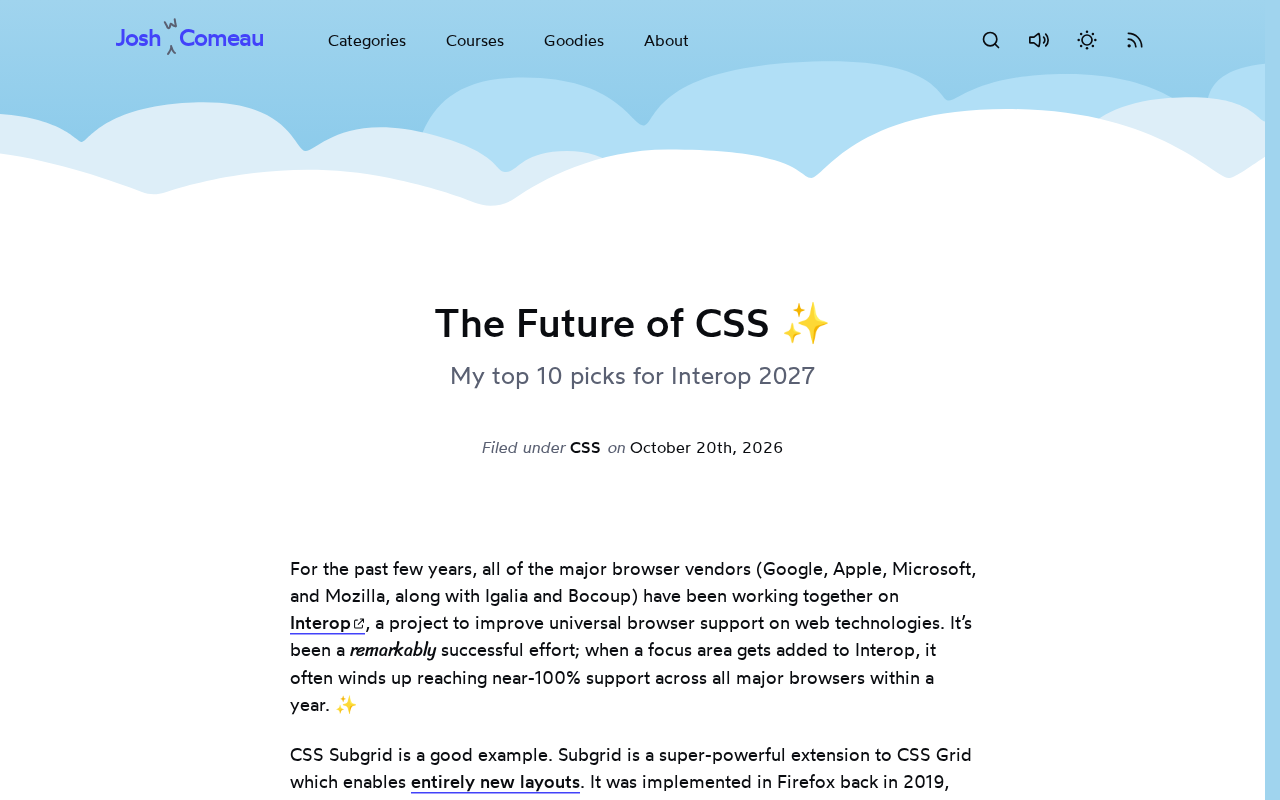
This article builds on the core points of that piece and incorporates community discussion to analyze the current direction of CSS and what these changes mean for day-to-day development.
The Interop Project: From "Compatibility Anxiety" to "Coordinated Progress"
CSS's long-standing pain point is this: no matter how elegantly the spec is written, if browsers don't implement it or implement it inconsistently, developers are forced back to legacy approaches. The Interop project involves multiple browser vendors working together, selecting a set of priority features each year, with all parties committed to completing implementation and fixes within a consistent time window.
According to Josh W. Comeau's analysis, the value of Interop lies not in any single property but in how it has changed the way browser vendors collaborate—shifting from going their own way to jointly setting priorities. For developers, the most direct payoff is that the window in which "you can safely use new features" is arriving earlier.
Some developers in community discussions noted that this mechanism doesn't solve every problem, but it has genuinely begun to loosen the default mindset of "wait two years before shipping to production."
The Interop project, officially called Web Interop, was jointly launched in 2022 by the four major browser engine vendors—Apple (WebKit), Google (Chromium), Microsoft (Edge), and Mozilla (Firefox)—with coordination support from consultancies such as Bocoup and Igalia. At the start of each year, the project team selects an annual list of focus areas based on developer surveys, Web Platform Tests (web-platform-tests) pass-rate data, and each vendor's engineering feasibility. Participants publicly commit to achieving consistent behavior for these features across their browsers within the year and publish progress through a continuously running automated test dashboard. For developers, Interop provides a credible "feature maturity timeline" that can be used directly for technology selection and roadmap planning, rather than relying on scattered version data from Can I Use to make guesses.
Key Directions of CSS Evolution in Recent Years
Continued Strengthening of Layout Capabilities
CSS Grid and Flexbox have been stable for years, but the finer details around layout are still iterating rapidly. Container Queries let components adapt responsively based on container size rather than viewport size—a paradigm-level liberation for design systems and component libraries.
According to the direction mentioned in Josh W. Comeau's article, CSS is gradually moving logic that previously required JavaScript or build tools down into native solutions at the styling layer.
Container Queries became fully available in mainstream browsers in 2023, centered on the @container rule together with the container-type property. Unlike media queries, which are based on viewport width, container queries let a component adjust its internal styles based on the size changes of its own parent container, making components truly reusable "context-independent." The companion container-name allows containers to be named for precise matching, while units such as cqw and cqh let internal dimensions be calculated relative to the container. This capability is significant for design systems: the same card component can automatically adapt when placed in a sidebar or main content area without externally passing size parameters, reducing the previous pattern of relying on ResizeObserver plus JS class toggling.
Improved Selector Expressiveness
The arrival of the :has() pseudo-class lets developers select a parent element based on the state of its child elements—something that previously required scripting. Combined with :is(), :where(), and others, selectors have become noticeably more expressive, and together with Cascade Layers, style priority can be controlled more precisely.
Cascade Layers explicitly declare the hierarchy of style priority through the @layer rule, solving the long-standing problem of "fighting" over selector specificity and source order. Developers can predefine layers such as reset, base, components, and utilities, where the order between layers determines priority and only specificity comparisons within the same layer take effect. This allows third-party styles, theme overrides, and utility classes to coexist peacefully, and greatly reduces the need for !important. Used together with :where() (whose specificity is always zero), it enables a base style system that is extremely override-friendly—an important piece of infrastructure for styling architecture in large projects.
Native Nesting and Syntax Simplification
The advancement of CSS Nesting makes stylesheet structure closer to the preprocessor syntax developers are familiar with, reducing dependence on tools like Sass. In community discussion, some see this as an important step toward "reducing toolchain complexity," while other developers caution that browser implementation details around nesting still need attention.
CSS Nesting became stably available in mainstream browsers by late 2023. Syntactically, it uses & to explicitly reference the parent selector (which can also be omitted in most scenarios) and supports nested selectors, nested media queries, and nested @layer. Unlike preprocessors such as Sass, native nesting follows CSS's own cascade and specificity rules; it no longer needs to be expanded at compile time and is parsed directly by the browser. Note that native nesting does not support programming features like variables, mixins, and functions in Sass, so it replaces the "structural organization" part of preprocessors, not all of their capabilities. For new projects, you can first assess whether native nesting plus custom properties alone can meet your needs, thereby streamlining the build chain.
Community Perspective: Optimism and Caution Coexist
Comments on Hacker News reveal two attitudes. One side believes CSS's pace of evolution has clearly accelerated, and that the Interop mechanism has greatly improved the availability of new features; the other side believes that the growing number of specs also brings learning costs and maintenance burdens, and that teams need to establish their own "feature adoption strategy."
This divergence is itself a healthy signal: CSS is no longer a stagnant standard but an actively evolving platform, and developers need to proactively manage technology choices.
Practical Takeaways for Developers
First, following Interop's annual focus list can help you judge in advance which features are worth investing time in learning. Second, capabilities like container queries, :has(), cascade layers, and native nesting are well suited for piloting first in component libraries and design systems. Third, compatibility strategy should be based on real user data rather than intuition—progressive enhancement remains a reliable path.
The future of CSS is not a replacement that suddenly arrives one day, but a series of incrementally improved, coordinated advances. Understanding this rhythm is more valuable than memorizing any specific property.
Further Reading
- Original article: Josh W. Comeau, The Future of CSS
- Discussion: the related Hacker News thread
One-line Summary
Interop's coordination mechanism accelerates CSS evolution, while container queries, :has(), cascade layers, and native nesting reshape how front-end development is done.
Paragraph Summary
Based on Josh W. Comeau's "The Future of CSS" and Hacker News community discussion, this article outlines the structural transformation CSS is undergoing. The core argument: the Interop project has shifted multiple browser vendors from going their own way to jointly setting priorities, bringing forward the availability window for new features and shaking developers' default mindset of "wait two years before shipping to production." At the capability level, container queries let components adapt responsively to their container rather than the viewport; :has() together with :is() and :where() improves selector expressiveness; cascade layers enable fine-grained priority control; and native nesting reduces dependence on tools like Sass. Community attitudes mix optimism and caution: one side recognizes the acceleration of evolution, while the other warns of rising learning and maintenance costs. The article advises developers to follow Interop's annual list, pilot new features first in component libraries, and base compatibility strategy on real user data.
Related articles

JobRunner MCP Server: AI Agents Can Now Fix Failed Java Jobs
JobRunner launches an open-source MCP server enabling AI agents to view cluster status, diagnose failures, and recover Java jobs—incident response from any cloud coding environment or existing agent.

MLAI Digital Launches 9 Security Agents: MCP Server Safeguards the Full Lifecycle of Agentic AI
MLAI Digital launches Security MCP Server with nine built-in specialized security agents covering vulnerability discovery, attack simulation, prompt injection detection, API and infrastructure assessment, and accelerated remediation—embedding security validation across the full Agentic AI lifecycle from development to production.

Running Isaac Lab on H100 GPUs: Exploring Better Approaches
Exploring optimization methods for running Isaac Lab on NVIDIA H100 GPUs, including MIG configuration, mixed precision, TensorRT acceleration, and community experience to improve robotics simulation and reinforcement learning efficiency.