The Game Industry's Dilemma: Who Can Fix This Business?

The game industry is trapped in a structural crisis of runaway costs, layoffs, and imbalanced value distribution; fixing it requires multi-party incentive restructuring.
The article centers on the Hacker News discussion thread "The game industry is broken – can we fix it?" and argues that the current predicament is not an operational problem of individual companies but a concentrated eruption of structural imbalances. AAA budget bloat makes publishers extremely risk-averse, with sequels and remakes dominating the market, creating a vicious cycle where bigger investments lead to less innovation. The deeper cause of the layoff wave is the shift of business models toward long-running live-service products, creating a mismatch between talent structure and job requirements. Indie games, though vibrant, have weak risk resistance and are likewise constrained by platform algorithms. The article also analyzes the imbalanced value distribution among prices, platform cuts, and marketing costs, and the difficulty of rebuilding trust between developers and players, and proposes paths such as tiered production scale, improved tool efficiency, and diversified publishing and financing—emphasizing that these require multiple parties across the industry chain to adjust incentive structures simultaneously.
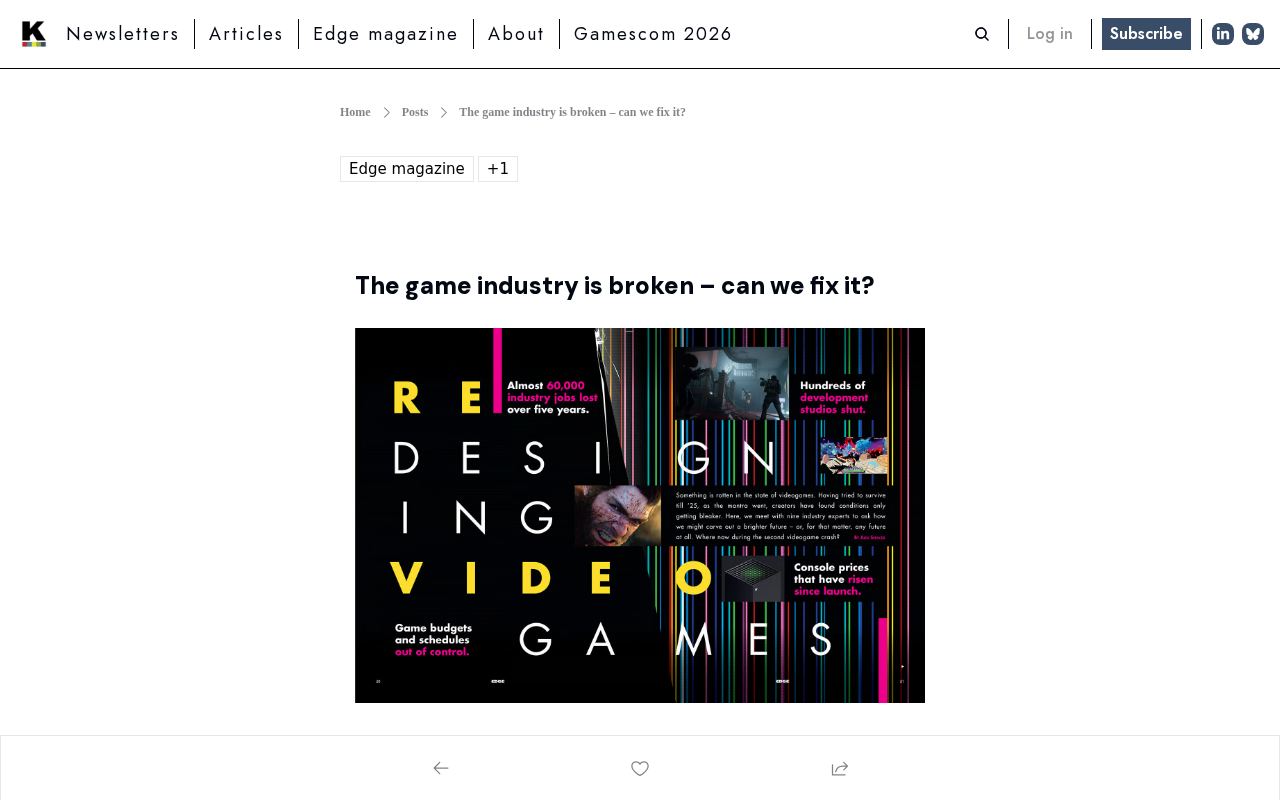
The game industry is in a paradoxical era. On one hand, technology keeps iterating, the player base keeps expanding, and the global market keeps growing. On the other hand, development costs are spiraling out of control, layoffs are spreading, studios are closing one after another, and creative risk is being compressed to the extreme. A recent discussion thread on Hacker News opened with a blunt assessment: "The game industry is broken – can we fix it?" The reason this topic resonates so widely is that it touches not on the operational problems of any single company, but on the concentrated eruption of structural imbalances across the entire industry.
The Vicious Cycle of Runaway Costs and Risk Aversion
AAA game development budgets have ballooned to the hundreds-of-millions-of-dollars level, with marketing expenses often on top of that. Investment of this magnitude means publishers cannot afford failure, so the logic of greenlighting a project shifts from "is this idea interesting" to "is this project safe." Sequels, remakes, and adaptations of established IP become the mainstream choices, and the room for trial and error on new IP is compressed to a minimum.
The problem is that even playing it safe is failing. When the market is flooded with structurally similar open worlds, live-service games, and battle pass designs, player fatigue accelerates. The bigger the investment, the less daring the innovation; the less innovation, the more severe the homogenization; the more severe the homogenization, the more uncertain the returns—this is a self-reinforcing loop that is very hard to break through the courage of individual teams alone.
AAA games is an informal industry classification, usually referring to high-budget, high-marketing-spend, large-team productions, with development costs often ranging from tens of millions to hundreds of millions of dollars, accompanied by comparable marketing expenses. In contrast are AA games (mid-budget, manageable scale) and indie games (small teams, low cost). The business logic of the AAA model relies on large-scale sales to amortize fixed costs, and therefore has extremely low tolerance for failure—a single failed title can bring down an entire studio. This is also the structural reason publishers favor sequels and established IP: an existing user base lowers customer acquisition costs and market uncertainty, but the price is that the space for exploring new genres is continuously squeezed.
The Structural Mismatch Behind the Layoff Wave
The massive layoffs in the game industry over the past two years are often explained as a correction of pandemic-era overexpansion. That explanation is only half right. The deeper reason lies in the shift in the center of gravity of business models: publishers increasingly rely on a small number of long-running live-service products to contribute stable cash flow, and the workforce structure these products require is completely different from the "release multiple new titles every year" model.
The result is that a large number of teams with full development capabilities have nowhere to go after their projects are canceled, while the industry's demand for roles that can "maintain online services, do data analytics, and design monetization systems" is rising. The talent hasn't disappeared—it has become mismatched with job requirements. The hidden losses brought by this mismatch—experience gaps, the dissolution of team chemistry, the rupture of creative networks—are hard to reflect in financial reports, but will continue to manifest in the coming years.
Games as a Service (GaaS) refers to a product form centered on long-term operations, earning long-term revenue through continuous content updates, seasonal systems, battle passes, and in-game purchases rather than one-time buyouts. The workforce structure for these products skews toward ongoing content operations, data analytics, economy system tuning, and community management, which differs greatly from traditional project-based teams that "deliver upon completion of development." When publishers concentrate resources on a few long-running products, a large number of developers skilled at building complete games from scratch lose matching positions—this is exactly the technical context behind the talent-job requirement mismatch described in the article, and also explains why layoffs and hiring demand can exist simultaneously.
The Prosperity and Fragility of Indie Development
In contrast to the plight of AAA is the vitality of indie games. Mature toolchains, diverse distribution channels, and improved community dissemination efficiency have given small teams unprecedented exposure opportunities. Many developers in the discussion mentioned that what truly keeps creativity alive is often indie projects with limited budgets but short decision chains.
But this prosperity has its fragility. Indie developers generally lack a stable financial buffer, and revenue is highly concentrated in a few hit titles, so once market attention shifts, their ability to withstand risk is extremely low. More realistically, when platform algorithms and recommendation slots become the primary discovery channels, indie games also face the pressure to "cater to the system," just in a different form from AAA.
Platform algorithms and recommendation slots refer to the distribution mechanisms by which distribution platforms such as Steam, console stores, and mobile app stores decide game exposure positions based on signals such as sales, wishlists, reviews, and click-through rates. For indie developers lacking marketing budgets, whether they can get into recommendation slots often directly determines the magnitude of their revenue, so "catering to the system" manifests as adjusting tags, launch timing, trailer pacing, and even gameplay design to improve algorithm friendliness. This dependence makes indie game success highly concentrated and unpredictable, and also weakens teams' creative autonomy—a different mechanism from AAA's conservatism due to budget pressure, but equally a hidden constraint on innovation.
Value Distribution Among Players, Platforms, and Developers
Among the discussions on "how to fix it," one dimension repeatedly mentioned is value distribution. Game prices have not risen in sync with development costs for years, while platform cuts, marketing costs, and channel fees are squeezing developers' profit margins. Some industry practitioners advocate a more transparent revenue-sharing structure, while others believe that subscription models and long-term operations are themselves complements to, rather than replacements for, the traditional buyout model.
The demands on the player side also deserve serious attention: resistance to microtransactions and battle pass mechanics, declining tolerance for launch versions with insufficient polish, and sensitivity to data collection. This feedback is not simply "players becoming pickier," but rather consumers making more direct judgments about product value in an environment of greater information symmetry. Rebuilding trust between developers and players may be the most fundamental and also the hardest part of repairing the industry ecosystem.
Possible Paths to Repair
The directions that emerged in the discussion fall roughly into a few categories. The first is tiering production scale: not every project needs an AAA budget, and product lines that are mid-scale, have manageable cycles, and prioritize creativity need to be re-emphasized. The second is improving the efficiency of tools and processes, handing repetitive work to automated pipelines so teams can focus their energy on design and experience. The third is diversifying publishing and financing models, including earlier community validation, crowdfunding, and more small-team-friendly revenue-sharing and exposure mechanisms from platforms.
None of these paths are new ideas; the difficulty is that they require the entire industry chain—upstream and downstream—to adjust incentive structures simultaneously. A single studio cannot change platform cuts, and a single platform can hardly stand up to publishers' conservative strategies. A truly feasible repair is more likely to come from gradual restructuring through multi-party negotiation rather than a single thorough overthrow and rebuild.
The problem with the game industry is not a lack of talent or a lack of players, but that the current structure makes it hard for talent to be reliably converted into a sustainable business. The answer to "Can we fix it" depends on whether the industry is willing, during this window of slowing growth, to seriously address the distribution and incentive issues that have been masked by high growth for years.
Related articles

Cursor Can Now Control Your Computer: AI Agents Can Drive Desktop Apps for Testing
Cursor adds desktop control: AI agents can drive desktop apps like the iOS Simulator to test their own features. We analyze the impact on dev workflows, possible technical approaches, and reliability concerns.

Vibecoding a Custom Inference Engine: High Hopes, Harsh Reality
A Reddit developer shares the real experience of vibecoding a custom inference engine: running GGUF Q4 models in the browser with WebGL2 and GLSL, only to fall into tokenizer debugging hell. This article analyzes the engineering challenges of browser-side LLM inference and why cloning llama.cpp is the more rational choice.

How High Are Anthropic's Early Investor Paper Returns Ahead of IPO?
Anthropic's early investor paper returns draw attention ahead of IPO. This article analyzes sources of book gains, capital structure, pre-IPO games and risks, and implications for the AI startup ecosystem.