The Glass Transformer: Peeking Inside the Model with an 11-Minute Training Run

Developer Rick uses a free 11-minute Kaggle training run to trace Transformer tokens, generating 1,000+ pages of data for analysis.
Reddit developer Rick designed a lightweight training pipeline that runs free on Kaggle for 11 minutes to observe token trajectories through Transformer layers, called "The Glass Transformer." He generated over 1,000 pages of tracing data and suggests using an LLM to assist analysis. While Rick admits the data isn't the gold standard, the method can serve as an early diagnostic tool for Transformer alternative architectures, lowering the barrier to interpretability research.
When the Transformer Becomes "Glass"
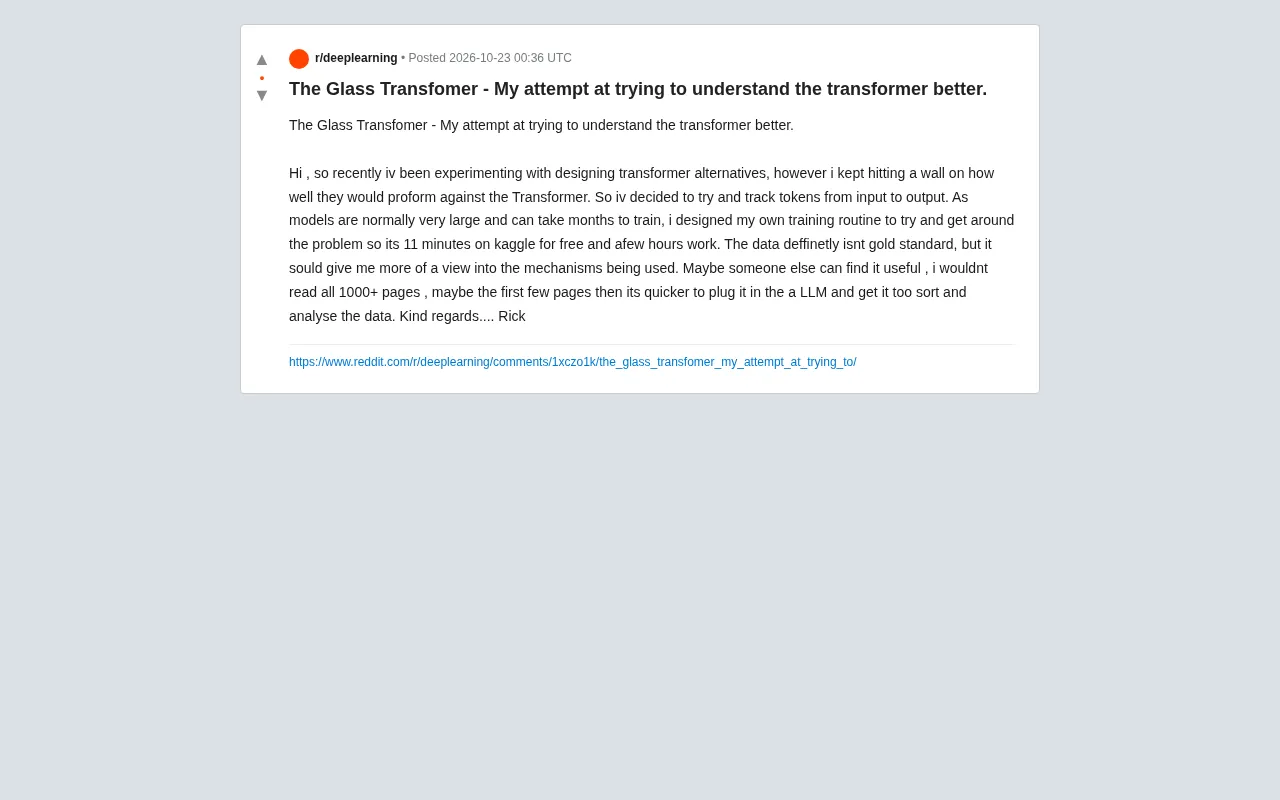
A developer named Rick on Reddit did something interesting: he designed a lightweight training pipeline that runs for free on Kaggle in just 11 minutes and lets you observe how tokens flow from input to output. He calls the project "The Glass Transformer"—a transparent, peek-inside Transformer.
The motivation is straightforward: when you're designing a Transformer alternative architecture, it's hard to tell what your new structure actually improves over the original. Rather than waiting months of large-scale training to find out, it's better to first see the mechanism clearly at small scale in a traceable way.
Transformer is a neural network architecture proposed by the Google team in the 2017 paper "Attention Is All You Need." Its core is the self-attention mechanism, which allows any two positions in a sequence to interact directly, freeing the model from the recurrent dependencies of RNNs. It is built by stacking encoders and decoders, where each layer contains a multi-head attention sublayer and a feed-forward network sublayer, supplemented by residual connections and layer normalization. This structure is exactly what enables large language models (such as GPT and BERT) to train efficiently in parallel, making it the cornerstone of the current AI wave. Understanding how tokens flow internally is key to improving architectures and enhancing interpretability.
Small-Scale Tracing: Not the Gold Standard, but Useful for Reference
Rick admits in his post that his data "definitely isnt gold standard," but it's enough to give him a window into the model's mechanisms. He generated over 1,000 pages of tracing data recording the trajectories of tokens through the Transformer's layers.
His advice is pragmatic: you don't need to read all 1,000 pages; the first few pages are enough to grasp the patterns, and the rest can be handed to an LLM to sort and analyze. This "human-machine collaboration" reading approach is itself noteworthy—using an LLM to process tracing data you generated yourself, forming a closed loop.
From an engineering perspective, the cost of an 11-minute training run is almost negligible. This lowers the barrier to trial and error for researchers: you can rapidly iterate on multiple variants, run tracing on each, and compare differences in token flow.
Kaggle is a data science competition platform that also provides a free cloud Notebook environment (Kaggle Notebooks) equipped with GPUs (such as NVIDIA Tesla P100 or T4) and limited compute hours (typically around 30 hours per week). Developers can upload datasets, run code, and share results publicly. Rick's use of free Kaggle resources to complete an 11-minute training run leverages exactly this low-barrier compute support, enabling individual developers to conduct lightweight model experiments and mechanism observation.
Why "Traceability" Is Worth Attention
Interpretability research on large models usually faces a dilemma: the models are too big, training takes too long, and observing internal behavior requires expensive compute. Rick's approach is the reverse—first figure out the mechanism with a small model, then decide whether it's worth scaling up.
This approach isn't academically novel, but the fact that an independent developer implemented it at such low cost and publicly shared the tracing data is illuminating. It suggests a possibility: interpretability doesn't have to be an exclusive project of large labs—individual developers can also conduct mechanism-level observation with Kaggle-level resources.
Rick writes at the end of his post: "Maybe someone will find it useful." This attitude of open sharing is exactly the value of the Reddit tech community.
Interpretability in AI refers to the ability to understand a model's internal decision-making process. It is generally divided into post-hoc explanation (such as feature importance and attention visualization) and intrinsic interpretability (such as models that are transparent by design). For Transformers, common methods include analyzing attention weights, tracing neuron activations, or using probes. Rick's "Glass Transformer" directly observes the trajectories of tokens through each layer via small-scale training, which is a mechanism-level interpretability exploration aimed at revealing how the model processes information rather than only focusing on input-output relationships.
Project Limitations and Reasonable Expectations
It should be clear that Rick himself acknowledges the data quality is limited, and the model trained for 11 minutes may behave significantly differently from real large models. The observed token flow patterns may not transfer directly to larger scales.
But this doesn't diminish its value as a "probe." For researchers designing Transformer alternative architectures, this rapid tracing method can serve as an early diagnostic tool: before investing in large-scale training, first check whether the new structure's token flow matches expectations.
Rick doesn't claim this is rigorous academic research; he calls it "My attempt." This humble framing actually makes the project more useful as a reference—it's a starting point, not a conclusion.
One-line Summary
Developer Rick used a free 11-minute Kaggle training run to achieve token-level tracing of a Transformer, generating a thousand pages of data for analysis.
Paragraph Summary
Reddit developer Rick designed a lightweight training pipeline that runs for free on Kaggle in just 11 minutes to observe the trajectories of tokens through the Transformer's layers. The project is called "The Glass Transformer." He generated over 1,000 pages of tracing data and suggests using an LLM to assist analysis rather than reading it all. Although Rick admits the data isn't the gold standard, this approach can serve as an early diagnostic tool for Transformer alternative architectures, lowering the barrier to interpretability research and demonstrating the feasibility of independent developers participating in mechanism observation.
Related articles

Running Real-Time Local Voice AI on a Single 12GB GPU: Full Pipeline with a 35B Model and Voice Conversation
A developer shows how to run a 35B MoE LLM, Whisper ASR, and Breeze TTS2 locally on a single 12GB GPU, cutting end-to-end voice chat latency from 8s to 2–3s via streaming, parallel synthesis, and quantization, plus Agent tool-calling integration.

Qwen4 Architecture Preview Open-Sourced: 125B Parameters, 512 Experts, Designed for VRAM-Constrained Hardware
Qwen4 isn't released yet, but its architecture is previewed via open-source Qwen3.8 Flash Next: 125B params, 6B activated per token, 512 experts, 262K context, built for VRAM-limited hardware. This article covers official confirmations, key config.json metrics, and local deployment tests on 24G memory.

Run 8K Images on 6GB VRAM! Hands-On Test of Fudan's Open-Source MOSS-Image Model
Fudan OpenMouse team and Shanghai MOSS Intelligence open-source MOSS-Image, a 500M-parameter DT architecture text-to-image model that runs locally on 6GB VRAM with precise text rendering, structured layout control, and 4K Token prompt support—ideal for e-commerce posters and local deployment by individual creators.