The Harsh Truth About AI Programming: It Won't Replace You, But Developers Who Use AI Will

AI compresses coding into five minutes, but verification is the real cost—be a reviewer, not a typist.
The article refutes the popular narrative that AI will put developers out of work, noting that AI's real ability is compressing an hour of work into five minutes, but its output is often "fast and confidently wrong." Because AI code is clean and consistent, it creates false security and lowers vigilance. Using the framework of "AI as junior developer, developer as reviewer," the author stresses separating generation from verification and counting review cost in real efficiency. The core conclusion: AI replaces typing, not judgment; the stronger the tool, the more valuable judgment becomes—what really eliminates developers isn't AI, but those who use AI with verification skills.
The Temptation of "One Hour Into Five Minutes"
The most widespread narrative about AI programming is that "developers are going to be out of work." But a creator on YouTube Shorts offers a completely opposite observation: AI's real ability is compressing an hour of work into five minutes of writing. Sounds like an efficiency miracle, but the story usually starts to sour after the fifth minute.
This creator's judgment is blunt—AI writes code fast, but it writes "fast and confidently wrong." No warnings, no hesitation; the output is clean, tidy, and looks flawless. The real cost isn't in the generation phase but in the verification phase: who reads it, who runs it, who takes responsibility for the result.

The Most Dangerous Thing Isn't the Error—It's That It "Looks Correct"
In traditional development, sloppy code usually comes with its own smell: messy naming, suspicious structure, missing comments—one glance tells you to be careful. AI's problem is exactly the opposite. Its output is well-formatted, stylistically consistent, and may even be "prettier" than what most people on your team write. This surface-level quality creates a false sense of security.
The creator highlights a key detail: AI never tells you "I'm not sure here." It outputs correct logic and incorrect logic with the same confidence, with no confidence labels whatsoever. So what's actually pushed in front of the developer isn't a piece of code—it's a judgment that needs to be reviewed.

Confidence calibration is a core concept in machine learning: an ideal model should not only output predictions but also ensure that its output confidence matches its actual accuracy—when it says "90% sure," it should actually be right about 90% of the time. Current large language models perform poorly in this respect: they are optimized during training to generate fluent text rather than to report their own uncertainty, so wrong answers and correct answers often come out with the same tone and the same format. This is the technical root of what the article calls "no confidence labels." The practical implication for developers is: you cannot treat the "degree of assertiveness" in AI output as a reliability signal; you can only rebuild confidence through independent verification—running tests, constructing edge cases, and reasoning through it line by line.
Treat AI as a Junior, Treat Yourself as the Reviewer
The most valuable framework in this content is positioning AI's role as a junior developer. This isn't belittling—it's a precise division of responsibilities: a junior can quickly produce a first draft, can take on repetitive work, can suggest implementation approaches, but before code is merged into the main branch, it must pass through the reviewer's eyes.
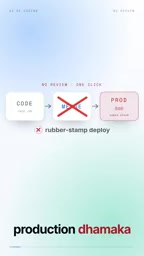
Following this metaphor, many practical questions become clear. You wouldn't let a junior push code directly to production, and likewise you shouldn't just click "accept all" on AI output. You wouldn't skip code review just because a junior writes fast, and likewise you shouldn't skip verification just because AI generates fluently.
Merging without reading is like throwing a bomb into production.

This positioning also explains why the narrative of "AI replacing developers" never holds up. AI replaces typing, not judgment. It compresses implementation time and amplifies review responsibility.
Code Review is a standard practice in software engineering: before code is merged into the main branch, one or more developers read it line by line, raise questions, request changes, and finally sign off. It is both a quality gate and a knowledge-sharing mechanism. Reviewers need to check not just syntax and style but also edge conditions, exception handling, concurrency safety, implicit assumptions, and consistency with the existing architecture. In the context of AI-assisted programming, the significance of code review is further amplified: because AI-generated code has no author who can answer "why did you write it this way," the reviewer must bear the full burden of judgment alone. This also means the time cost of review cannot be compressed by AI—it actually rises linearly with the volume of generation. Positioning AI as a junior is essentially acknowledging: generation can be outsourced, but review cannot.
"AI Won't Replace You, But Developers Who Use AI Will"
The creator's closing line is a classic assertion in this kind of discussion: AI won't replace you, but developers who use AI will. The reason this line gets quoted repeatedly is that it shifts anxiety from "technology versus people" to "how people use technology."
From a practical workflow perspective, this judgment has real grounding. The same model and the same set of tools can produce vastly different value in different developers' hands—the difference isn't in prompt tricks but in verification ability. The person who can quickly judge whether AI output is right or wrong, who can design effective tests, and who can catch that hidden bug during review is the one who can truly turn five-minute output into shippable code.
Conversely, treating AI as a "write it and forget it" black box is the highest-risk usage. The gains from speed will be paid back with interest in the form of debugging and production incidents.
What This Logic Means for Daily Work
Translating the above points into concrete practice, we can summarize a few directly actionable principles.
Generation and verification must be separated. Let AI write, but don't let AI be the final judge. You can loosen up during generation, but you must tighten up during merging.
Factor review cost into the efficiency equation. Generating a piece of code in five minutes doesn't mean the task only took five minutes. The time spent reading code, running tests, and verifying edge conditions is the real cost. Underestimating this makes efficiency gains nothing more than numbers on paper.
Beware the deceptive nature of "clean code." Pretty formatting doesn't equal correct logic. During review, focus more on edge conditions, exception paths, and implicit assumptions rather than code style.
Write role positioning into team standards. If a team adopts AI-assisted programming, clearly defining it as a junior also clarifies who signs off and who is responsible. With a clear chain of responsibility, tools can be used with confidence.
This line of thinking isn't new, but every time AI capability takes another step up, it gets validated all over again. The stronger the tool, the more valuable judgment becomes—this is probably the least harsh truth in the AI programming discussion.
Production refers to the live system that real users are using, as opposed to the local development environment and testing environment. Pushing code to production means changes will immediately affect real traffic; if something goes wrong, the cost is user-visible failures, data corruption, or lost revenue. For this reason, the industry generally sets up multiple lines of defense: CI pipelines automatically run tests, canary releases gradually ramp up, and monitoring alerts serve as a backstop. When the article says "merging without reading is like throwing a bomb into production," it points precisely to the risk of this defense line being numbed by AI's fluent output—merge is the last human checkpoint before code enters the main branch, and skipping the read and merging directly means building all downstream defenses on the untested assumption that "AI is probably right."
One-line Summary
AI compresses coding into five minutes, but verification cost is the real price—developers should be reviewers, not typists.
Paragraph Summary
The article refutes the popular narrative that "AI will put developers out of work," pointing out that AI programming's real ability is compressing an hour of work into five minutes, but the output is often "fast and confidently wrong." Because AI code is well-formatted and stylistically consistent, it creates a false sense of security and lowers vigilance. The author borrows the framework of "AI is a junior developer, the developer is the reviewer," emphasizing that generation and verification must be separated and that review cost should be counted in the real efficiency equation. The core conclusion: AI replaces typing, not judgment; the stronger the tool, the more valuable judgment becomes; what really eliminates developers isn't AI, but people who use AI and have verification skills.
Related articles
 Tech Frontiers
How Do You Stop AI Agent Emails From Sounding Like AI? One Developer's Solution
AI agent emails always sound like AI? A developer shares reright: a rewrite step that validates numbers, names, and links, preventing humanizers from tampering with key info. Test data and integration details inside.
 Tech Frontiers
Starlink Mobile: SpaceX's Carrier Ambitions and the 5G Deployment Challenge
SpaceX plans to make Starlink Mobile a mainstream carrier, deploying thousands of direct-to-cell satellites and building a terrestrial 5G network to challenge AT&T, Verizon, and T-Mobile. This article analyzes its dual-track strategy, 5G deployment challenges, and the competitive landscape.
 Tech Frontiers
OpenAI Raises Another $11 Billion, Valuation Hits $1.25 Trillion
OpenAI has raised an additional $11 billion in a new funding round at a valuation of $1.25 trillion. The deal is not yet closed and is expected to be completed in the coming weeks, further consolidating its leading position in AI.