The Hidden Cost of AI Products: How App-Switching Triggers Double Billing and Erodes User Trust

A 6-month unfixed billing bug in an AI product reveals how double-charging erodes user trust and threatens survival.
A Reddit user exposed a persistent billing bug in an AI product where switching apps triggers duplicate credit deductions. This article analyzes the technical causes (race conditions, poor state management), explains why AI's usage-based billing makes such bugs especially damaging, and offers best practices including idempotency design, trust-based bug prioritization, and proactive communication to prevent billing issues from becoming brand crises.
An Overlooked Bug Is Quietly Eroding User Trust
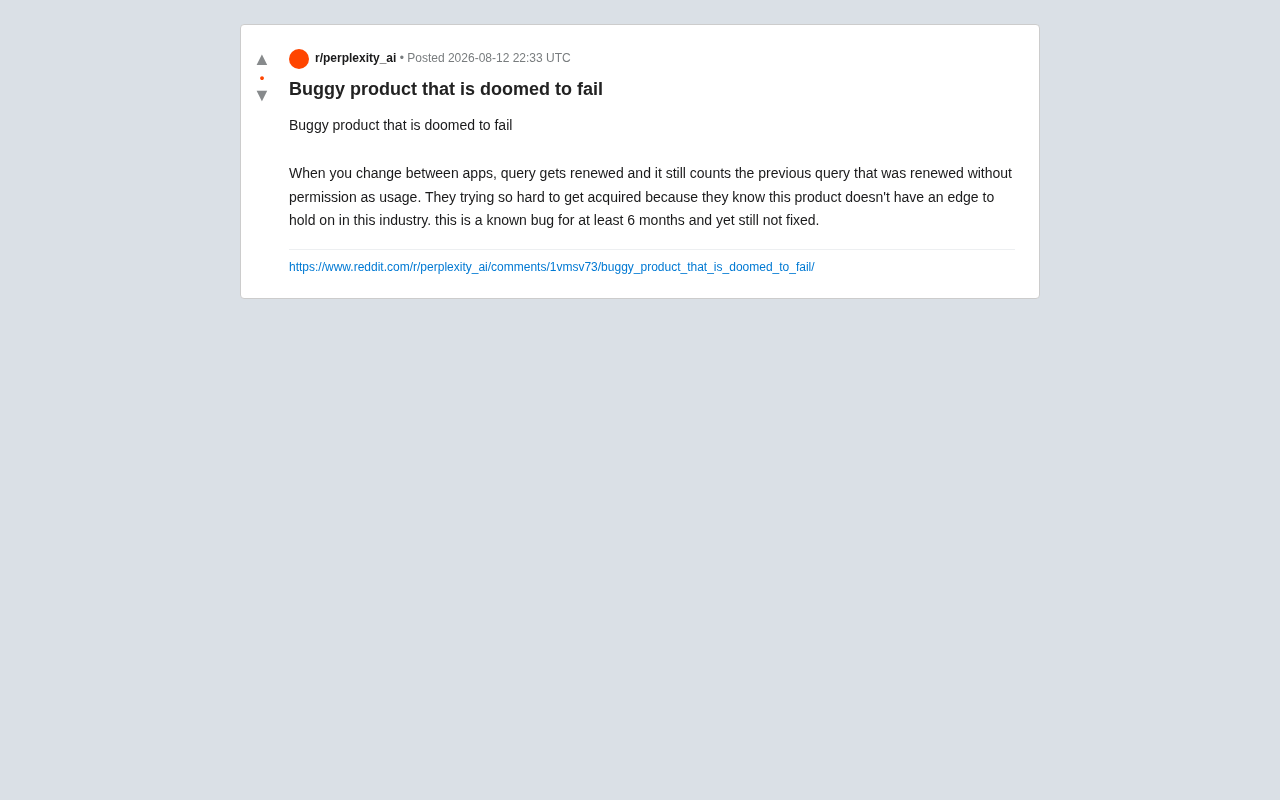
In today's fiercely competitive AI tools landscape, user experience often determines a product's survival. Recently, a Reddit user posted a scathing critique of a certain AI product, pointing to a billing bug that has persisted for at least six months without being fixed — when users switch between applications, ongoing queries get "refreshed," and these reset queries, which were never authorized by the user, still count against their usage quota.
What might seem like a minor technical detail actually strikes at the most sensitive nerve of AI subscription products: the fairness and transparency of billing. When users pay for each query or consume credits with every interaction, any form of "double billing" is perceived as a direct betrayal of trust.
The Technical Logic Behind App-Switching Triggering Double Billing
Why Does Switching Apps Cause Credits to Be Deducted Twice?
From a technical perspective, this type of issue typically stems from a disconnect between frontend state management and backend billing logic. When a user switches apps (for example, switching from a browser to another window and back), the frontend may reinitialize the session state, triggering a new query request (query renewal).
To understand the root cause, you need to understand the state management mechanisms of modern web applications. Frontend state management frameworks (such as React's useState, Redux, Zustand, etc.) maintain the application's UI state, while backend APIs independently handle business logic. When users switch apps, mobile or desktop WebViews may trigger page lifecycle events (such as visibilitychange, pagehide/pageshow), causing components to remount or sessions to reinitialize. If the frontend hasn't implemented request deduplication or idempotency token mechanisms, a single user intent can generate multiple API calls.
The problem is: the old query request may not be properly canceled or marked as invalid. When the backend receives a new request, it treats it as an independent usage event and deducts credits accordingly, while the "abandoned" old request has already generated a billing record. The result — the user only receives one valid result but gets charged twice.
This type of race condition problem is not uncommon in asynchronous web applications. Race conditions are a classic problem in concurrent programming, occurring when the execution order of two or more operations is uncertain, causing the system to enter an unexpected state. In ordinary applications, race conditions might only cause redundant rendering or brief UI flickering. But for AI products that use "query count" as their core billing unit, it directly harms users' financial interests — every unexpected credit consumption represents real monetary loss.
The Special Sensitivity of AI Product Billing Models
AI product billing models have rapidly evolved from free trials to subscriptions to usage-based pricing. Early ChatGPT adopted a monthly subscription + unlimited usage model, but as inference costs became differentiated (GPT-4's inference cost is approximately 30-60x that of GPT-3.5), the industry has gradually shifted toward "base subscription + credit limits" or pure token-based billing models. Claude, Gemini, and similar products have adopted comparable tiered strategies. Under this model, every query corresponds to quantifiable costs and credit consumption, and users' perception of "waste" is extremely amplified. Unlike traditional SaaS seat-based pricing, per-query billing puts users in a psychological state of "every click costs money," and any involuntary credit consumption triggers intense distrust.
Why Hasn't It Been Fixed in Six Months?
The user specifically emphasized that this is a bug that has been "known for over six months and still hasn't been fixed." From a product management perspective, several factors may explain this:
- Prioritization issues: The team may have concentrated resources on new feature development, believing the bug has limited impact.
- Technical debt accumulation: Fixing billing logic often requires touching core systems, creating cascading risks that lead teams to postpone action.
- The concern of misaligned incentives: If the bug results in users being "overcharged" rather than the platform losing money, then fixing it offers no direct revenue benefit to the platform — this is the most troubling interpretation for users.
The concept of technical debt was introduced by Ward Cunningham in 1992 as an analogy for the long-term costs accumulated from suboptimal technical decisions made to achieve short-term delivery speed. In AI startups, technical debt accumulates even faster — teams need to rapidly iterate on model integration, prompt engineering, context management, and other cutting-edge features, while infrastructure (including billing systems, error handling, state synchronization, etc.) is often treated as "good enough if it runs." Billing system fixes are particularly tricky because they typically span multiple system boundaries — frontend, backend, database, and payment gateways — and modifying any one component can introduce new consistency issues. Teams often find themselves stuck in a judgment of "the risk of fixing is greater than the risk of tolerating," until the problem explodes on a public platform.
From Billing Bug to Brand Trust Crisis
What Does the "Desperate to Be Acquired" Accusation Reveal?
This user's critique also included a sharp judgment: the product is "desperately trying to get acquired because they know this product has no competitive advantage in this industry."
While this is subjective speculation from a single source and lacks direct evidence, it reflects a pervasive anxiety in the AI startup ecosystem. Between 2023-2024, AI application layer companies faced unprecedented survival pressure. Foundation model companies like OpenAI, Google, and Anthropic have continuously extended downstream, launching features like ChatGPT Plugins and Gemini Extensions that directly encroach on the survival space of many "wrapper" applications. According to a16z's analysis, many AI applications have user retention rates below 20% after 90 days, because users can obtain similar capabilities at lower cost.
Under the pressure of big tech companies continuously releasing free or low-cost features, many AI application layer products lacking technical moats indeed face severe survival challenges. Some companies have pivoted to an "acquisition exit" strategy — accumulating user data, building brand recognition, or occupying niche market positions to attract acquisition by larger companies, rather than pursuing independent profitability. This strategic shift is often accompanied by declining investment in product quality.
When a product's operational focus shifts from "polishing experience and retaining users" to "packaging narratives and seeking an exit," it's no surprise that long-standing user experience issues go unfixed.
Billing Transparency: The Lifeline of AI Subscription Products
Regardless of whether the accusations are true, this case serves as a wake-up call for the entire industry. In SaaS and AI subscription models, billing transparency is the most fundamental and non-negotiable bottom line:
- Users are hyper-sensitive to "credits": Unlike traditional software's one-time purchases, per-use or usage-based billing makes users acutely aware of every consumption event.
- Double billing = trust collapse: A single detected erroneous charge is enough to create the impression that "this platform is secretly taking advantage of me" — an impression that is extremely difficult to reverse.
- The amplification effect of word-of-mouth: A single Reddit post or social media complaint can create negative expectations among potential users.
Lessons and Best Practices for AI Product Teams
Billing Logic Must Follow the Principle of "Better to Undercharge Than Overcharge"
For any product involving usage-based billing, engineering teams should establish a clear principle: in billing gray areas, always err in favor of the user. A query that was abandoned due to cancellation should not count against the user's credits. This isn't just technically correct — it's a matter of business ethics.
The technical foundation for implementing this principle is idempotency design — a key principle in distributed systems design meaning that executing the same operation once or multiple times produces exactly the same result. Implementing idempotency in billing systems typically requires:
- Unique idempotency keys: Generate a unique idempotency key for each user intent to ensure duplicate requests don't produce duplicate charges;
- Two-phase commit: Adopt a "pre-deduction → confirmation → rollback" pattern, only confirming the charge after the user actually receives a valid result;
- Request deduplication layer: Identify and merge duplicate requests within short time windows at the gateway level.
Payment platforms like Stripe have already made idempotency a core principle of their API design. AI products' billing systems should adopt equally rigorous standards.
Establish a "Trust Impact" Assessment Dimension for Bugs
Traditional bug priority assessment is often based on scope of impact and severity, but for billing-related bugs, a "trust impact" dimension should be introduced. A bug that only affects a small number of users but directly harms their financial interests may have far greater destructive power on brand trust than a widely-affecting but inconsequential display error.
Specifically, product teams can establish the following assessment matrix: classify bugs along two dimensions — "technical severity" and "trust impact" — in a four-quadrant model. Issues involving money, privacy, and data security, even if technically edge cases, should be elevated to the highest priority. This assessment framework helps teams avoid the blind spots of a purely technical perspective.
Proactive Communication Beats Silent Fixes
If a bug genuinely exists and cannot be thoroughly fixed in the short term, promptly informing users about the situation and providing credit compensation or refund mechanisms is far better than letting users discover the problem themselves and then taking their grievances to public platforms. A transparent attitude itself is an important step toward rebuilding trust.
In crisis communication, the "acknowledge → compensate → improve" three-step framework has been proven to be the most effective trust repair strategy. For AI products, this can be concretized as: publicly listing known issues within the product (similar to a status page), automatically detecting and refunding abnormally deducted credits, and regularly publishing technical improvement reports. The cost of these measures is far lower than the user churn caused by a PR crisis.
Conclusion
This piece of feedback from a single Reddit user may contain emotional expressions, and judgments like "doomed to fail" and "desperate to be acquired" require more evidence to substantiate. But it precisely reveals a core proposition in AI product competition: In an era of increasing technological homogeneity, a product's moat lies not only in model capabilities but also in honesty and respect toward users.
A billing bug left unfixed for six months doesn't just consume users' credits — it consumes the trust capital upon which the product depends for survival. For every AI startup team, this is an essential lesson worth heeding.
Related articles

ChatGPT Space Launches: Team Collaboration and New Pages Features Explained
ChatGPT Space is OpenAI's new team collaboration feature with Pages, real-time collaboration, and Slack/Google Drive sync. We break down its privacy design, multi-platform integration, and the full workflow from conversation to document.

Migrating Apache Spark UDFs to GPU Acceleration with AI Agents
NVIDIA developer blog explains how AI Agents rewrite Apache Spark UDFs for GPU acceleration, covering migration criteria, agent rewriting and verification workflows, plus pitfalls like result consistency and CPU-GPU transfer overhead.
Zed Editor v0.40.4-rc2 Released: Usage Credits Now Available Without Upgrading
Zed editor releases v0.40.4-rc2, allowing users to use usage credits for AI features without upgrading to a paid plan, lowering the trial barrier.