The Inside Story of OpenAI and Cursor's Split: Model Access to Be Cut Off in November
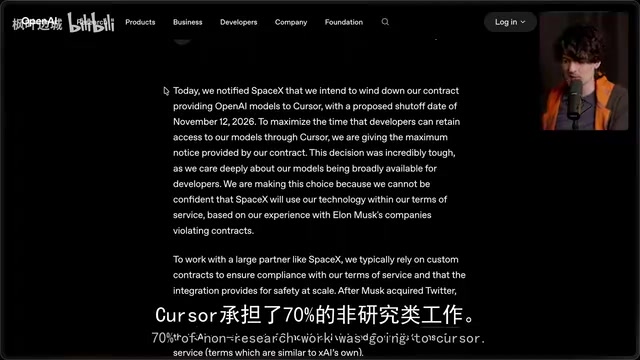
OpenAI cuts Cursor's model access on Nov 12 after SpaceX acquisition raises data distillation concerns.
After Cursor was acquired by SpaceX, OpenAI announced it will terminate model services on November 12th, citing a lack of trust rooted in xAI's documented distillation of OpenAI data and concerns about the upcoming Astra model. The dispute sparked public executive feuding over usage statistics, while Anthropic publicly backed Cursor due to its compute partnership with SpaceX. For users, the all-in-one subscription model is effectively broken — direct API subscriptions or open-source tools are now the recommended path forward.
The AI coding tool space just experienced a major shakeup. According to a prominent tech blogger (developer of the T3 stack) in a recent video, OpenAI has officially notified Cursor that it will terminate model services, with the cutoff date set for November 12th. This means Cursor subscribers will no longer be able to call OpenAI models directly within the editor after that date. What appears on the surface to be a routine commercial contract dispute is actually the product of a complex web involving acquisitions, data distillation, compute politics, and personal grievances.
The Catalyst: Cursor Gets Acquired
At the heart of this story is a change in Cursor's ownership. According to the blogger, Cursor was acquired by SpaceX's AI division. The deal could have gone one of two ways: either SpaceX AI would pay roughly $10 billion to partner with Cursor — primarily to access its data and engineering capabilities around reinforcement learning (RL) to improve the Grok model — or SpaceX would outright acquire Cursor by year-end for around $60 billion. In the end, SpaceX chose not to wait and completed the acquisition directly.
The blogger disclosed that he was an early investor in Cursor and has a direct financial stake in the transaction, but emphasized that this wouldn't make him pull punches in his reporting — if anything, he holds companies he's financially tied to a higher standard. He also noted he has no financial relationship with OpenAI, only a long-term paid subscription.
The phrasing in OpenAI's official statement is worth noting: they said they would notify SpaceX with "the maximum advance notice permitted under the contract," setting the closure date at November 12th to "maximize the window for developers to continue accessing models." This reads more like a refusal to renew after a contract expires than an abrupt about-face.
The Real Concern: Model Distillation and Astra
OpenAI's stated core reason is "trust." Their statement explicitly cited past experience with Musk-affiliated companies "violating contracts" as grounds for not being confident that SpaceX would use the technology within the bounds of the terms of service. The blogger's analysis is that what OpenAI truly fears is model distillation — Musk himself has already admitted in prior testimony that xAI engaged in distillation of OpenAI data.
The most telling detail is buried at the end of the statement: OpenAI mentions that its upcoming new model, Astra, will require "a new tier of accountability mechanisms." The blogger argues this is the real reason — Astra may represent a significant capability leap, and OpenAI is worried that if Cursor (now owned by SpaceX) gains access to Astra, the massive volume of user interaction data could flow directly to Elon for training Grok.
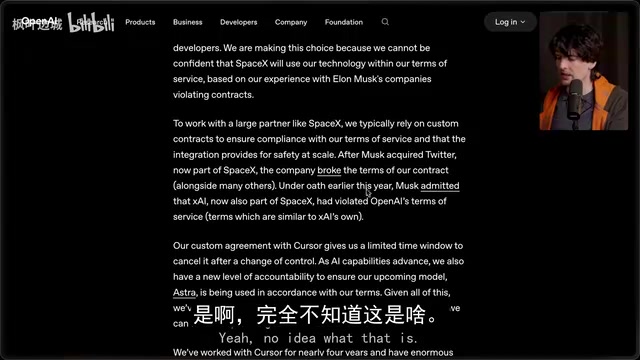
The blogger offered a nuanced take on this logic. He argues that "everyone is distilling," and the only reason OpenAI and Anthropic have an advantage is that they collected vast amounts of data before the internet woke up to the value of data and started locking things down. Using a paid model to collect data is fundamentally a legitimate business practice, and both companies' strict lockdowns are actually harmful to the broader ecosystem.
Model Distillation refers to using the outputs of a powerful "teacher model" (rather than raw training data) to train a "student model," allowing the latter to approach or even surpass the teacher's performance on specific tasks. Because the student model learns the teacher model's "behavioral patterns" rather than its internal weights, the process is technically distinct from directly copying a model — but it has always occupied a legal and ethical gray area. For top labs like OpenAI, the input-output pairs generated when users call their models via API at scale essentially constitute high-quality training data that can be directly used for distillation. As a developer-focused coding tool, Cursor generates enormous volumes of daily code completions and debugging conversations that hold exceptional distillation value — which is precisely why OpenAI fears the data flowing into Grok's training pipeline. Musk's admission of distillation behavior in court testimony transformed OpenAI's concerns from speculation into documented risk.
Compute Politics: Anthropic's Subtle Allegiance
This split also exposed the industry's complex web of compute dependencies. Anthropic's head of compute publicly stated that Cursor has been a trusted partner since Sonnet 3.5 and pledged to continue increasing compute support. The blogger noted that this "goodwill" has a practical explanation — Anthropic is now heavily reliant on SpaceX for compute. So even though Anthropic and xAI are competitors, they're willing to temporarily join forces over their shared disdain for OpenAI.
The blogger also dug up historical precedents to show this kind of lockout isn't new: when Windsurf was rumored to be acquired by OpenAI, Anthropic blocked its access to Claude; xAI was blocked earlier this year from accessing Anthropic models through Cursor; Anthropic even revoked OpenAI's access to the Claude API for violating terms of service. These precedents show that model vendors blocking competitors from data access has been a longstanding practice — but this is the first time OpenAI has done it directly.
The compute dependency relationships in AI are far more complex than they appear on the surface. Training and running large language models requires enormous GPU compute, and compute suppliers often simultaneously play the roles of competitor, investor, and partner. SpaceX has accumulated significant compute infrastructure through its Starlink satellite network and proprietary data centers, giving it considerable leverage over AI companies hungry for compute. Anthropic's compute partnership with SpaceX means the two have substantial commercial ties, which partly explains why Anthropic would publicly back Cursor in this dispute — even though Anthropic and xAI (Grok's developer) are direct competitors on the model side. This "the enemy of my enemy is my friend" dynamic vividly illustrates the entangled relationship between technological competition and commercial interests in today's AI industry.
Executive Twitter Beef: A Public Feud Nobody Needed
As the news broke on Friday evening, public responses from executives at both Cursor and OpenAI drew criticism from the blogger. He argued that Cursor CEO Michael's tweet was "too combative," and that the claim that "OpenAI models account for only about 5% of Cursor user traffic" was misleading.
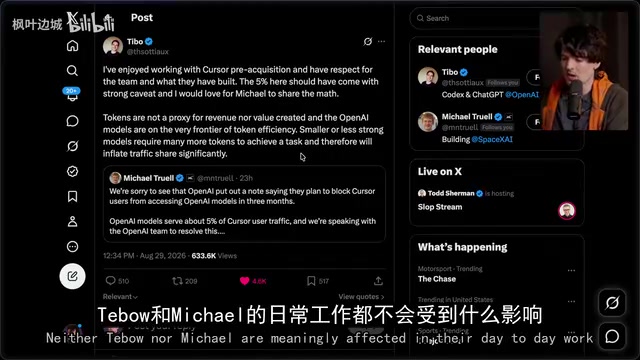
The blogger dissected the "5%" figure from a technical angle: there are multiple ways to measure AI usage — by users, requests, lines of code, or tokens. OpenAI's models (like 5.6 Sol) are at the frontier of token efficiency, consuming far fewer tokens than Anthropic models for the same task. Using data from Artificial Analysis and Cursor's own benchmarks as examples, certain Anthropic models require 3x the tokens of OpenAI models to complete the same task. So if that 5% is calculated by token count, the actual value share should probably be understood as closer to 15%.
OpenAI executive Tebow responded that "tokens are not a proxy for revenue or value" and demanded Michael release his methodology. The blogger conceded that everything Tebow said was factually accurate — but argued this personal beef between executives was entirely unnecessary. The people actually affected are the users, while neither executive's job or livelihood is at risk.
What Should Users Do?
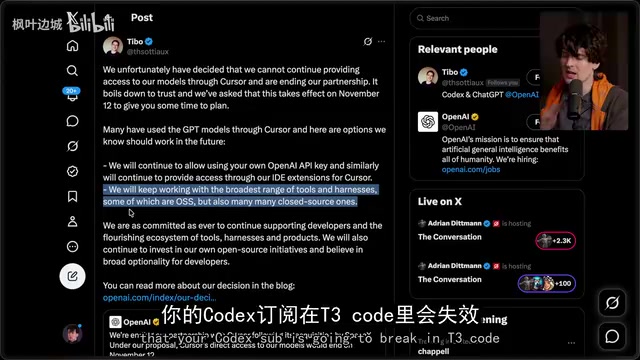
For developers who rely on Cursor as an all-in-one model platform, the blogger offered practical advice. Users can still access OpenAI models in Cursor using their own OpenAI API key, or continue using OpenAI models via its official IDE extension (such as the Codex plugin). But he was blunt: if you want one subscription to cover all models, "that's basically not happening" — the pricing you get by subscribing directly to model vendors is far better than any aggregation service.
The blogger explained the underlying economics: inference margins for model vendors are reportedly 70–90%, which gives them enormous room to subsidize. The same prompt might cost ten times more through an aggregation service compared to going directly to the source. One reason Cursor was able to sustain its subsidies for so long is precisely that it was extracting value from user data — data that reportedly helped the Grok model improve substantially.
He also mentioned several open-source alternatives, including terminal-based tools like Gene, Superset, and Herder, as well as his own T3 Code. The core recommendation: if you want to avoid being caught in the crossfire of corporate disputes, "own your own tools" — make your relationship with the products you depend on direct, not mediated through a middleman.
The business model of aggregated AI coding tools like Cursor is essentially "resell and add value": the platform bulk-purchases API access from model vendors and repackages it for users at a flat subscription price, layering on proprietary features like code completion and context awareness. This model can attract users with low prices early on, partly because the platform can offset compute costs with user data, creating a data flywheel. However, once model vendors tighten API access or develop conflicting interests with the platform, users face service disruption risk — while their workflows have already become deeply dependent on the tool. Subscribing directly to model vendors (like the official APIs from OpenAI or Anthropic) requires more technical setup, but bypasses the uncertainty of the intermediary layer and offers greater pricing transparency. Open-source local deployment (e.g., running local models via Ollama) represents the other extreme — trading some performance for complete data sovereignty and access stability.
This May Just Be the Beginning
The blogger closed with an unmistakable note of concern: this split is probably not an isolated incident, but rather "the beginning of the end." More lockouts between Anthropic, OpenAI, Google, SpaceX, and others may follow. He even took a parting shot at Google's closed-off policies around subscription integrations.
For developers who rely on OpenAI models inside Cursor every day, this is undeniably bad news — after November, they'll lose access entirely, and they'll miss out on the upcoming Astra. As the blogger put it, Astra might be excellent and worth looking forward to in the future, but right now, this moment is genuinely frustrating. In this parental quarrel, the biggest casualties are always the users caught in the middle.
Related articles

LynnReal-Omni: 32B Unified Video Diffusion Model Goes Open Source with Multi-Task Coverage in Four Steps
LynnReal-Omni is a 32B unified video diffusion model on MiniMax H3, covering text-to-video, pose guidance, style transfer, restoration in 4 steps. Flash version generates 540p video in 377ms on one H100.

Anthropic Co-Founder: AI 'Kill Switch' May Need to Be Mandatory by Law
Anthropic's co-founder tells the BBC that AI 'kill switches' may need to be legally mandated. We analyze the industry logic, technical challenges, and the tension between regulation and innovation.

The AI Data Center Boom Is Colliding With Cities Scarred by Heavy Industry
The AI data center boom is clashing with post-industrial communities. Philadelphia's case reveals structural conflicts between AI growth, energy use, water, and environmental justice.