The Intelligence Explosion Is No Longer Distant: How Recursive Self-Improvement Is Shifting Researcher Consensus

Recursive self-improvement is shifting AI researchers' timelines for when an intelligence explosion might actually occur.
The article centers on a researcher's tweet highlighting a key shift: recursive self-improvement-driven "intelligence explosion" is not a new idea, but recent advances in large models — across code generation, experiment design, and automated R&D pipelines — have given it a real-world foothold. More credible researchers are now placing it within a foreseeable timeframe. This shift in expert consensus carries policy weight: if a capability leap could occur in the near term, the window for building AI safety, alignment, and governance mechanisms is narrow, demanding proactive rather than reactive preparation.
An Old Idea Suddenly Feels Imminent
"Intelligence explosion" is not a new concept. More than half a century ago, researchers proposed a possibility: once a system gains the ability to improve itself, it can make the next version smarter — and that smarter version can improve itself even more efficiently. This cycle repeats, ultimately breaking through the boundaries of human intelligence at remarkable speed. This kind of explosive growth driven by recursive self-improvement has long remained in the realm of thought experiments.
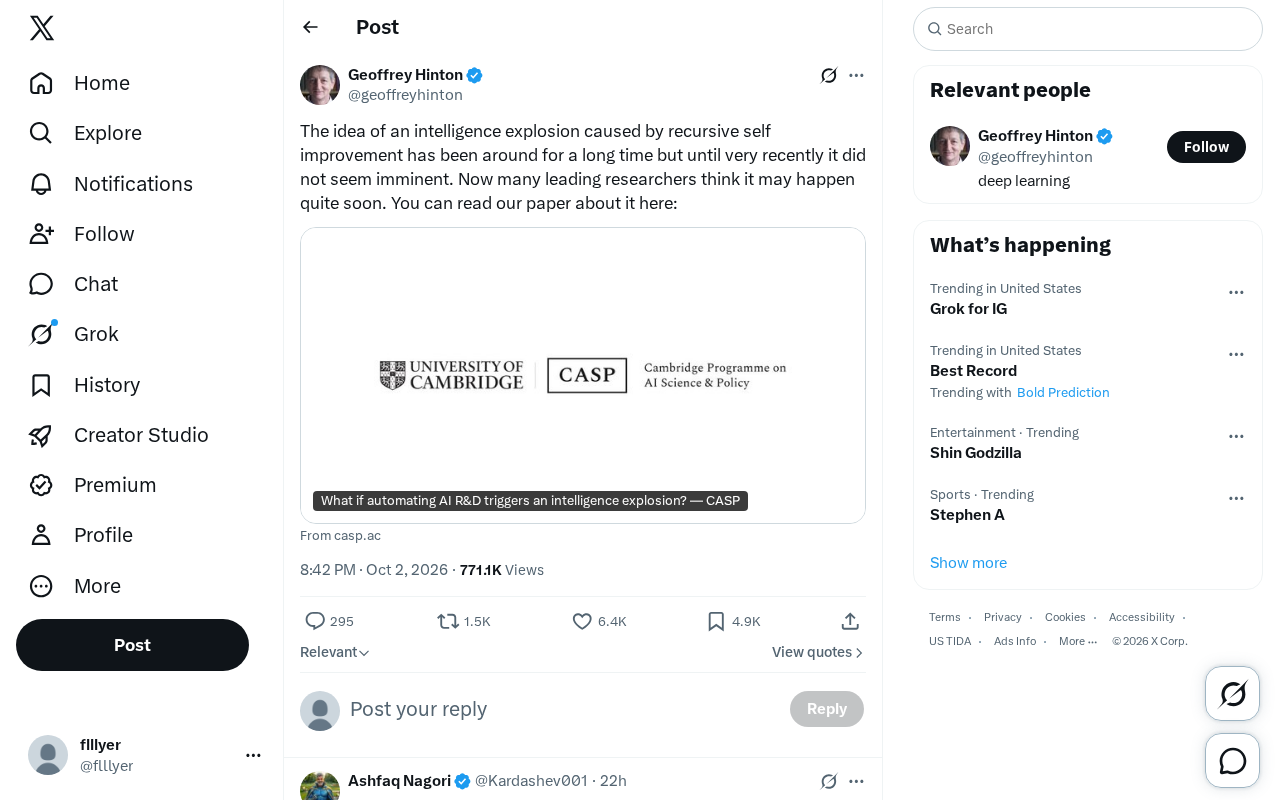
A tweet from a researcher captures the key shift: the idea has existed for a long time, but "only recently started to feel imminent." In other words, what has changed is not the concept itself, but people's judgment about when it might occur. The author notes that many top researchers now believe the intelligence explosion could arrive in the relatively near future, and links to a related paper for deeper reading.
This concept traces back to 1965, when mathematician I.J. Good described what he called an "ultraintelligent machine": once a machine surpasses human intelligence, it can design even better machines, triggering an "intelligence explosion" that leaves human intellect far behind. Later, science fiction writer Vernor Vinge and futurist Ray Kurzweil incorporated it into the broader framework of the "Technological Singularity," bringing the concept to wider public awareness. It's worth distinguishing the two: "intelligence explosion" focuses specifically on the uncontrolled acceleration of capability growth, while "Technological Singularity" refers more broadly to the cognitive discontinuity beyond which humans cannot predict the shape of the world. They overlap, but the intelligence explosion is one possible cause of the Singularity — not the same concept.
Why Researcher Attitudes Are Shifting
The core logic of recursive self-improvement lies in a "self-reinforcing feedback loop." Traditional software systems have fixed capabilities, but an AI system that can optimize its own architecture, training process, or even research methodology could theoretically invest a portion of its intelligence into the task of "making itself smarter." Once the returns on that investment are high enough, the system's capability curve could shift from linear growth to superlinear or even exponential growth.
For a long time, the research community remained skeptical — largely because there was no concrete technical foothold in reality. No system had shown genuine signs of improving itself. But in recent years, advances in large language models across code generation, research assistance, and automated machine learning pipelines have transformed "AI participating in AI development" from a philosophical discussion into an engineering question. When models can already help write training code, design experiments, and filter architectural proposals, that once-abstract feedback loop has a concrete place to land.
This is the underlying reason the tweet emphasizes "imminence": it's not that the theory has become more persuasive — it's that reality is providing increasingly observable signals, compelling serious researchers to reassess their timelines.
Automated Machine Learning (AutoML) and Neural Architecture Search (NAS) currently represent the most prominent technical pathways for "AI participating in AI development." NAS uses algorithms to automatically search for optimal neural network structures and has already found architectures that outperform human-designed ones in tasks like image recognition. More recent developments include large models helping to generate training code, automatically tuning hyperparameters, and even proposing new research hypotheses. However, these systems still rely heavily on humans to set objectives and evaluation criteria — there remains a significant structural gap before "closed-loop self-improvement" is achieved. They can optimize parameters within a given objective, but cannot autonomously redefine the optimization goal itself. This is the central fault line in current debates: whether existing technology is close enough to a true recursive self-improvement threshold, or whether it still represents a fundamentally different, assistive stage.
From Thought Experiment to Policy Issue
When a critical mass of credible researchers begins to believe that an intelligence explosion "could happen soon," the implications extend far beyond academic curiosity. It directly affects AI safety, the pace of governance, and the prioritization of resources.
If a capability leap could genuinely occur within a short timeframe, the window available for humans to establish oversight, alignment, and control mechanisms is extremely limited. This means safety research, evaluation frameworks, and governance discussions need to be built proactively — not reactively assembled after capabilities have already surged. The paper linked in the tweet is attempting to systematize this judgment for a broader audience, pushing the conversation from vague concern toward structured analysis.
How to Evaluate This Signal Rationally
It's important to stay clear-headed: "many researchers believe it could happen soon" is not the same as "it will definitely happen soon." Whether recursive self-improvement can truly trigger an uncontrolled explosion still depends on several unverified premises: whether the marginal returns on improvement remain consistently positive, whether physical or algorithmic bottlenecks exist, and whether humans can maintain effective intervention throughout the process.
The value of this tweet lies more in what it reflects — a shift in expert consensus. A scenario once considered distant is being brought by more and more people into a foreseeable timeframe. For those following AI development, rather than fixating on a specific timeline, it's more productive to take seriously the reasons behind this attitude shift and to engage with the argumentative details in the cited paper.
Since this article is based on a brief tweet and the paper it links to, readers are encouraged to consult the original paper directly for more complete arguments, data, and underlying assumptions.
The AI safety community refers to such scenarios as the "fast takeoff" hypothesis, in contrast to "slow takeoff" — where capability improvements are gradual and observable, allowing for human intervention. The concern with fast takeoff is that if a system's capabilities jump by orders of magnitude within days or weeks, human monitoring, evaluation, and intervention mechanisms will not have time to respond. Currently, major labs including OpenAI, Anthropic, and DeepMind all incorporate takeoff speed as a key variable in their risk models, though genuine disagreement exists among researchers about which scenario is more likely. Proponents of the slow takeoff view argue that physical constraints on compute, data, and real-world feedback will naturally slow the process, giving humans sufficient time to adapt. Those more concerned about fast takeoff emphasize the unpredictability of algorithmic breakthroughs and the potential for nonlinear effects.
Related articles

ChatGPT Space Launches: Team Collaboration and New Pages Features Explained
ChatGPT Space is OpenAI's new team collaboration feature with Pages, real-time collaboration, and Slack/Google Drive sync. We break down its privacy design, multi-platform integration, and the full workflow from conversation to document.

Migrating Apache Spark UDFs to GPU Acceleration with AI Agents
NVIDIA developer blog explains how AI Agents rewrite Apache Spark UDFs for GPU acceleration, covering migration criteria, agent rewriting and verification workflows, plus pitfalls like result consistency and CPU-GPU transfer overhead.

Zed Editor v0.40.4-rc2 Released: Usage Credits Now Available Without Upgrading
Zed editor releases v0.40.4-rc2, allowing users to use usage credits for AI features without upgrading to a paid plan, lowering the trial barrier.