The Key to AI Agent Adoption: Making Virtual Machines as Simple as Clicking a Folder

AI Agent mass adoption hinges on making VM environments as intuitive as clicking a folder in Finder.
As AI Agents move from concept to deployment, their biggest barrier to mainstream adoption isn't capability — it's usability. This article examines why non-developer users need VM operations simplified to Finder-level interactions, explores the product philosophy behind effective abstraction layers, and argues that the next competitive battleground for AI Agents is user experience, not raw power.
AI Agent's Hidden Barrier: Technical Complexity Shouldn't Be Passed to Users
As AI Agents move from concept to real-world deployment, a problem often overlooked by the tech community is surfacing: for non-developer users, the technical barrier to running AI Agents remains far too high. Recently, a brief but incisive discussion on Twitter caught attention — its core argument being that non-developer users need to feel like using a virtual machine (VM) is as simple as pointing to a folder in Finder.
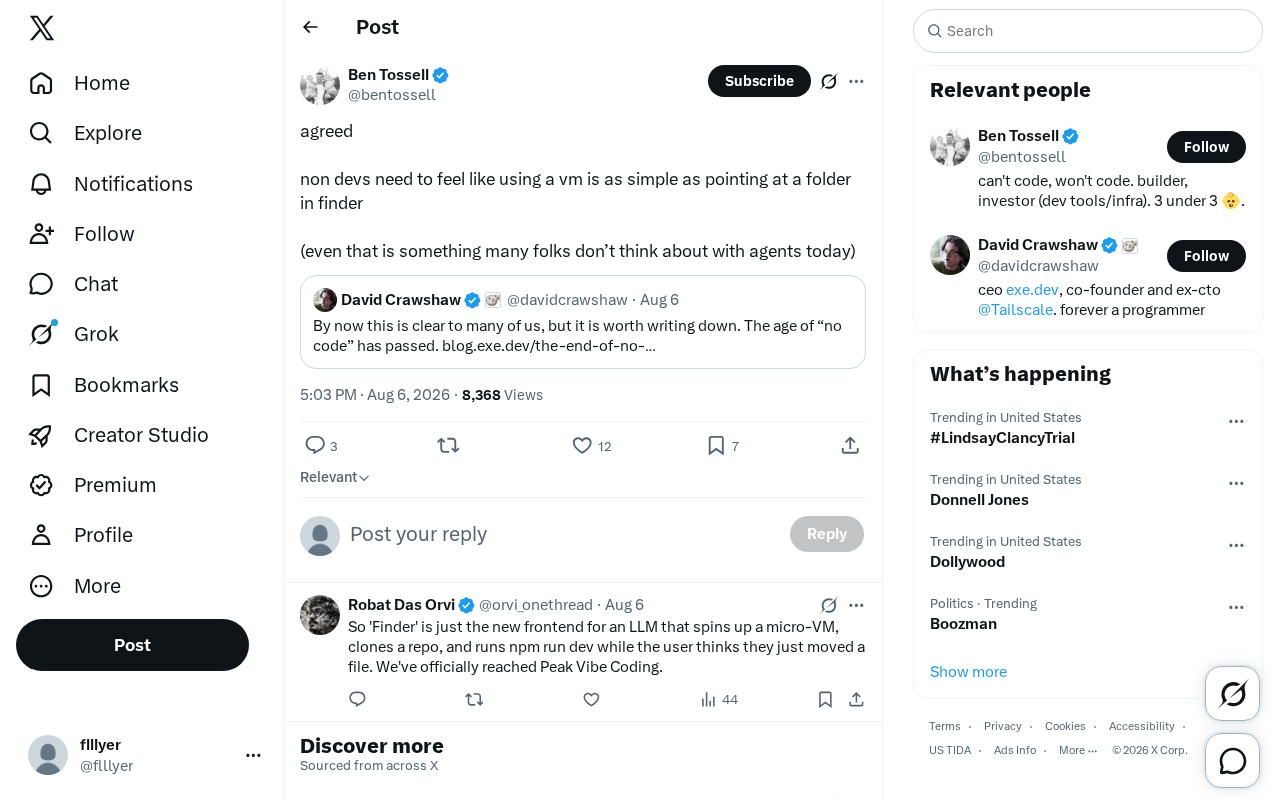
Though short, this tweet articulates the most easily overlooked pain point in the productization of AI Agents: technical complexity should not be transferred to end users.
Why Virtual Machines Are AI Agent's Security Sandbox
Why Agents Need Isolated Environments
To appreciate the weight of this tweet, we first need to understand why AI Agents typically need to run in virtual machines or isolated environments. An AI Agent is an artificial intelligence system capable of perceiving its environment, making autonomous decisions, and executing actions to achieve specific goals — unlike traditional conversational AI, Agents have "agency." They can not only generate text responses but also invoke tools, manipulate file systems, execute code, browse the web, and more. Current mainstream Agent frameworks (such as LangChain Agent, AutoGPT, CrewAI, etc.) typically employ paradigms like ReAct (Reasoning + Acting) or Plan-and-Execute to autonomously complete multi-step tasks.
When we grant AI Agents the ability to perform tasks — like manipulating files, running code, or accessing system resources — security and isolation become unavoidable concerns.
Virtual machines provide an isolated sandbox environment where Agents can freely read and write files and execute commands without causing irreversible damage to the user's primary system. From a technical implementation perspective, VMs create fully isolated operating system instances on top of physical hardware through a Hypervisor, with each VM having its own independent kernel, file system, and network stack. By comparison, Docker containers share the host kernel but achieve process-level isolation through Linux namespaces and cgroups — lightweight but with a lower degree of isolation. In between lies microVM technology (such as AWS Firecracker), which balances VM-level security isolation with container-level startup speed. For AI Agents that need to execute arbitrary Shell commands or modify system configurations, VM-level isolation is almost a mandatory security choice.
Current State of Agent Sandbox Solutions
In actual AI Agent products, isolated environments are implemented in various ways. Anthropic's Computer Use feature lets Claude operate an isolated virtual desktop through a remote desktop protocol; OpenAI's Code Interpreter runs an independent Python sandbox environment on the server side; open-source projects like Open Interpreter default to executing code directly on the user's local machine (with user confirmation required). Cloud-based sandbox services specifically designed for AI Agents, such as E2B (Environment to Build), are also emerging — they provide API-based isolated environments, attempting to lower the barrier for developers to integrate sandboxes. However, these solutions primarily target developers, and end-user experience packaging remains severely insufficient.
The Complexity Cost of VM Configuration
Yet what developers take for granted in VM configuration — image selection, resource allocation, network settings, file mounting — reads like hieroglyphics to ordinary users. Configuring a VM often requires understanding command lines, path mapping, permission management, and a series of other concepts — precisely the points where non-technical users are most likely to give up.
A detail mentioned in the tweet is particularly crucial: "Even pointing to a folder in Finder — this is something many people building Agents today haven't seriously thought about." This reveals an industry blind spot — technical teams are often immersed in the complexity of feature implementation while ignoring whether the user's first step of interaction with the system is sufficiently intuitive.
The Product Philosophy Behind the Finder Metaphor
The Interaction Evolution from Command Line to GUI
Comparing VM operations to "pointing to a folder in Finder" is essentially calling for a dimensional reduction in interaction paradigms. Looking back at computing history, the reason graphical user interfaces (GUIs) brought personal computers into every household was precisely because they transformed abstract file system operations into intuitive "drag and drop" and "click" actions.
The 1984 launch of the Macintosh marked the true beginning of the GUI era. Before that, personal computer users had to master DOS command lines to complete basic operations. The "desktop metaphor" proposed by Alan Kay at Xerox PARC — using real-world concepts like folders, trash cans, and desktops to map computer operations — reduced the barrier to computer use by orders of magnitude. Similar paradigm shifts occurred when web browsers transformed the internet from an academic tool into mass media, and when iPhone's multi-touch made smartphones accessible to everyone rather than just business professionals. At the core of every wave of technological democratization is finding the right abstraction layer to hide underlying complexity.
The same logic is replaying in the AI Agent space. Current Agent tools mostly remain in the "command-line era" — powerful but user-unfriendly. Whoever can first package complex runtime environments into operations as simple as "pointing to a folder" will likely win the massive non-developer market.
Core Elements of Abstraction Layer Design
Excellent product design is essentially about building abstraction layers. Users don't need to know whether the underlying system runs Docker containers, micro VMs, or remote sandboxes — they just need an intuitive interaction entry point. This requires product teams to invest effort at several levels:
- Visual resource selection: Replace path input with folder pickers
- Automated environment configuration: Hide technical details like images, dependencies, and permissions
- Instant state feedback: Let users clearly know what the Agent is doing
- Secure defaults: Provide protection without requiring users to understand isolation mechanisms
Key Implications for the AI Agent Industry
The Leap from Developer-Friendly to User-Friendly
The vast majority of AI Agent products on the market today still center on developers as their core users. They assume users understand terminal operations, comprehend file paths, and can handle configuration files. This is understandable during the early technology adoption phase, but if AI Agents are to achieve true widespread adoption, they must bridge the gap from "developer-friendly" to "user-friendly."
Geoffrey Moore pointed out in Crossing the Chasm that market acceptance of technology products follows a curve from Innovators → Early Adopters → Early Majority → Late Majority → Laggards. The key challenge lies in crossing the "chasm" between early adopters and the early majority — the former are willing to tolerate rough user experiences to gain technological advantages, while the latter demand products that "just work." Most current AI Agent products are still serving innovators and early adopters. To cross the chasm into the mainstream market, simplifying the user experience is a necessary path, not an optional nice-to-have.
The value of this tweet lies in reminding the entire industry: the next growth driver isn't making Agents more powerful, but making Agents more usable. Once technical capabilities reach a certain level, user experience becomes the core battleground for differentiated competition.
The Complex Engineering Challenges Behind Simple Interactions
It's worth emphasizing that "making things feel simple for users" is precisely the hardest part of engineering. Behind a seemingly simple "point to a folder" operation, there may be permission granting, path mapping, sandbox isolation, data synchronization, and a series of other complex problems to solve. True product excellence is demonstrated by elegantly hiding this complexity beneath a clean interface.
This is also why Apple products like Finder and iCloud have become paradigms of interaction design — they use minimalist surfaces to support extremely complex underlying logic. iCloud file sync appears to be nothing more than "files appearing on another device," but behind the scenes it involves conflict resolution, incremental synchronization, end-to-end encryption, cross-platform compatibility, and dozens of other engineering challenges. If AI Agent products want to achieve a similar "seamless experience," they likewise need to make enormous investments in engineering depth.
Conclusion: Usability Determines AI Agent Adoption
The technical race in AI Agents has been underway for quite some time, with significant progress in model capabilities, tool calling, multi-step reasoning, and more. But as this brief tweet points out, the last mile to the mass market is usability.
Making non-developer users feel like using a virtual machine is as natural as clicking a folder may seem like a modest goal, but it's actually a critical step toward making AI Agents accessible to everyone. Whoever truly understands and solves this "simple" problem holds the key to unlocking a much broader market. The ultimate goal of technology has never been to show off — it's to empower every ordinary person to harness it with ease.
Related articles

@ai-sdk/vue 3.0.306 Patch Release Syncs with [email protected] Update
@ai-sdk/vue 3.0.306 released, synced with [email protected]. A routine patch release for the Vercel AI SDK ecosystem with no public API changes; the Vue adapter layer stays version-aligned with the core package.

Gemini 4 Argon API Launches: The Era of Million-Token Output Begins
Google launches Gemini 4 Argon with sparse MoE architecture, up to 1M output tokens, and a 68.90% Vals Index score, available across API, AI Studio, and the Gemini app.

DukaanAI: Turning Product Photos into Inventory Lists with Open-Source AI
DukaanAI is an AI inventory tool for small retailers that turns product photos into inventory entries using the open-source Gemma 3 model, with local inference, editable fields, and CSV export.