The Key to Quantum Computing's Advantage Over Classical: Contextuality Experiment Tops Science

Google is the first to scale quantum contextuality on the Willow processor, proving it explains quantum advantage better than entanglement.
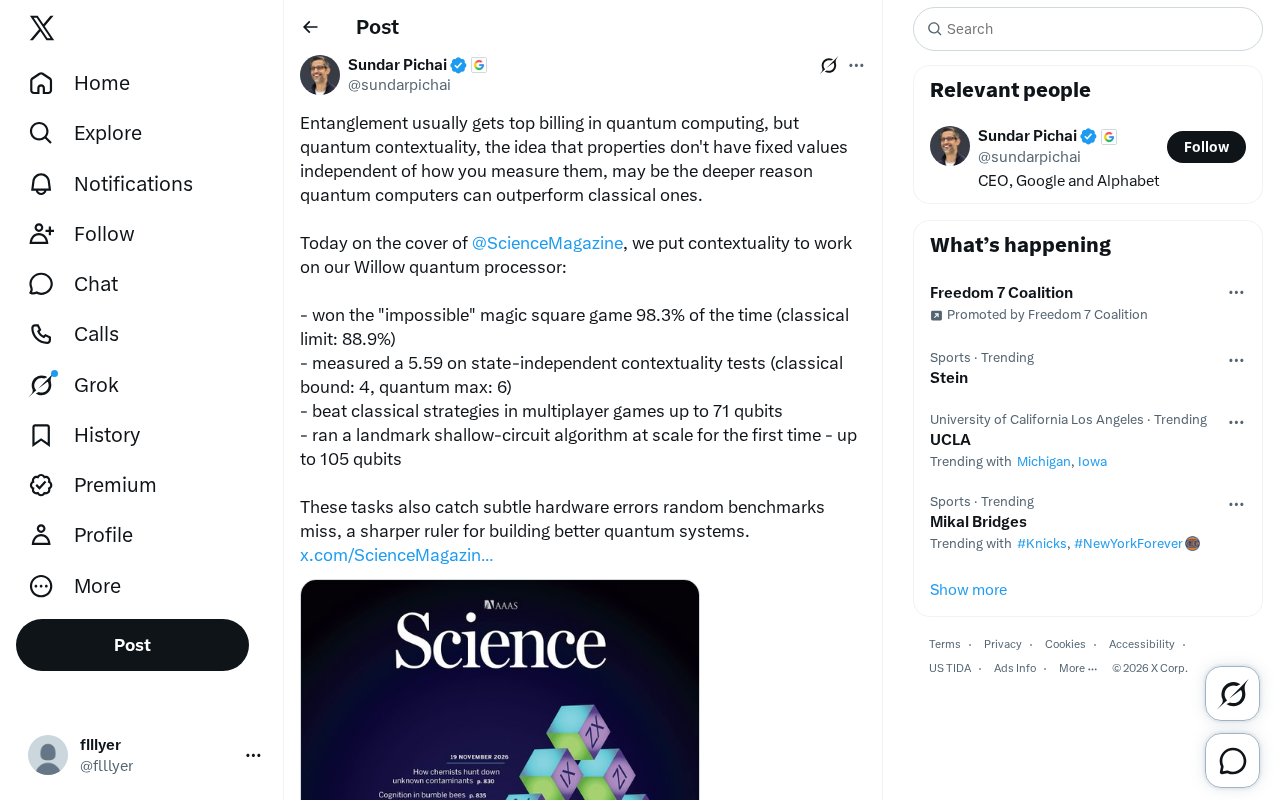
The superiority of quantum computing has long been attributed to entanglement, but experiments by Google's Quantum AI team on the Willow processor show that quantum contextuality may be the more fundamental driver. Contextuality means that a quantum system has no fixed properties independent of measurement—its behavior depends on the measurement context. Through four experiments—the "impossible" magic cube game (98.3% success rate vs. the 88.9% classical limit), a state-independent contextuality test (metric 5.59 vs. the classical bound of 4), a 71-qubit multiplayer game, and a 105-qubit shallow-circuit algorithm—the team validated the scalability of the contextuality advantage. Contextuality tests can also capture hardware errors that randomized benchmarking misses, providing a finer evaluation tool and marking the concept's transition from theoretical discussion into engineering practice.
Title
Quantum Computing's Key to Surpassing Classical: Contextuality Experiment Tops Science
Meta Description
Google is the first to put quantum contextuality into practice on the Willow quantum processor—the magic cube game achieves a 98.3% success rate, surpassing the classical limit, and runs shallow-circuit algorithms at the 105-qubit scale, with the results landing on the cover of Science.
Article Content
The superiority of quantum computing is often attributed to entanglement, but the latest experiment by Google's Quantum AI team on the Willow processor points to a deeper cause: quantum contextuality. This research made the cover of Science magazine, marking the first time contextuality has been transformed from a theoretical concept into a scalable computational resource.
What Is Quantum Contextuality
Contextuality refers to the fact that the properties of a quantum system do not have fixed values independent of how they are measured. In other words, how a qubit behaves depends on how you measure it, rather than some definite state pre-existing and waiting to be read out. This property defies classical physical intuition, yet it is one of the most essential features of quantum mechanics.
For a long time, entanglement was regarded as the primary source of quantum computational advantage. But the Google team's latest work suggests that contextuality may be the more fundamental driver. When a quantum computer outperforms a classical computer on a specific task, contextuality provides correlation structures that classical systems cannot reproduce.
Contextuality is closely related to, but not identical with, another famous concept in quantum mechanics—the Bell inequality. The Bell inequality tests nonlocal correlations between spatially separated systems, whereas contextuality requires no spatial separation; it tests whether the results of the same system are consistent across different measurement contexts (i.e., when measured jointly with other observables). Mathematically, the Kochen-Specker theorem proves that no non-contextual hidden-variable model can assign definite values to all quantum observables in advance, providing a rigorous theoretical foundation for contextuality. Around 2008, Cabello, Severini, and others proposed a graph-theoretic framework for "state-independent contextuality," mapping contextuality correlations onto the independent-number problem of graphs, enabling contextuality to be quantified and converted into operable experimental protocols—this is precisely the theoretical source of the metric values tested by the Google team.
Four Key Results on the Willow Processor
The research team designed a series of tests on the Willow quantum processor to put contextuality into practice, achieving four landmark results:
- The "impossible" magic cube game: In a magic cube game known to be unsolvable under classical logic, the quantum strategy achieved a success rate of 98.3%, far exceeding the classical limit of 88.9%. Although this gap may seem small, it represents a chasm that classical systems cannot cross.
- State-independent contextuality test: The team measured a metric value of 5.59, whereas the classical bound is 4 and the quantum theoretical maximum is 6. This result approaches the quantum maximum, indicating that Willow performs excellently in maintaining contextuality correlations.
- Multiplayer game extended to 71 qubits: In a multi-player game scenario, the quantum strategy defeated the classical strategy at a scale of up to 71 qubits, demonstrating the scalability of the contextuality advantage.
- First large-scale run of a shallow-circuit algorithm: The team ran a landmark shallow-circuit algorithm at a scale of up to 105 qubits for the first time, validating the potential of contextuality in practical algorithms.
These tasks are not merely demonstrations of quantum advantage; they can also capture subtle hardware errors that randomized benchmarking tends to miss, effectively providing a finer ruler for quantum systems.
Why Contextuality Deserves More Attention Than Entanglement
Entanglement describes correlations among multiple qubits, whereas contextuality describes the behavior of a single quantum system under different measurement contexts. From the perspective of computational resources, contextuality may more directly explain why quantum computers can achieve exponential speedup on certain tasks.
Classical computers can simulate certain aspects of entanglement, but they cannot reproduce the measurement-dependent correlations required by contextuality. This means that contextuality constitutes a "hard boundary" of quantum computational advantage—one that classical systems cannot breach no matter how much they are optimized. The Google team's experiment exploits precisely this point, designing tasks that classical computers cannot efficiently simulate.
"Shallow circuits" refer to quantum circuits whose depth (i.e., the number of gate layers) is constant, unlike general quantum algorithms that require polynomial depth. Because the depth does not grow with problem size, shallow circuits are more friendly to current noisy intermediate-scale quantum (NISQ) hardware, with limited accumulation of gate errors. Bremner, Montanaro, and others proved early on that even when circuit depth is very shallow, classical computers struggle to efficiently simulate their output distributions; such problems are known as "IQP" (Instantaneous Quantum Polynomial-time) circuits or "quantum supremacy" sampling tasks. The Google team embedded the contextuality protocol into shallow circuits and ran them on 105 qubits, exploiting precisely this structural advantage of being "hard for classical simulation, easy for quantum implementation."
Implications for Quantum Hardware Development
Another value of this research lies in hardware diagnostics. Although traditional randomized benchmarking can assess the fidelity of gate operations, it tends to miss certain systematic errors. Contextuality tests, by contrast, are highly sensitive to measurement-dependent correlations and can reveal subtle deviations that randomized benchmarking cannot capture.
For teams building larger-scale quantum systems, this "sharper ruler" means hardware problems can be detected earlier, thereby accelerating iteration. Willow's performance at the 105-qubit scale also proves that the contextuality protocol remains effective on systems approaching practical scale.
Randomized benchmarking estimates the average gate error rate by applying random gate sequences and comparing outputs with ideal results; its advantages are speed and scalability, but its disadvantages are insensitivity to specific types of correlation errors (such as measurement crosstalk and context-dependent measurement bias) and an inability to directly reflect the correlation structure at the computational-task level. Contextuality tests directly examine whether the joint distribution of measurement results violates classical inequalities, and are therefore naturally sensitive to any hardware defect that disrupts such correlations—including readout errors, crosstalk between gates, and drift. The two are complementary: randomized benchmarking provides a "macro checkup" of gate-level fidelity, while contextuality tests provide a "fine-grained diagnosis" at the correlation level.
A Turning Point from Theory to Engineering
For a long time, contextuality remained confined to discussions of quantum foundations, far removed from practical quantum computing engineering. The Google team's results mark this concept's formal entry into engineering practice: it is no longer merely a topic debated by philosophers and theoretical physicists, but a practical tool that can be used to design algorithms, validate hardware, and measure system performance.
As quantum processors continue to scale up, contextuality is expected to become one of the standard frameworks for evaluating quantum advantage. For practitioners following the trajectory of quantum computing, this research points to a direction: future proofs of quantum advantage may no longer talk only about entanglement, but revolve more around contextuality.
One-line Summary
Google is the first to scale quantum contextuality on the Willow processor, demonstrating that it explains quantum advantage better than entanglement.
Paragraph Summary
The superiority of quantum computing has long been attributed to entanglement, but experiments by Google's Quantum AI team on the Willow processor show that quantum contextuality may be the more fundamental driver. Contextuality means that a quantum system has no fixed properties independent of measurement—its behavior depends on the measurement context. Through four experiments—the "impossible" magic cube game (98.3% success rate vs. the 88.9% classical limit), the state-independent contextuality test (metric 5.59 vs. the classical bound of 4), a 71-qubit multiplayer game, and a 105-qubit shallow-circuit algorithm—the team validated the scalability of the contextuality advantage. Contextuality tests can also capture hardware errors that randomized benchmarking misses, providing a finer evaluation tool for quantum systems and marking the concept's formal transition from theoretical discussion into engineering practice.
Related articles

Prompt Engineering for Beginners: From Writing Prompts to Engineering Thinking
Starting from the essence and four functions of prompts, this article systematically explains the six-step process, four success criteria, learning value, and practical limitations of prompt engineering to help you build a complete understanding.

Anthropic Launches Nasdaq IPO: AI Giant's Listing and Risk Disclosures
Anthropic officially launches its Nasdaq IPO under ticker ANT, with market valuation expected to potentially exceed SpaceX's record. The prospectus devotes nearly 100 pages to AI risks, while first-half revenue grew over 14x but net losses widened sharply, reigniting the AI bubble debate.

Rust cURL Clone Uses 4,832 unsafe Blocks—Is the Memory Safety Myth Broken?
A Rust cURL clone uses 4,832 unsafe keywords, challenging Rust's memory safety narrative. We analyze what unsafe really means, compare Fil-C, and examine rewrite motives.