The Knuth Reward Check: A Legendary Easter Egg in Computer Science

Knuth sends $2.56 checks to readers who report errors in his books, making it one of computer science's most famous cultural Easter eggs.
The article introduces a unique reward mechanism established by computer scientist Donald Knuth: readers who find technical errors in his book The Art of Computer Programming receive a $2.56 check, a number corresponding to the values a single byte can hold. This decades-old tradition recently drew attention again after Thomas Hühn received a check and shared it on Hacker News. The reward's significance lies not in the amount but in its representation of precision and reader interaction. It applies only to technical errors; due to bank costs, Knuth later switched to deposit vouchers. Many recipients frame their checks rather than cash them.
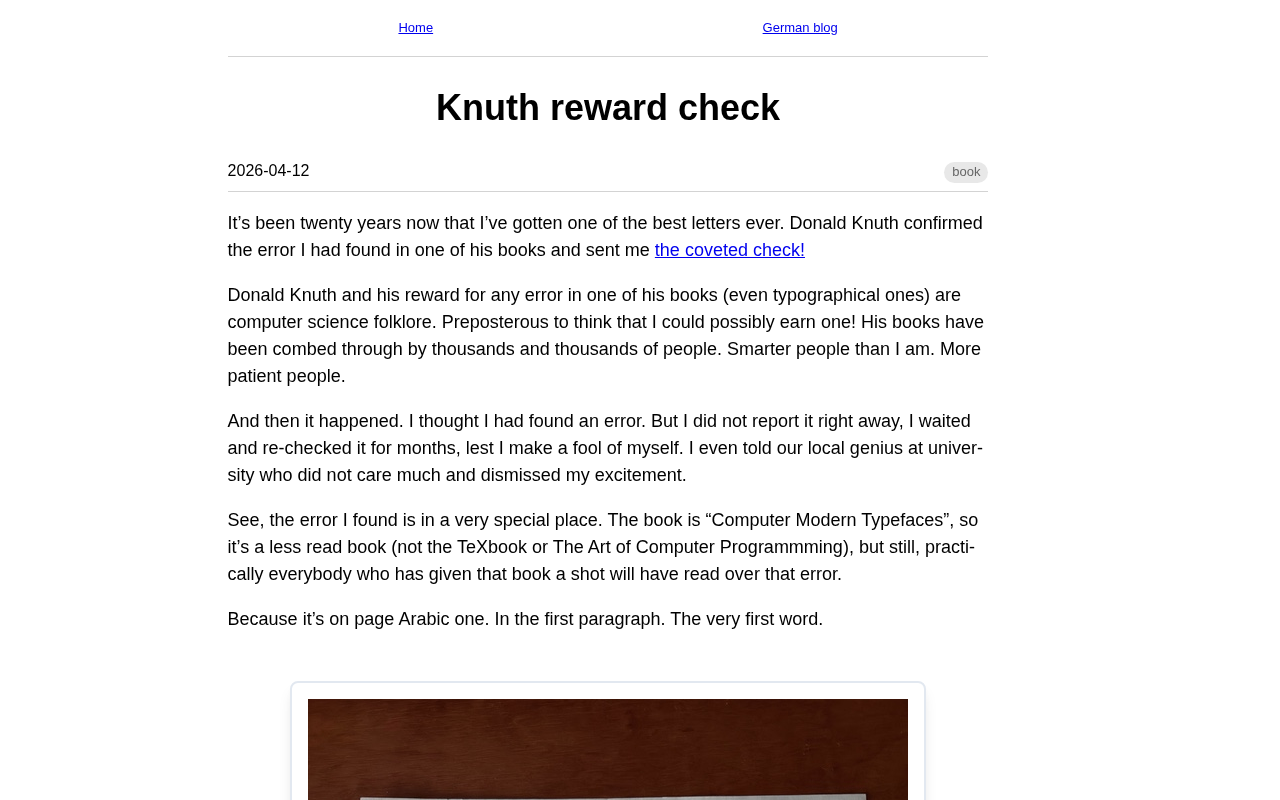
In programmer circles, there's an unwritten honor: if you find an error in one of Knuth's books, he'll send you a check for $2.56. This tradition has continued for decades and recently sparked discussion again on Hacker News.
What Is the Knuth Reward Check
Donald Knuth is the author of The Art of Computer Programming (TAOCP) and the creator of the TeX typesetting system. He established a unique reward mechanism: any reader who finds a technical error, typographical problem, or factual mistake in his books can report it to him. As a token of appreciation, he sends out a check for $2.56.
Why $2.56? Because 256 is 2 to the 8th power, corresponding exactly to the number of values a single byte can hold. The number itself is a tribute to computer science.
According to Thomas Hühn's blog, he recently received one of these checks. He wrote about the experience in detail in a blog post, which subsequently received 203 upvotes and 75 comments on Hacker News—a testament to the topic's enduring appeal in the tech community.
The Art of Computer Programming (TAOCP) is a multi-volume monograph that Donald Knuth began writing in 1962 and is widely regarded as one of the most authoritative and in-depth classic works in computer science. The book is planned for seven volumes, with the first three volumes and some fascicles of Volume 4 completed so far. TAOCP systematically covers core topics such as algorithm analysis, data structures, sorting and searching, and combinatorial algorithms, with a level of mathematical rigor and narrative depth that is virtually unmatched among comparable works. Precisely because the content is so meticulous, any single error could have a profound impact on readers' understanding—which explains why Knuth is willing to use a reward mechanism to encourage readers to participate in errata reporting.
TeX is a typesetting system that Knuth developed in 1978 to typeset TAOCP. Thanks to its exceptional ability to handle mathematical formulas, it remains the de facto standard for typesetting academic papers, especially in mathematics, physics, and computer science. Knuth's relentless pursuit of typographic quality is consistent with his demand for accuracy in his written content; together they form an important facet of his academic character.
Why This Matters
On the surface, $2.56 won't even buy you a cup of coffee. But the significance of the Knuth reward check goes far beyond the money itself.
It represents an extreme pursuit of precision. Knuth is willing to spend time personally reviewing every errata report and to bear the financial cost of doing so—something almost unimaginable in today's fast-paced technical publishing world.
It's also a unique form of interaction. Through this mechanism, Knuth has established a direct connection with readers around the world. Each check is a form of recognition—acknowledging the reporter's attentiveness and contribution to knowledge.
Many recipients choose to frame their checks rather than cash them. The value of the check lies not in its face amount but in the story behind it and the signature from Knuth himself.
Details and Evolution of the Reward Mechanism
Knuth has his own rules for reward checks. He only pays for technical errors, including mathematical errors, logical errors, and typographical errors. For simple spelling mistakes or grammar issues, he typically does not issue a check.
Over time, Knuth has said on multiple occasions that the bank's cost of processing these checks has exceeded the amounts themselves. According to various discussions, he later switched to issuing a form of "deposit voucher" redeemable at a U.S. bank. Sometimes, for particularly valuable errata, he would include an extra thank-you note or even gift other books.
This mechanism has also motivated generations of computer science learners to read TAOCP carefully. Many programmers say that it was precisely the hunt for errors that drove them to read this monumental work word by word—which may well have been Knuth's intention all along.
Knuth's errata reward dates back to 1962, when he established a reward of $2 for each error in the first volume of The Art of Computer Programming. Later, due to inflation and symbolic considerations, the amount was adjusted to $2.56. More interestingly, Knuth once joked that if someone found a "valuable suggestion" rather than an error, he might pay a higher amount, such as $3.08—because 308 is the approximate value of "e" multiplied by 100 and rounded. These number games themselves reflect Knuth's style of weaving mathematical playfulness into his daily work.
From a practical standpoint, Knuth maintains an official errata list published on the Stanford University CS department website. Before reporting an error, readers typically need to consult this list to confirm whether what they've found is a new error. This process both reduces Knuth's own review burden and fosters a community-based quality assurance mechanism.
A Cultural Symbol in the Tech Community
In the Hacker News discussion, many users shared their own experiences or those of friends who received Knuth checks. The reason this topic keeps drawing attention is that it encapsulates several qualities valued by the computer science community: rigor, humility, respect for knowledge, and a touch of geeky humor.
Knuth has proven in his own way that pursuing correctness can be both fun and rewarding. The $2.56 denomination may seem trivial, but it has become one of the most famous "Easter eggs" in computer science.
For today's developers and researchers, the story of the Knuth reward check reminds us that beyond code and algorithms, a dedication to detail and an honesty about errors are equally indispensable parts of technical work.
Hacker News is a tech community news aggregator operated by Y Combinator, with broad influence in Silicon Valley and the global tech scene. Its content focuses on programming, startups, and cutting-edge technology, and its comment quality is relatively high—many in-depth discussions of technical topics originate and spread from here. For an article to receive 203 upvotes and 75 comments on Hacker News means it reached a substantial core technical audience and sparked substantive conversation rather than mere browsing.
In the tech community, Bill Gates once said, "Knuth is the only person I've ever met who can discuss programming as an art form." This quote is often used to summarize Knuth's legendary status in the industry. The Knuth reward check became a cultural symbol not only because it's amusing but also because it represents an increasingly rare attitude: amid the wave of industrialized, fast-paced software development, someone still insists on proofreading word by word, signing checks by hand, and mailing them out—maintaining the precision of knowledge in a nearly artisan-like manner.
One-line Summary
Knuth sends $2.56 checks to readers who report errors in his books, making it one of the most famous cultural Easter eggs in computer science.
Paragraph Summary
The article introduces a unique reward mechanism established by computer scientist Donald Knuth: readers who find technical errors in his book The Art of Computer Programming receive a check for $2.56, a number corresponding to the number of values a single byte can hold. This tradition has continued for decades and recently drew attention again after Thomas Hühn received a check and shared it on Hacker News. The article explains that the reward's significance lies not in the amount but in its representation of an extreme pursuit of precision and direct interaction with readers. The reward applies only to technical errors, not spelling issues; due to bank processing costs, Knuth later switched to deposit vouchers. Many recipients choose to frame their checks rather than cash them, and the mechanism has also motivated readers to read TAOCP word by word.
Related articles

DeepCell: One-Click AI Generation of Documents, Spreadsheets, and Slides
DeepCell tops Product Hunt with one-click generation of documents, spreadsheets, and slides, using the .deepcell format for linked updates, designed for System 2 tasks like modeling and sales reviews.

Doneas: 15-Minute Daily Accountability Calls That Keep Indie Developers From Procrastinating
Doneas is a daily accountability tool for indie developers: plan tasks on Monday, join a 15-minute call with five builders each day, and log deliveries on a public progress page. This article analyzes its core mechanics, effectiveness, and potential issues around retention and matching.

Fastlane 2.0: Fully Automated AI Ad Campaigns, From Creative to Optimization
Fastlane 2.0 is an AI ad automation tool: enter your website and it learns your brand, generates video and image ads, and runs and optimizes them on Meta, TikTok, Instagram, and YouTube.